

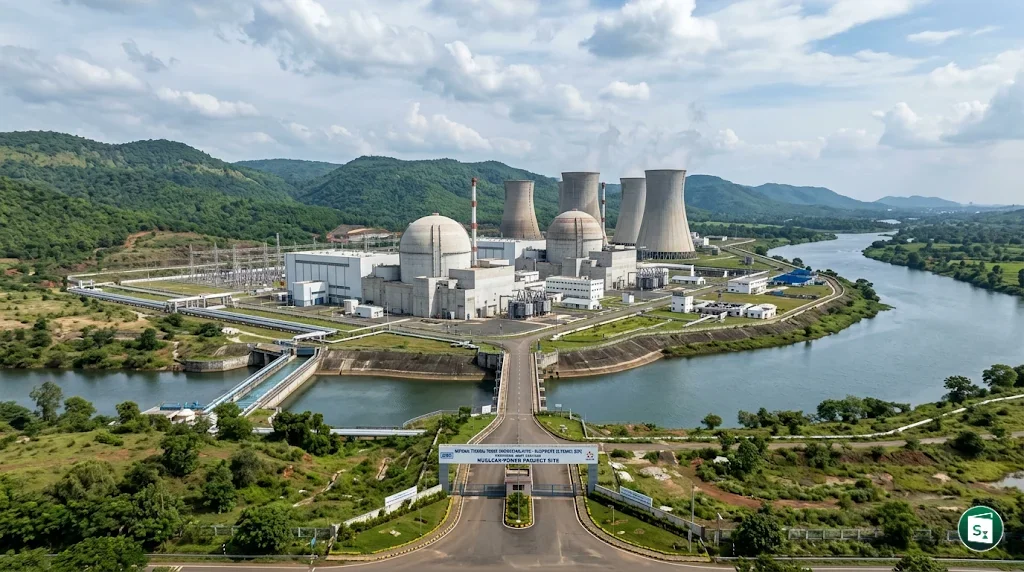
NTPC Limited and the French state owned utility Electricite de France signed a non binding Memorandum of Understanding on April 14, 2026, to cooperate on the development of new nuclear power projects in India. This agreement signals a major transition for NTPC as it seeks to diversify its portfolio from coal based generation toward high capacity nuclear energy. The collaboration aims to leverage international expertise to help India reach its ambitious long term energy security and decarbonisation targets.
Strategic Expansion: NTPC’s Shift Toward Nuclear Power
NTPC Limited, established on November 7, 1975, and headquartered in New Delhi, is the largest power producer in India. Historically dominant in the thermal energy sector, the company has recently pivoted toward carbon free power sources. The collaboration with Electricite de France (EDF) marks a decisive entry into the nuclear generation space as part of its broader corporate goal of achieving 30 GW of nuclear capacity by 2047.
This journey into nuclear energy is spearheaded by two primary entities. NTPC Parmanu Urja Nigam Limited (NPUNL) is a wholly owned subsidiary incorporated on January 7, 2025, dedicated to nuclear project development. Additionally, the company operates through ASHVINI, also known as Anushakti Vidhyut Nigam Limited, which is a joint venture between NTPC (49%) and the Nuclear Power Corporation of India Limited (NPCIL) (51%).
Key Provisions of the NTPC-EDF Collaboration
Under the Memorandum of Understanding, both organizations will jointly assess the feasibility of deploying advanced nuclear technologies across various project sites in India. A primary focus of the partnership involves the evaluation of the European Pressurised Reactor (EPR) technology, which is a third generation pressurized water reactor design developed by EDF.
Key strategic areas of cooperation include:
- Localization and Supply Chain: Identifying opportunities to maximize domestic manufacturing and the deployment of local equipment.
- Economic Assessment: Conducting detailed studies on project costs, financing models, and potential electricity tariffs.
- Human Resource Development: Launching specialized training programs for Indian nuclear engineers to build long term technical expertise.
- Technical Support: Providing engineering and safety consultancy to ensure international standards are met in new projects.
The partnership aims to build on the existing Indo French energy dialogue, which includes the large scale Jaitapur Nuclear Power Project in Maharashtra. While Jaitapur has been a long standing project involving six EPR units with a total capacity of nearly 10 GW, the new agreement between NTPC and EDF focuses on exploring fresh opportunities beyond the current pipeline.
The Evolution of India’s Nuclear Energy Infrastructure
India has set a target to triple its nuclear power capacity to approximately 22.48 GW by 2031 to 2032. To facilitate this, the government has introduced significant policy reforms, including the Nuclear Energy Mission launched in 2025. This mission is supported by a substantial budgetary allocation of ₹20,000 crore to accelerate the deployment of both large scale reactors and smaller, modular designs.
ASHVINI and the Mahi Banswara Project
The ASHVINI joint venture is currently the primary vehicle for NTPC’s nuclear ambitions. Its flagship project is the Mahi Banswara Rajasthan Atomic Power Project (MBRAPP), located in the Banswara district of Rajasthan. The project will feature four reactors with a capacity of 700 MW each, utilizing indigenous Pressurised Heavy Water Reactor (PHWR) technology. Current projections indicate that the initial units will begin testing and operations by the early 2030s.
Paving the Way for Small Modular Reactors
A significant component of the national strategy involves the development of Small Modular Reactors (SMRs). These reactors are designed to be built in factories and transported to sites, offering lower costs and shorter construction timelines. The Bhabha Atomic Research Centre (BARC) is leading the design of indigenous SMRs, including the BSMR-200 (Bharat Small Modular Reactor) and the SMR-55.
The government has also amended the Atomic Energy Act, 1962, to permit private sector participation in the nuclear field. This change allows non government entities to invest in and operate nuclear plants, which was previously a state monopoly.
Vision 2047: Achieving a 100 GW Nuclear Milestone
India’s long term energy roadmap, titled Viksit Bharat 2047, envisions a total nuclear capacity of 100 GW by the centenary of its independence. This massive scaling up is essential for India to reach its Net Zero emissions target by 2070.
The inclusion of NTPC as a major player alongside NPCIL marks a paradigm shift in how India manages its power assets. By transitioning from coal to nuclear, NTPC is not only ensuring energy security but also providing the reliable, high capacity baseload power required for a rapidly industrializing economy. The collaboration with global leaders like EDF ensures that India stays at the forefront of nuclear safety and technological innovation.
| Entity | Function | Key Specifics |
|---|---|---|
| NTPC Limited | Thermal & Clean Energy | Targeting 30 GW nuclear power by 2047 |
| NPCIL | Nodal Nuclear Agency | Responsible for all nuclear plant construction |
| ASHVINI | Joint Venture | JV between NTPC (49%) and NPCIL (51%) |
| NPUNL | Whole Owned Subsidiary | Wholly-owned nuclear branch of NTPC |
| EDF | Technology Partner | Technical leader for Jaitapur and EPR tech |
Key Takeaways
- NTPC and Electricite de France (EDF) signed a non-binding MoU on April 14, 2026, for new nuclear power projects in India.
- The collaboration focuses on evaluating European Pressurised Reactor (EPR) technology and maximizing localization.
- NTPC has a target to achieve a nuclear power capacity of 30 GW by 2047, contributing to the national goal of 100 GW.
- The ASHVINI joint venture between NTPC (49%) and NPCIL (51%) was approved in September 2024 to build and operate nuclear plants.
- NTPC’s flagship project is the Mahi Banswara Rajasthan Atomic Power Project (MBRAPP) in Rajasthan, comprising four 700 MW units.
- India aims to triple its nuclear capacity to 22.48 GW by 2031 to 2032 through the Nuclear Energy Mission.
- The Bhabha Atomic Research Centre (BARC) is developing indigenous Small Modular Reactors like the BSMR-200.
- Amendments to the Atomic Energy Act, 1962, have opened the nuclear sector for private sector participation in India.