

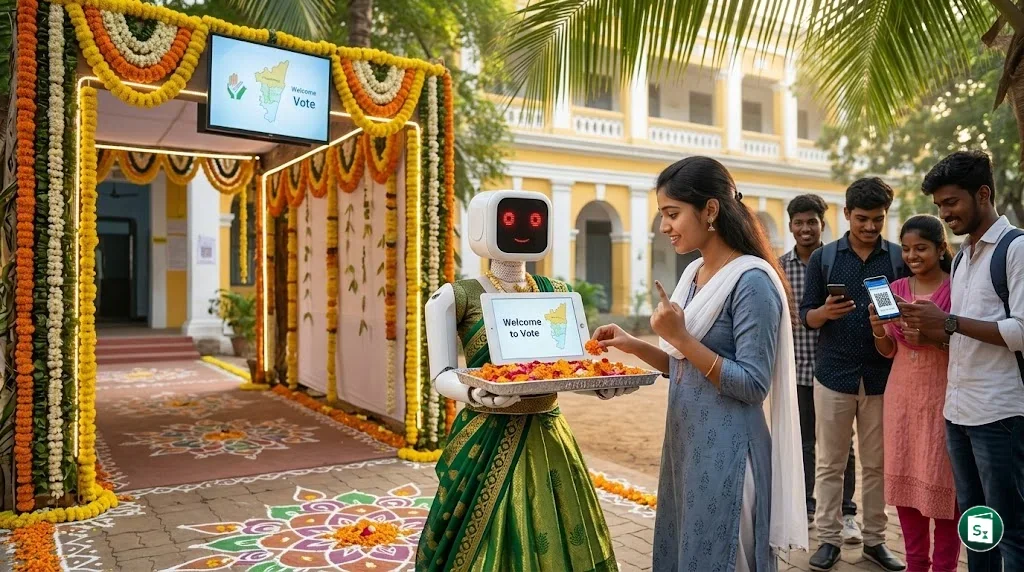
The Puducherry election administration has deployed a saree-clad humanoid robot named Nila at the VOC Government School polling booth during the 2026 Assembly elections. Developed by a Coimbatore-based tech firm, the robot is designed to greet and assist voters in a high-tech welcoming environment. This innovative initiative primarily targets youth and first-time voters to enhance electoral participation through a blend of technology and tradition.
Nila: India’s Saree-Clad Election Guide
The humanoid robot Nila is an interactive, event-based machine developed by Robo Mirror, a robotics company headquartered in Coimbatore, Tamil Nadu. Dressed in a traditional saree and adorned with jewelry, Nila was seen greeting voters with flowers and providing guidance at the VOC Government School polling station. The robot is capable of communicating in both Tamil and English, making it accessible to a wide demographic within the Union Territory.
Election authorities programmed the robot to answer common queries related to the polling process, such as the location of specific booths and the identification documents required for voting. This deployment marks a significant integration of robotics in the electoral process, moving beyond simple automation to interactive voter assistance.
Enhancing Voter Participation through SVEEP
The deployment of Nila is a strategic part of the Systematic Voter’s Education and Electoral Participation (SVEEP) program. SVEEP is a flagship initiative of the Election Commission of India (ECI) aimed at educating and motivating voters to participate in the democratic process. By introducing futuristic tools like humanoid robots, election authorities aim to bridge the gap between traditional civic duties and modern technological expectations, particularly for first-time voters.
Under SVEEP, various outreach efforts are categorized into Information, Motivation, and Facilitation (IMF). Nila fulfills all three roles by providing information about the polling process, motivating citizens through a unique attraction, and facilitating a smooth entry into the polling station. Such initiatives help improve the overall voter turnout and make the electoral experience more inclusive and less intimidating for new participants.
Technological Innovations in Indian Elections
The use of humanoid robots like Nila represents a growing trend of technology adoption by the Election Commission of India. While the core voting mechanism remains based on Electronic Voting Machines (EVMs) and Voter Verifiable Paper Audit Trail (VVPAT), the auxiliary processes are increasingly becoming digital. From the Voter Helpline App to facial recognition systems for identity verification in some jurisdictions, technology is being used to streamline the voting process.
Other states have also experimented with similar technological aids. For instance, districts in Kerala have previously used robots for election awareness campaigns. These initiatives serve as a testing ground for more advanced Artificial Intelligence (AI) applications in public service. The goal is to provide a seamless, transparent, and user-friendly experience that reflects India’s status as a global leader in digital infrastructure and digital innovation.
Puducherry: A Unique Electoral Landscape
Puducherry occupies a unique position in India’s federal structure as a Union Territory with its own legislative assembly. The Puducherry Legislative Assembly consists of 33 seats in total. Of these, 30 members are directly elected by the people, while three members are nominated by the Central Government. The assembly was established in 1963 under the Government of Union Territories Act, 1963.
The territory comprises four geographically separate districts, namely Puducherry, Karaikal, Mahe, and Yanam. Historically a French colony, the region underwent a de facto transfer to India on November 1, 1954. This historic background is reflected in the territory’s diverse culture and administrative practices, making the inclusion of multilingual robots like Nila a culturally resonant move. The Lieutenant Governor, appointed by the President of India, serves as the constitutional head, while the Chief Minister leads the Council of Ministers.
Key Takeaways
- Puducherry deployed Nila, a saree-clad humanoid robot, at a polling booth during the 2026 Assembly elections.
- The robot was developed by Robo Mirror, a robotics company based in Coimbatore, and can communicate in Tamil and English.
- This initiative is part of the Systematic Voter’s Education and Electoral Participation (SVEEP) program of the Election Commission of India.
- The Puducherry Legislative Assembly consists of 33 seats, with 30 elected and three nominated members.
- Puducherry was established as a Union Territory with a legislative assembly in 1963 following its transfer from French administration.