According to the report titled “Global Economic Outlook (GEO 2027)” released by Goldman Sachs Research, the global economy is projected to grow at 2.8% in Calendar Year 2027 (CY27).
The report projected India to remain the fastest-growing major economy globally, with the GDP of India expected to grow by 7.2% in CY27.
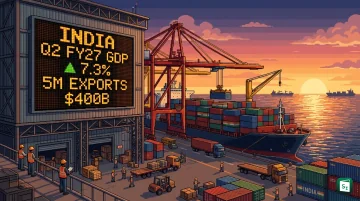
According to the ‘Ecowrap’ report released by the Economic Research Department of the State Bank of India, the GDP growth of India for the second quarter (July–September) of FY27 is projected at 7.8%. This is 60 basis points (bps) higher than the RBI estimate of 7.2%.
The real GDP growth is expected to moderate to 6.9% in both the third and fourth quarters of FY27. Furthermore, the Gross Value Added (GVA) is projected to grow by 8-8.2%, while nominal GDP growth is estimated at 11-11.5%.
According to a report by the Ministry of Commerce and Industry, total exports of India (comprising merchandise and services) increased by 16.66% to $568.84 billion during the April-October period of FY27, compared to $487.59 billion in the corresponding period of FY26. The total exports of India in October 2026 were estimated at $89.99 billion.
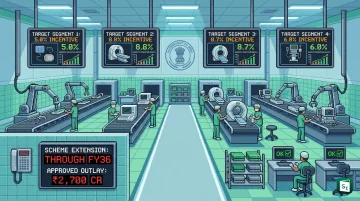
The Government of India has extended the Production Linked Incentive Scheme for Promoting Domestic Manufacturing of Medical Devices (PLI-MD) until FY36, with an approved financial outlay of ₹2,700 crore.
The scheme provides targeted incentive rates across four target segments (TS) based on technical complexity, averaging 5% for TS1, nearly 9% for TS2 and TS3, and 6% for TS4.
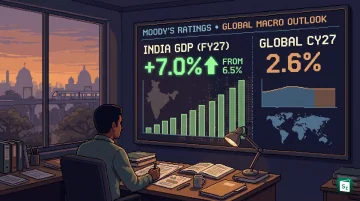
According to the “Global Macro Outlook 2027-28” report released by Moody’s, India’s Gross Domestic Product (GDP) growth forecast for FY27 has been revised upward to 7% from the earlier estimate of 6.5%.
The report projected the global economic growth rate to ease from 2.8% in Calendar Year 2025 (CY25) to 2.6% in CY26, and remain at 2.6% through CY27.
The Union Cabinet has approved the continuation of the Credit Guarantee Fund for Micro Units (CGFMU) scheme for 5 years up to FY31. The scheme provides credit guarantee coverage to Lending Institutions (LIs) through the National Credit Guarantee Trustee Company Ltd (NCGTC) against default risks.
As of September 2026, more than 60.36 crore loans amounting to ₹43.34 lakh crore have been sanctioned by LIs since the launch of the PM Mudra Yojana (PMMY).
The CGFMU fund guarantees credit facilities including loans up to ₹20 lakh for eligible micro-enterprises under PMMY, overdrafts up to ₹10,000 under PM Jan Dhan Yojana (PMJDY) accounts, and loans ranging from ₹10 lakh to ₹20 lakh for Self-Help Groups (SHGs).
The guarantee fee has been reduced from 1% per annum to 0.75% per annum, while the fee for SHGs remains unchanged at 0.25% for the first year and 0.50% in subsequent years. The scheme applies to loans extended under PMMY from FY27 to FY31, enabling an estimated loan disbursement of ₹12.6 lakh crore over the next 5 years.
The Union Cabinet has approved the Nutrient Based Subsidy (NBS) rates on Phosphatic and Potassic (P&K) fertilizers for the Rabi Season 2026-27, effective from October 2026, to March 2027. The tentative budgetary requirement for the season is ₹62,370.02 crore.
The Central Board of Indirect Taxes and Customs (CBIC) has notified November 1, 2026, as the date for key Goods and Services Tax (GST) changes under the Finance Act, 2026, to come into force.
Under the revised provisions, provisional refunds for the inverted duty structure will enable businesses to receive 90% of eligible refunds provisionally within seven days. Additionally, the amendments remove the ₹1,000 minimum refund restriction for tax paid on goods exported out of India, benefiting small exporters.
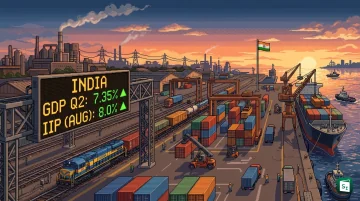
According to the “Monthly Economic Review for October 2026” released by the Ministry of Finance, the GDP growth of India is projected at 7.35% in the second quarter (Q2: July-September) of FY27.
The Index of Industrial Production (IIP) emerged as the strongest indicator, recording an 8% annual growth rate in August 2026.
The Central Board of Direct Taxes (CBDT) under the Ministry of Finance has introduced a new reporting Form 173A for taxpayers seeking specified Income-Tax exemptions on interest and capital gains earned from government securities.
Effective from October 19, 2026, the form was notified under the Income-tax (Seventh Amendment) Rules, 2026. Form 173A aims to standardise reporting, improve transparency, and strengthen the verification of tax exemption claims.
The CBDT also inserted Rule 281A into the Income-tax Rules, 2026, to facilitate reporting of exemption claims under Schedule IV, Table Serial Numbers 13D and 13E of the Income-tax Act, 2025. Eligibility for this form is applicable to specified Foreign Institutional Investors (FIIs) and the Bank for International Settlements (BIS).
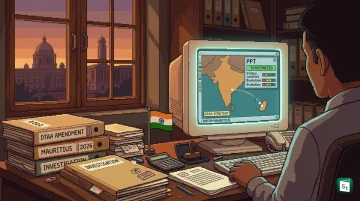
The Central Government has notified amendments to the India-Mauritius Double Taxation Avoidance Agreement (DTAA) to prevent treaty abuse and tax avoidance. The amended treaty, whose protocol was signed in 2024, introduces the Principal Purpose Test (PPT) and came into force on August 10, 2026.
Following the amendment, Mauritius-based investors and investment funds claiming treaty benefits may face increased scrutiny regarding the commercial substance and purpose of their transactions.
The central government has announced that Karnataka, Maharashtra, Uttar Pradesh, Gujarat, and Tamil Nadu will become permanent members of a new Standing Committee under the Goods and Services Tax (GST) framework.
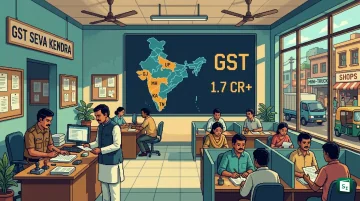
The committee, comprising 12 states, aims to strengthen tax administration and expand the taxpayer base. India currently has 1.7 crore registered GST taxpayers.
The Research, Development and Innovation Fund (RDIF), a flagship initiative of the central government, has announced its first cohort of 19 Second Level Fund Managers (SLFMs).
The cohort comprises 14 Alternative Investment Funds (AIFs) and 5 Focused Research Organisations (FROs), approved by the Empowered Group of Secretaries (EGoS). These approved institutions have secured a combined RDIF funding commitment of ₹7,131 crore under the government RDI Scheme.
According to the “Trade and Development Report 2026: The Geoeconomics of Development” released by the United Nations Conference on Trade and Development (UNCTAD), the economy of India is projected to grow by 7.3%.
The report projected global economic growth at 2.6% (down from 2.9% in 2025) and growth in developing economies at 4% (down from 4.7% in 2025). Additionally, Asia is expected to contribute 59% of global growth in 2026.
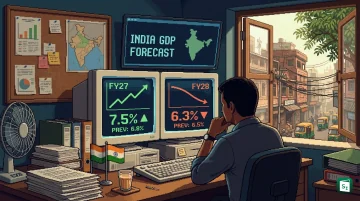
According to a report by Business Monitor International (BMI), a unit of Fitch Solutions Company, the GDP growth forecast of India for FY27 has been raised to 7.5% from 6.8%.
However, the forecast for FY28 is lowered to 6.3% from 6.5% due to concerns over household consumption and external economic risks.
The 57th meeting of the Goods and Services Tax (GST) Council was held in New Delhi under the chairpersonship of Union Minister Nirmala Sitharaman.
During the meeting, the council made recommendations relating to process reforms, primarily covering registration, returns, refunds, and adjudication. The council also issued clarifications regarding the applicability of GST on the supply of certain goods and services, alongside measures for trade facilitation and streamlining compliances.
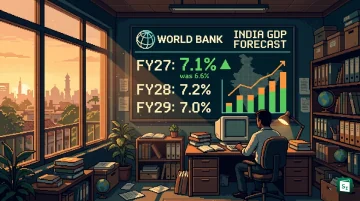
According to the International Monetary Fund (IMF), India’s growth forecast for FY27 has been raised to 7% from the earlier 6.4%. The IMF also revised its growth forecast for FY28 upward to 7% from 6.7%.
The Department of Commerce (DOC) under the Ministry of Commerce and Industry (MoC&I) has extended the Remission of Duties and Taxes on Exported Products (RoDTEP) scheme until December 31, 2026.
The Ministry of Textiles (MoT) has also extended the Rebate of State and Central Taxes and Levies (RoSCTL) scheme until December 31, 2026. These extensions are intended to mitigate the impact of geopolitical disruptions in West Asia.