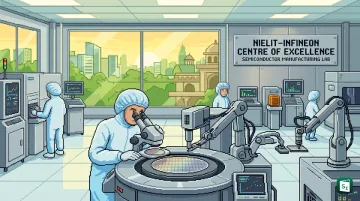
The National Institute of Electronics and Information Technology (NIELIT) under the Ministry of Electronics and Information Technology (MeitY) has inaugurated the NIELIT-Infineon Centre of Excellence (CoE) on Semiconductor Manufacturing.
It is to be noted that the CoE is established in collaboration with Infineon Technologies at the NIELIT facility in Ahmedabad, Gujarat.
TypeSafe AI has introduced “Jev”, which utilizes a new architecture known as a “System One Model”. The model is designed to overcome the structural limitations found in traditional Large Language Models (LLMs).
It is to be noted that while LLMs are proficient in conversational tasks, they are often unsuitable for direct, programmatic backend software automation. Jev aims to bridge this gap.
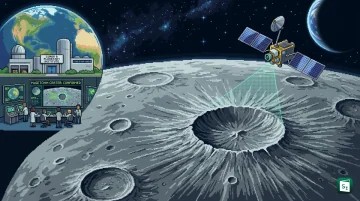
NASA scientists have confirmed the discovery of the ‘McGetchin crater’ on the Moon using imagery from the Lunar Reconnaissance Orbiter (LRO). The crater, formed by an asteroid or comet impact in May 2024, is recognized as the largest known impact crater formed in recent times within the solar system.
It is to be noted that the crater is named in honor of the late Thomas McGetchin, the former Director of the Houston-based Lunar and Planetary Institute.
Garden Reach Shipbuilders & Engineers (GRSE) has launched “Sagar Manthan”, the first indigenous advanced Ocean Research Vessel (ORV) of India. The vessel was launched at the Rishi Bankim Shipyard in Kolkata for the National Centre for Polar and Ocean Research (NCPOR) under the Ministry of Earth Sciences (MoES).
It is to be noted that the project, having a total valuation of ₹840 crore, is being implemented under the “Deep Ocean Mission”. The ORV, which has a gross tonnage of 5,900 tonnes and a maximum speed of 14 knots, is expected to be fully operational by early 2028.
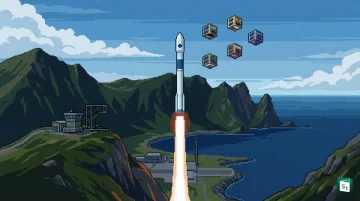
Isar Aerospace, a Germany-based aerospace company, has launched its Spectrum rocket from the Andoya Spaceport in Norway under its second-flight mission titled ‘Onward and Upward’. The rocket is designed to carry payloads of up to 1,000 kg to the Low Earth Orbit (LEO).
The mission successfully deployed 5 CubeSats, namely CyBEEsat (Germany), TriSat-S (Slovenia), Platform 6 (Bulgaria), FramSat-1 (Norway), and SpaceTeamSat1 (Austria).
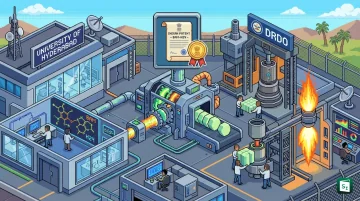
The DRDO and the Advanced Centre of Research in High Energy Materials (ACRHEM) at the University of Hyderabad have secured an Indian patent for a next-generation solid rocket propellant fuel named “BAM-H24”.
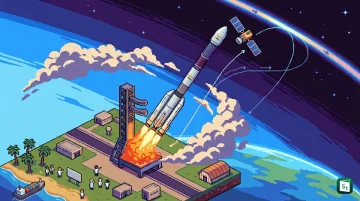
The ISRO has successfully launched the “EOS-05” Earth Observation Satellite (EOS) onboard the Geosynchronous Satellite Launch Vehicle (GSLV)-F17 from the Second Launch Pad of the Satish Dhawan Space Centre (SDSC) in Sriharikota. It is to be noted that the EOS-05 is the first Indian imaging satellite deployed from a geosynchronous orbit.
It aims to strengthen domestic Earth observation and imaging capabilities. The GSLV-F17 is a 51.7 m tall 3-stage rocket with a total liftoff mass of 420.5 tonnes. The launch vehicle successfully injected the 2,367 kg satellite into a Sub-Geosynchronous Transfer Orbit (Sub-GTO).
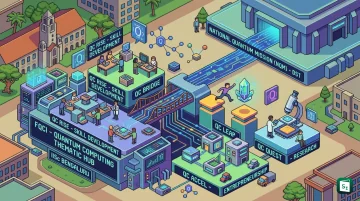
The IISc Bengaluru, has established the Foundation for Quantum Computing Innovation (FQCI) to function as the Quantum Computing Thematic Hub (QC T-Hub) under the National Quantum Mission (NQM). It is to be noted that the NQM is implemented by the Department of Science and Technology (DST).
FQCI is tasked with developing skilled manpower and promoting entrepreneurship in quantum technologies through 5 specialized programmes: Quantum Computing (QC) Rise, QC Bridge, QC Leap, QC Accel, and QC Quest.
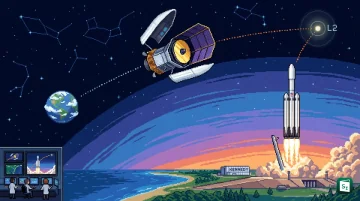
The NASA has successfully launched the “Nancy Grace Roman Space Telescope” onboard the SpaceX Falcon Heavy rocket from the Kennedy Space Center in Florida, USA. The project was developed at a cost of $4.3 billion.
The telescope is destined for the Lagrange Point 2 (L2) and has a primary lifespan of 5 years. It is to be noted that the telescope is named after Nancy Grace Roman, the first Chief of Astronomy of the NASA and the “Mother of Hubble”, making it the first NASA telescope named after a woman.
The Centre for Development of Telematics (C-DOT) has unveiled 14 indigenous quantum products during its 43rd Foundation Day celebrations in New Delhi. The products are developed in the areas of Quantum Key Distribution (QKD) and Post-Quantum Cryptography (PQC).
The newly launched QKD systems include “Q-AKSHAY CD” (a fibre-based system using Coherent One Way and Differential Phase Shift protocols in a compact 1U size) and “Q-AKSHAY MD” (based on the Measurement Device Independent protocol). The hardware components introduced include “C-SPD” (a Single-Photon Detector) and “C-RD” (a wideband Radio Frequency (RF) driver).
The encryptor lineup features “Q-SETU” (securing Layer 3 communications up to 80 Mbps), “Q-MAHASETU” (a commercial-grade Layer 2/3 encryptor up to 40 Gbps), “Q-VIKRAM” and “Q-PARAKRAM” (defence-grade Layer 2/3 encryptors up to 1 Gbps), and “Q-AMOGH” (a high-speed Layer 1 optical encryptor up to 200 Gbps).
For secure communications, C-DOT introduced “Q-DARSHAN” (a quantum-safe video Internet Protocol (IP) phone) and “Q-VACHAN” (an in-line node using National Institute of Standards and Technology (NIST) PQC algorithms). The network solutions include “Q-RAQSHAK” (for enterprise network protection), “Q-VAAYU” (a wireless point-to-point solution), and “Q-VAJRA1000” (a quantum-safe access node).
The Indian Pharmacopeia Commission (IPC), operating under the Ministry of Health and Family Welfare (MoHFW), has introduced 7 Indian Pharmacopoeia Nitrosamine Impurities Reference Standards to enhance the precise detection and quantification of carcinogenic impurities in pharmaceutical products.
The reference standards were officially launched during an interactive meeting titled “IP 2026: Perspectives, Suggestions, & Way Forward” organized by the IPC in Kolkata, West Bengal.
It is to be noted that nitrosamines are classified as highly potent genotoxic and carcinogenic compounds, which are substances capable of causing cancer or genetic mutations.
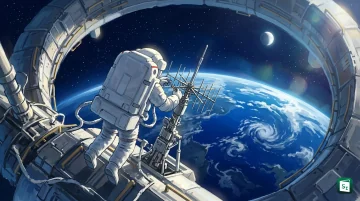
Sophie Adenot, an astronaut of the European Space Agency (ESA) from France, has conducted a mission to repair a communications system on the International Space Station (ISS).
With this, she becomes the first French woman to perform a spacewalk.
It is to be noted that she is also the second European woman to walk in space, following Samantha Cristoforetti of Italy who completed a spacewalk in 2022.
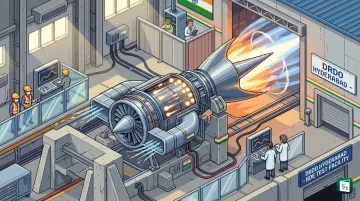
D-Propulse Aerospace Pvt Ltd has successfully demonstrated the first indigenously developed 5 kilo-Newton (kN) air-breathing Rotating Detonation Engine (RDE) of India, integrated with an aerospike nozzle. The demonstration was held at the DRDO test facility in Hyderabad.
It is to be noted that the test validated the Technology Readiness Level-5 (TRL-5), which marks a milestone in the advanced propulsion capabilities of the country.
Researchers Bhakta Bahadur Raskoti and Rita Ale have discovered a new Himalayan plant species named ‘Impatiens nimspurjai’ in the Myagdi district of Nepal.
The species is named to honour the Nirmal Purja, a Nepali mountaineer, for his contributions to mountaineering and high-altitude environmental conservation. It is to be noted that he achieved the distinction of climbing all 14 of the 8,000-metre peaks of the world in 2019.
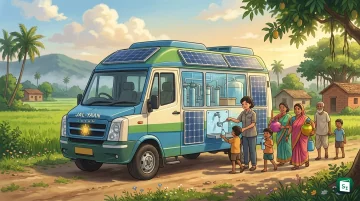
India has unveiled “JAL-YAAN”, the first solar-integrated and self-powered mobile water purification van of the country, in Nagpur, Maharashtra. The vehicle was jointly developed by the CSIR-Central Salt and Marine Chemicals Research Institute (CSIR-CSMCRI) and Rite Water Solutions.
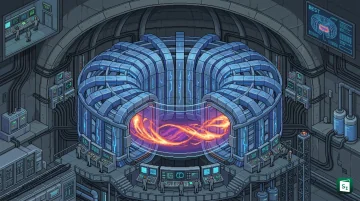
China has successfully completed the full-parameter testing of the world’s largest superconducting fusion magnet.
The magnet is designed to act as an “invisible magnetic cage” within the next-generation Burning Plasma Experimental Superconducting Tokamak (BEST) reactor.
OpenAI has introduced ChatGPT for Teens, a specialized version featuring parental controls and enhanced security measures to address risks associated with AI chatbots.
The platform automatically activates when a user is estimated to be under 18 years of age (or self-identifies their age as between 13 and 17 years).