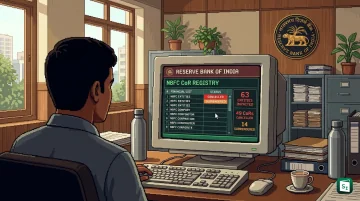
The RBI has cancelled the Certificates of Registration (CoRs) of 49 Non-Banking Financial Companies (NBFCs) and accepted the voluntary surrender of licences from 13 NBFCs and 1 Housing Finance Company (HFC), impacting a total of 63 entities.
The registrations were cancelled under Section 45-IA (6) of the Reserve Bank of India Act, 1934, and Section 29A of the National Housing Bank (NHB) Act, 1987.

SEBI has granted in-principle approval to the Indore, Madhya Pradesh-based financial services company Arihant Capital Markets Ltd (ACML) to sponsor a mutual fund business and establish an Asset Management Company (AMC) and a Trustee Company in India.
Tamilnad Mercantile Bank (TMB) celebrated its 105th Foundation Day at Manickam Mahal in Thoothukudi, Tamil Nadu, under the theme “TMB @ 105- Celebrating a Legacy, Inspiring the Future!”.
During the event, the bank launched a ‘Smart Kiosk’, a self-service banking kiosk designed to modernize bank-customer interactions and streamline branch visits. It also introduced “TMB Vani”, an AI-powered telecalling service capable of communicating in 40 languages.
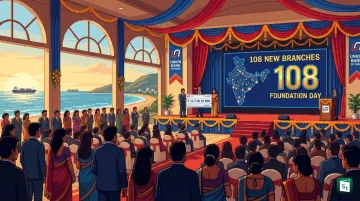
Union Bank of India (UBI) celebrated its 108th Foundation Day in Visakhapatnam, Andhra Pradesh, under the theme “108 Years Young – Shaping a Brighter Future Together.”
During the event, 108 new bank branches across the country were virtually inaugurated by M. Damodaran. Employees of the bank also contributed their Privilege Leave equivalent to ₹11.7 crore towards the National Defence Fund (NDF).
The RBI has issued the RBI (Domestic Money Transfer) Directions, 2026, consolidating existing instructions on domestic money transfers.
The new directions permit walk-in customers without a bank account at the branch to transfer up to ₹50,000 in cash into the bank account of a beneficiary through the National Electronic Funds Transfer (NEFT) system. The maximum transfer limit is ₹10,000 per transaction, subject to an overall monthly ceiling of ₹25,000 per beneficiary.
The Government of India has notified commodity trading contracts as financial products and commodity trading as a financial service under the International Financial Services Centres Authority (IFSCA) Act, 2019.
The initiative aims to strengthen the Gujarat International Finance Tec-City (GIFT City) International Financial Services Centre (IFSC) in Gandhinagar, Gujarat, as a global commodity trading hub. It is designed to attract international commodity trade through major global hubs such as Singapore, Dubai, Hong Kong, and Switzerland.
ICICI Life Insurance Ltd has launched a Unit-Linked Insurance Plan (ULIP) named “ICICI Life EzyGrow”.
The plan offers enhanced Waiver of Premium (WOP) benefits of 2X and 3X, where the insurer funds twice or thrice the future pending premiums upon the death of the life assured. It is distributed exclusively online through Policybazaar.
RBI has issued Master Directions (MD) on Cyber Resilience and Digital Payment Security Controls for non-bank Payment System Operators (PSOs) to tighten cybersecurity protocols.
These directions take effect on November 5, 2026, for large and medium non-bank PSOs, while small payment operators have been granted a compliance window until April 1, 2028. PSOs must notify the RBI and the Indian Computer Emergency Response Team (CERT-In) within 6 hours of detecting unusual incidents.
Indian Overseas Bank (IOB) has launched the ‘IOB Digital Rupee’ mobile app to enable customers to conduct transactions using the Central Bank Digital Currency (CBDC) of India.
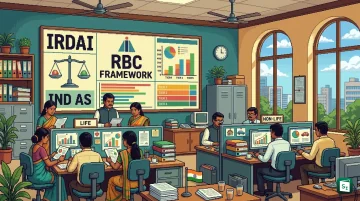
The Insurance Regulatory and Development Authority of India (IRDAI) has constituted two working groups, one each for life and non-life insurance, to develop a Risk-Based Capital (RBC) framework aligned with Indian Accounting Standards (Ind AS).
The 13-member Life Insurance Working Group is chaired by Jamuna Choudhary, while the 12-member Non-Life Insurance Working Group is chaired by Parmeshwar Shelke.
The National Payments Corporation of India (NPCI) has launched the “UPI Vyapaar Saksham Scheme” to expand the UPI acceptance infrastructure among small merchants. The scheme will operate for 3 years from the implementation of the UPI Merchant Discount Rate (MDR).
Under the scheme, small merchants are defined as those with a maximum annual turnover of ₹40 lakh in the previous year. The initiative targets merchants in Tier-III to Tier-VI cities, North-Eastern (NE) states, Jammu & Kashmir (J&K), and Ladakh.
The financial incentives are structured into three components: Component A allocates ₹300 per QR code and ₹750 per soundbox, Component B offers a 0.03% incentive for a 5% Quarter-on-Quarter (Q-o-Q) growth, and Component C provides a 0.20% incentive on incremental transactions in targeted geographies.
MobiKwik Financial Services Pvt Ltd (MFSPL), a wholly-owned subsidiary of One MobiKwik Systems Ltd, has received the final Certificate of Registration (CoR) from the RBI to operate as a Non-Banking Financial Company (NBFC).
The Pension Fund Regulatory and Development Authority (PFRDA) has introduced changes regarding the naming of National Pension System (NPS) schemes and the display of pension fund options on Point of Presence (PoP) platforms, effective from December 1, 2026.
The new naming format will consist of three elements - the abbreviation of the Pension Fund (PF), the common identifier “NPS”, and a unique scheme name assigned by the PF. Tier II schemes must carry the suffix ‘Tier II’ at the end of their names, while Tier I schemes do not require a separate tier designation.
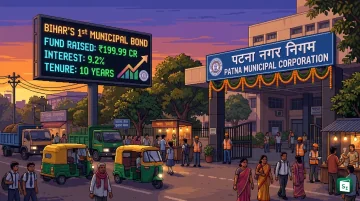
The Patna Municipal Corporation has become the first urban local body in Bihar to raise funds through municipal bonds, mobilizing about ₹199.99 crore from the capital market. The bonds carry an annual coupon rate of 9.2% with a tenure of 10 years.
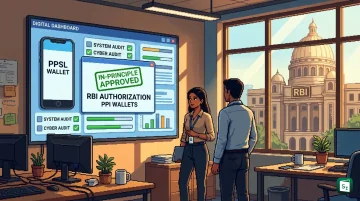
Paytm Payments Services Ltd (PPSL), a wholly-owned subsidiary of One 97 Communications Ltd, has received in-principle authorization from the RBI to set up and operate prepaid payment instruments (PPIs), including prepaid wallets, in India.
The SEBI has issued a new framework allowing Mutual Fund (MF) schemes to net fund obligations arising from outright purchase and sale transactions in the cash market, effective from April 1, 2027.
SEBI has also introduced securities market exposure as an additional eligibility criterion, setting a threshold of ₹5 crore for individuals, Hindu Undivided Families (HUFs), family trusts, and sole proprietorships, and ₹20 crore for body corporates and trusts other than family trusts. Manager-led accreditation will remain valid for 3 years from the date of accreditation.
Additionally, SEBI has reduced the limit for outstanding positions in Indian Rupee (INR)-linked currency derivatives without underlying exposure from $100 million to $5 million for domestic investors and Foreign Portfolio Investors (FPIs).
RBI has constituted a Technical Consultative Committee for Financial Markets (TCCFM), chaired by Deputy Governor Rohit Jain, to strengthen engagement with market participants.
Additionally, the RBI has amended the Foreign Exchange Management (Export and Import of Goods and Services) Regulations, 2026 effective from October 1, 2026. Under the amended rules, Authorized Dealer (AD) banks must enter service import details in the Import Data Processing and Monitoring System (IDPMS) within 5 working days. Non-individual exporters will receive similar treatment for service export receipts of up to ₹10 lakh.
The SEBI has issued frameworks enabling Real Estate Investment Trusts (REITs) and Infrastructure Investment Trusts (InvITs) to issue Depository Receipts (DRs) backed by their units and list them on exchanges at the Gujarat International Finance Tec-City (GIFT City), Gujarat.
A fresh issue of DRs requires prior approval from unitholders, with at least 75% of the total votes cast in favour of the resolution. Additionally, SEBI has reduced the Offer for Sale (OFS) cooling-off period from 12 weeks to 8 weeks for illiquid private listed InvITs.