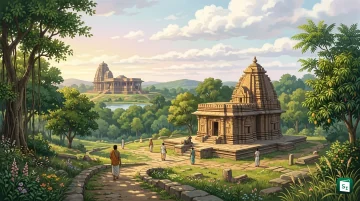

The Ministry of Culture, through the Archaeological Survey of India (ASI), has declared Raniwas Mound in Kesariya, Bihar, as an archaeological site of national importance under the Ancient Monuments and Archaeological Sites and Remains (AMASR) Act, 1958.
It is to be noted that Alexander Cunningham, the first Director General of the ASI, had explored the Kesariya region in 1861.
The Ministry of Culture has signed an MoU with Google Arts & Culture to digitally preserve, document, and showcase the cultural heritage of India using advanced digital technologies.
The Permanent Delegation of India to the UNESCO has added 3 new Indian sites to the UNESCO World Heritage Tentative List.
The newly included locations are the Karst-mud-volcano Complex of Baratang and the Andaman Subduction Volcanoes (situated in the Andaman and Nicobar Islands), along with the Sirpur Cultural and Archaeological Landscape (Chhattisgarh). With these additions, the total number of Indian entries on the tentative list has increased to 81, comprising 59 Cultural, 3 Mixed, and 19 Natural sites.
The Archaeological Survey of India (ASI) has officially designated the Gollala Gudi Temple, located in Palampet, Telangana, as a Monument of National Importance. The temple is situated in southwest of the Kakatiya Rudreshwara (Ramappa) Temple, which is a UNESCO World Heritage Site.
With this addition, the total number of centrally protected monuments in Telangana has increased to 10. It is to be noted that there are currently 3,693 centrally protected monuments and archaeological sites of national importance across India.
The Mizoram government has designated 79 monuments and archaeological sites as “State Protected Monuments” to preserve the cultural and historical legacy of the region.
Two sites in the Champhai district, namely Kawtchhuah Ropui and Ralven Puk, have been recognized as “Monuments of National Importance” under the Archaeological Survey of India. Furthermore, the state has proposed four additional heritage sites Reng Puk, Lung Milem, Pipute Lungdawh, and Ruhro Puk for designation as protected monuments.
The administration of the Union Territory (UT) of Ladakh, with the approval of Lt Gov Vinai Kumar Saxena, has notified 23 heritage sites as Protected Monuments. The designated monuments are distributed across the regions of Leh, Sham, Nubra, Zanskar, and Kargil.
PM Narendra Modi has visited Indonesia at the invitation of President Prabowo Subianto to strengthen bilateral ties and strategic cooperation between the two nations.
He became the first Indian PM to address the Indonesian Parliament in Jakarta, where he unveiled the 'Ganga-Mahakam Vision' to foster a long-term strategic partnership. During the visit, he was conferred with the 'Bintang Adipurna of the Republic of Indonesia,' the highest civilian honour of the country.
PM Modi visited the Prambanan Temple and inaugurated its restoration project, which is proposed to be led by the Archaeological Survey of India (ASI). India has agreed to establish a branch campus of the Indian Institute of Management (IIM) Bangalore in Jakarta. The visit resulted in 20 key outcomes, including the signing of 14 MoUs and agreements.
The Lieutenant Governor of Ladakh, Vinai Kumar Saxena, has laid the foundation stone for the first Petroglyph Conservation Park of India on the banks of the Indus River at Sindhu Ghat (Leh, Ladakh). The ceremony was held on April 18, coinciding with World Heritage Day.
An MoU has been signed between the Department of Archives, Archaeology and Museums and the Archaeological Survey of India (ASI) to facilitate scientific conservation, education, and research at the site.