India is ranked 88th out of 143 countries (covering 95% of the world’s population) with an overall score of 0.48 in the “WJP Rule of Law Index 2026” released by the World Justice Project (WJP).
Denmark topped the index with a score of 0.9, followed by Norway and Finland. Venezuela recorded the lowest rank in the index with an overall score of 0.26.
Union Minister of State Dr L Murugan has resigned from his positions in the Ministry of Information and Broadcasting and the Ministry of Parliamentary Affairs. He has also stepped down as a member of the Rajya Sabha.
The Ministry of Information and Broadcasting has reconstituted the Press Council of India (PCI) by nominating 13 journalists. The PCI is a statutory, autonomous, and quasi-judicial body comprising 1 Chairperson and 28 other members.
The 28 members include 13 working journalists (6 editors and 7 others), 6 newspaper-owner representatives, 5 Members of Parliament, and 3 specialised-field representatives. Retired Justice Ranjana Prakash Desai serves as the Chairperson of the PCI for a 3-year term.
President Droupadi Murmu has amended the Inter-State Council (Amendment) Order, 2026, amending the Inter-State Council Order, 1990. The amendment, which came into force immediately upon publication, introduces special conditions for the participation of Governors and Lieutenant Governors in Inter-State Council meetings.
Enacted under Article 263 of the Constitution of India, the updated guidelines state that the Governor of a State will be invited to council meetings when a proclamation by the President under Article 356 is in force in that State. For the National Capital Territory (NCT) of Delhi, the Lt Governor will be invited when an order by the President under Article 239AB is in force.
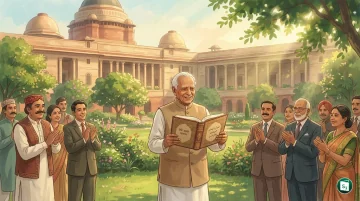
PM Narendra Modi has released the autobiography of Ram Nath Kovind, the 14th President of India, titled “Triumph of the Indian Republic: My Life, My Struggles” at Vigyan Bhavan in New Delhi.
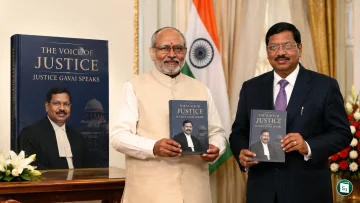
Vice-President CP Radhakrishnan has released a book titled "The Voice of Justice: Justice Gavai Speaks" at Uprashtrapati Bhavan.
The volume, edited by Prof. S Sivakumar, compiles the speeches, lectures, and reflections of Justice BR Gavai. It is published by Thomson Reuters in association with the Commonwealth Legal Education Association (CLEA).
The Union Cabinet has passed a resolution recognizing 10 June 2026, as PM Narendra Modi becomes the longest-serving elected Prime Minister of India. PM Modi achieved this record with 4,399 days of continuous service, surpassing the previous record held by Jawaharlal Nehru, who served for 4,398 continuous days between 1952 and 1964.
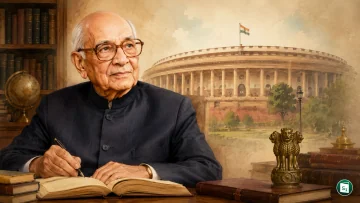
Dr Subhash C Kashyap, a distinguished constitutional expert and former Secretary-General of the Lok Sabha, passed away at the age of 97. He was a recipient of the Padma Bhushan in 2015.
He served the Parliament of India for over 37 years, from the first Lok Sabha under Jawaharlal Nehru to the 9th Lok Sabha. He held the office of Secretary-General from 1983 to 1990.
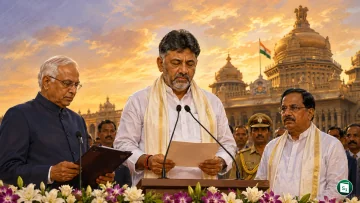
DK Shivakumar has been sworn in as the 25th Chief Minister (CM) of Karnataka, with the oath of office and secrecy administered by Governor Thaawarchand Gehlot.
He succeeds Siddaramaiah, who resigned from the position following a planned power-sharing arrangement. Dr G Parameshwara has been sworn in as the Deputy CM of Karnataka.
Vice President CP Radhakrishnan has released the updated edition of the Constitution of India in the Sindhi language on April 10, 2026, to mark the Sindhi Language Day (Sindhi Bhasha Diwas). The publication was released at Uparashtrapati Bhawan in New Delhi in two versions: Devanagari Script and Persian Script.
The initiative was executed by the Legislative Department under the Ministry of Law and Justice (MoL&J) in accordance with Articles 343, 345, and 350B of the Constitution. It is to be noted that Sindhi was included in the Eighth Schedule of the Constitution of India via the 21st Constitutional Amendment Act, 1967.
The central government has introduced ‘The Constitution (One Hundred and Thirty-First Amendment) Bill, 2026’ to increase the maximum strength of the Lok Sabha from 543 to 850 seats. The move aims to facilitate the immediate implementation of the ‘Nari Shakti Vandan Adhiniyam’ (Women’s Reservation Act) by reserving one-third of the house, totaling 283 seats, for women in the 2029 general elections.
The expansion is designed to accommodate the reservation for women without reducing the existing number of general category seats. Under the proposed revision, the 850 seats will be distributed with 815 seats for States and 35 seats for Union Territories (UTs).