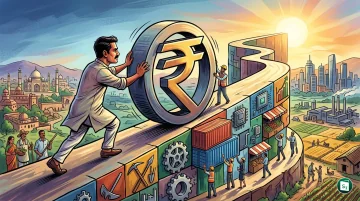
According to the latest “Ecowrap” report by the State Bank of India, the Gross Domestic Product (GDP) growth of India for FY26 is projected to increase to 7.7%. This growth is attributed to the strong performance of the economy in Q4 of FY26, which accelerated to 7.8%.
The National Statistics Office (NSO) has released the Provisional Estimates (PE) of annual Gross Domestic Product (GDP) for the FY26 and the quarterly estimates for the fourth quarter (Q4) of FY26.
India’s real GDP growth for FY26 is estimated at 7.7%, reflecting a 60 basis points (bps) increase from 7.1% in FY25. Real GDP at constant (2022-23) prices is estimated at ₹323.12 lakh crore for FY26, compared to ₹299.89 lakh crore in the First Revised Estimates (FRE) for FY25
Nominal GDP at current prices grew by 8.9% in FY26 to reach ₹346.36 lakh crore, compared to 9.7% growth and a value of ₹318.07 lakh crore in the previous financial year. These estimates are based on a revised base year of 2022-23, which was introduced by the Ministry of Statistics and Programme Implementation (MoSPI) in February 2026, replacing the previous 2011-12 base year.
In Q4 FY26, real GDP grew by 7.8%, with the value estimated at ₹87.77 lakh crore, up from ₹81.40 lakh crore in Q4 FY25. Meanwhile, nominal GDP in Q4 FY26 registered a growth rate of 9.1%, reaching an estimated value of ₹94.65 lakh crore compared to ₹86.75 lakh crore in Q4 FY25.
The Ministry of Health and Family Welfare (MoH&FW) has released the 10th National Health Accounts (NHA) estimates for FY23. The Total Health Expenditure (THE) of India in FY23 is estimated at ₹8.81 lakh crore, which constitutes 3.37% of the Gross Domestic Product (GDP).
The Government Health Expenditure (GHE) has increased from ₹1.3 lakh crore in FY14 to ₹3.85 lakh crore in FY23. The report was prepared by the National Health Accounts Technical Secretariat (NHATS) under the National Health Systems Resource Centre (NHSRC).
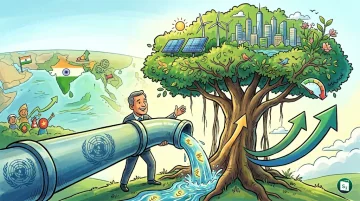
According to the “World Economic Situation and Prospects 2026” report released by the UN Department of Economic and Social Affairs (UN-DESA), the GDP growth of India for FY27 is revised down to 6.4% from the previous projection of 6.6%. The growth forecast for FY28 is also reduced to 6.6%.
According to the Mid-Year Outlook report released by Morgan Stanley, India’s real GDP growth forecast for FY27 has been revised upward by 50 basis points (bps) to 6.7%. The report projects the GDP growth for FY28 at 7%. Additionally, India’s inflation is expected to average 4.7% for FY27.
According to a report by the SBI Research, the real GDP growth of India for FY27 is estimated at 6.6%. The report projects growth rates of 6.8% for Q1 and 6.6% for Q2, while the growth for the second half (H2) of the fiscal year is projected at 6.5%.
According to the 'India Forward- Emerging Perspectives' report jointly released by S&P Global Market Intelligence and CRISIL Ratings Ltd, the Gross Domestic Product (GDP) growth of India for FY27 is revised downward by 50 basis points (bps) to 6.6%.
The report estimated the GDP growth for FY26 at 7.6% and the average annual growth between FY23 and FY26 at 7.3%. The retail inflation is projected to average 5.1% in FY26. The Current Account Deficit (CAD) is expected to expand from 0.8% of GDP in FY26 to 2.2% in FY27. Further, the debt-to-GDP ratio of India is forecasted to increase to 57.5% from 56.1% in FY26.
According to a report titled “Economic and Social Survey of Asia and Pacific 2026: Socioeconomic Prosperity Amid the Transition to an Environmentally Sustainable Economy” released by the UN Economic and Social Commission for Asia and the Pacific (ESCAP), the economy of India is projected to grow at 6.4% in Calendar Year 2026 (CY26) and 6.6% in CY27.
The inflation of India is expected to reach 4.4% in CY26 and 4.3% in CY27. The growth rate of the South and South-West Asia region is estimated at 5.4% in CY25, which is an increase from 5.2% in CY24. During the first three quarters of CY26, India attracted the largest share of greenfield Foreign Direct Investment (FDI) worth $50 billion. It is followed by Australia, Republic of Korea, and Kazakhstan.
According to a report by the State Bank of India (SBI), the GDP growth of India for FY26 is estimated at 7.6% and for FY27 it is projected to range between 6.8-7.1%. The report also estimated India’s average inflation at 4.5% and the fiscal deficit between 4.5-4.6%.
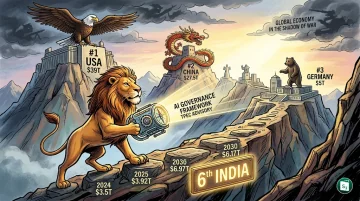
According to the April 2026 “World Economic Outlook” (WEO) report titled “Global Economy in the Shadow of War” released by the International Monetary Fund (IMF), India is ranked 6th in the global Gross Domestic Product (GDP) rankings.
The GDP of India is projected to grow from $3.5 trillion in 2024 to $3.92 trillion in 2025, and it is estimated to reach $6.17 trillion by 2030. In the global rankings, the USA is expected to lead with a GDP of $39 trillion, followed by China at $27.5 trillion and Germany at $5 trillion.
According to the report “South Asia Economic (SAE) Economic Update April, 2026: Working with Industrial Policy” released by the World Bank (WB), the GDP growth of India for FY27 is revised upwards to 6.6% from the earlier projection of 6.3%.
According to a report by the International Monetary Fund (IMF), the Gross Domestic Product (GDP) growth of India for FY27 is revised to 6.5% from the 6.4% growth rate estimated in the January outlook.