The Department of Consumer Affairs (DoCA), under the Ministry of Consumer Affairs, Food and Public Distribution (MoCAF&PD), has notified the “Legal Metrology (Indian Standard Time) Rules, 2026”.
The rules mandate Indian Standard Time (IST) as the sole and compulsory time reference for all legal, administrative, commercial, and official purposes in India. The regulations will come into effect 180 days after their publication in the Official Gazette.
The ISRO has successfully launched the “EOS-05” Earth Observation Satellite (EOS) onboard the Geosynchronous Satellite Launch Vehicle (GSLV)-F17 from the Second Launch Pad of the Satish Dhawan Space Centre (SDSC) in Sriharikota. It is to be noted that the EOS-05 is the first Indian imaging satellite deployed from a geosynchronous orbit.
It aims to strengthen domestic Earth observation and imaging capabilities. The GSLV-F17 is a 51.7 m tall 3-stage rocket with a total liftoff mass of 420.5 tonnes. The launch vehicle successfully injected the 2,367 kg satellite into a Sub-Geosynchronous Transfer Orbit (Sub-GTO).
The Indian Space Promotion and Authorization Centre (IN-SPACe) has approved an agreement for the development of the first indigenous and fully commercial Earth Observation (EO) constellation of India under the Public Private Partnership (PPP) model.
The agreement is signed with a private consortium, Allied Orbits Pvt Ltd, which is led by PixxelSpace India Pvt Ltd and includes Dhruva Space Pvt Ltd, PierSight Space Pvt Ltd, and Satsure Analytics India Pvt Ltd.
The consortium will be responsible for the design, construction, ownership, and operation of the 12-satellite constellation. It is to be noted that the consortium will invest over ₹1,200 crore for the project, which is expected to be developed and operationalized by 2029.
Somanath Panicker, the former Chairman of the ISRO, has been appointed as a part-time, non-official director on the Central Board of the RBI) for 4 years, starting August 20, 2026. Anand Mahindra has also been re-appointed to the board for another 4 years.
It is to be noted that other non-official directors on the board include Venu Srinivasan (Chairman Emeritus of TVS Motor Company), Pankaj Ramanbhai Patel (Chairman of Zydus Lifesciences), and Dr Ravindra H Dholakia.
Astrobase Space Technologies Pvt Ltd has unveiled “EVEREST”, the first privately developed 800 kilonewton (kN) Full-Flow Staged Combustion (FFSC) rocket engine of India, in Bengaluru. The engine is specifically designed for reusable medium-lift launch vehicles and advanced orbital missions.
It is to be noted that Astrobase completed sub-scale and turbopump tests during 2025 and 2026, with plans to produce around 20 engines and conduct full-scale hot-fire testing in 2026.
Dr. Annapurni Subramaniam, the Director of the Indian Institute of Astrophysics (IIA) in Bengaluru, has been awarded the Vikram Sarabhai Medal 2026 by the Committee on Space Research (COSPAR). The award was presented at the 46th COSPAR Scientific Assembly in Florence, Italy.
She is the first Indian woman scientist and the third woman globally to receive this international honour. She is also the fourth Indian recipient of the medal, following UR Rao (1996), Gurbax Lakhina (2014), and Anil Bhardwaj (2024).
The Indian National Space Promotion and Authorisation Centre (IN-SPACe) has released guidelines titled "Norms, Guidelines and Procedures for Implementation of Indian Space Policy-2023 in respect of Authorisation for Undertaking Planned Re-entry of Space Objects".
Under these guidelines, entities of India must obtain approval from IN-SPACe for the planned re-entry of space objects. Foreign entities intending to perform re-entry must apply through an entity incorporated in India. Entities are required to maintain a casualty risk of less than 1 in 10,000 and must submit trajectory and risk assessments for approval.
The Vikram Sarabhai Space Centre (VSSC), a unit of the ISRO, has signed an MoU with the Council of Scientific and Industrial Research-Indian Institute of Chemical Technology (CSIR-IICT) to jointly develop indigenous technology for next-generation, environmentally sustainable blowing agents.
The Human Space Flight Centre (HSFC) of the ISRO has signed an Implementing Agreement (IA) with the Thiruvananthapuram-based Sree Chitra Tirunal Institute for Medical Sciences and Technology (SCTIMST) for collaboration in space medicine and Bioastronautics research and training.
Under this partnership, both institutions have launched India's first indigenous 2-year Postdoctoral Fellowship programme in Bioastronautics.
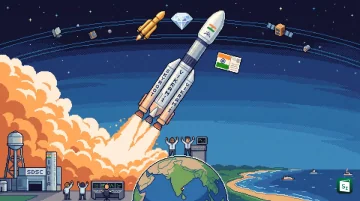
Skyroot Aerospace has successfully launched 'Vikram-1', India's first privately developed orbital-class rocket, into a 450 km Low-Earth Orbit (LEO). The mission, titled 'Mission Aagaman' (meaning arrival), marks India as the third nation with private orbital launch capabilities, following the US and China.
The 4-stage, 7-storey-tall rocket, named after Vikram Sarabhai, the father of India's space programme, has a payload capacity of up to 350 kg. It was launched from the Satish Dhawan Space Centre (SDSC) in Sriharikota, Andhra Pradesh.
The mission successfully deployed technology demonstrators from Grahaa Space, Cosmoserve, DCubed, and the SCOPE satellite. It also carried symbolic payloads, including an 18-karat gold rocket, an artistic lab-grown diamond, and a handwritten postcard from PM Narendra Modi bearing the message 'Vande Mataram'.
Union Minister Pralhad Joshi has launched a White Rabbit technology-based demonstration network at the Regional Reference Standard Laboratory (RRSL) in Bengaluru to securely distribute Indian Standard Time (IST) across the country.
The project is a collaborative effort between the Department of Consumer Affairs, the Council of Scientific and Industrial Research-National Physical Laboratory (CSIR-NPL), and the ISRO.
The network uses an advanced Precision Time Protocol (PTP)-based Ethernet network extension to deliver sub-nanosecond accuracy and microsecond-level synchronization over long distances. It is to be noted that the time signal is traceable to the Coordinated Universal Time (NPLI) (UTC (NPLI)).
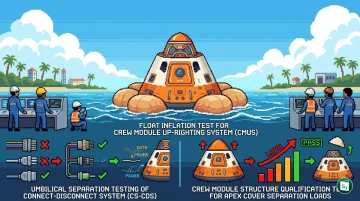
ISRO has successfully conducted 3 critical tests of the Gaganyaan Crew Module (CM) systems as part of the human spaceflight programme of India.
These tests included the float inflation test for the Crew Module Up-Righting system (CMUS), the Umbilical Separation Testing of the Connect-Disconnect System (CS-CDS), and the crew module structure qualification test for Apex Cover separation loads.
Indian Air Force (IAF) Group Captain Shubhanshu Shukla has launched his debut book titled "The Second Orbit: Belief of a Man… Dreams of 1.4 Billion Hearts" in Bengaluru. The book is published by Penguin Random House India.
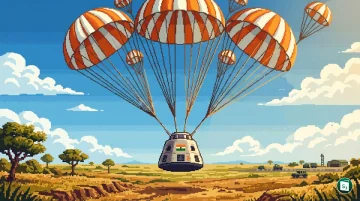
The ISRO has successfully conducted the Integrated Main Parachute Airdrop Test-05 (IMAT-05) for the Gaganyaan G1 mission at the Aerial Delivery Research and Development Establishment (ADRDE) drop zone in Sheopur, Madhya Pradesh.
The test aimed to validate the Main Parachute System under maximum expected load conditions for the first uncrewed Gaganyaan G1 mission. It is to be noted that the Gaganyaan Crew Module uses a system of 10 parachutes of 4 distinct types.
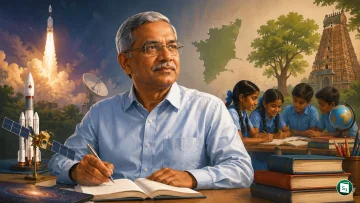
The Tamil Nadu government has appointed Mylswamy Annadurai, a former ISRO scientist, as the Chairman of the Curriculum Design Committee (CDC) for School Education for a 3-year tenure.
The Directorate General of Civil Aviation (DGCA) has successfully completed India's first satellite-based landing system (SLS) approach on a commercial jet aircraft. The demonstration was conducted using an IndiGo Airbus A320 at Maharana Pratap Airport in Udaipur, Rajasthan.
The operation utilized the indigenous GAGAN (Global Positioning System (GPS) Aided GEO (Geostationary Earth Orbit) Augmented Navigation) system to execute a Localiser Performance with Vertical Guidance (LPV) approach.