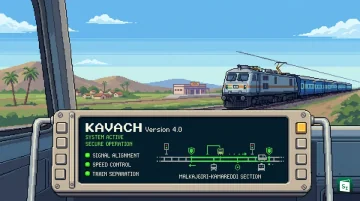
Indian Railways has commissioned KAVACH Version 4.0 for the first time on the South Central Railway (SCR). The project involved the upgradation from KAVACH Version 3.2 to Version 4.0.
The implementation was completed on the Malkajgiri-Kamareddi section of the Hyderabad Division, covering a total distance of 108 Route Kilometres (RKm).

Mazagon Dock Shipbuilders Ltd (MDL) has signed an MoU with the government of Andhra Pradesh to serve as the anchor shipyard for a mega greenfield shipbuilding industrial cluster.
The proposed industrial facility is scheduled for development at Dugarajapatnam in the Tirupati district of the state.
Union Minister Rajnath Singh has unveiled several policy initiatives at the ‘VIMARSH 2026’ DRDO-Industry Synergy Meet held in New Delhi under the theme ‘Varta se Vikas’.
During the event, 9 Licensing Agreements for ToT (LAToTs) were handed over to 13 manufacturing partners. DRDO also signed a contract with the Quality Council of India (QCI) for the implementation of the ‘System for Advance Manufacturing Assessment and Rating’ (SAMAR) version 2.0.
A group of scientists led by Dr Meena Mishara has developed indigenous Gallium Nitride (GaN) Monolithic Microwave Integrated Circuit (MMIC) technology for high-frequency defence applications, was unveiled.
Bharat Heavy Electricals Ltd (BHEL) has partnered with Titagarh Rail Systems Ltd (TRSL), a railway rolling stock manufacturer, to establish a 50:50 Joint Venture Company (JVC). The JVC will be responsible for the maintenance of Vande Bharat Sleeper trainsets for a period of 35 years.
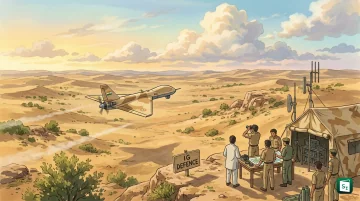
India has successfully flight-tested its first indigenous long-range one-way attack drone named ‘KAL’ at the Pokhran Field Firing Range in Rajasthan. Developed by the Noida-based IG Defence, the loitering munition (kamikaze drone) is designed for one-way strike missions.
The drone features an operational range of up to 1,000 km and a payload capacity of 50 kg. It is capable of fully autonomous flight at an altitude of up to 5,000 m using a navigation suite that combines multi-band Global Navigation Satellite System (GNSS) and Inertial Navigation Systems (INS).
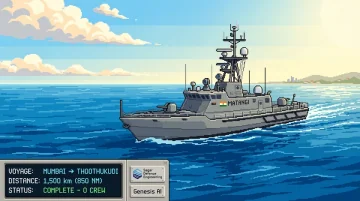
Matangi, an indigenous Autonomous Surface Vessel (USV) developed by Sagar Defence Engineering, has successfully completed a 1,500 km (850 nautical miles) open-ocean voyage from Mumbai to Thoothukudi, Tamil Nadu.
The voyage, which was completed with zero human intervention (no captain or crew on board), was flagged off by Union Minister Rajnath Singh. The mission was conducted under the ‘Swavlamban’ initiative of the Indian Navy to foster self-reliance. The vessel is controlled by an indigenously developed AI-driven operating suite named ‘Genesis’.
Union Minister Rajnath Singh has released a document on Defence Diplomacy named ‘RAKSHA’ in New Delhi. The document outlines the vision of India for strengthening international defence ties over the next 10 years.
The ‘RAKSHA’ framework identifies defence diplomacy as a primary driver for fostering international cooperation and increasing defence exports. It is to be noted that the strategy is integrated with the ‘Make in India’ initiative.
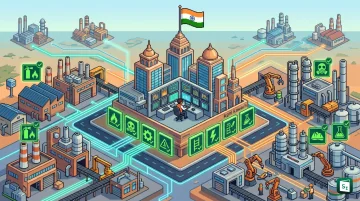
Agnikawach Safety Solutions Pvt Ltd has launched ‘Agni Kawach’, the first indigenously developed AI powered safety platform of India.
The platform aims to provide protection against 8 major industrial hazards to establish a global industrial safety ecosystem. It is to be noted that the prototype of the platform has reached Technology Readiness Level 5 (TRL-5).
Tata Advanced Systems Ltd (TASL) has signed an MoU with the Javelin Joint Venture (JJV), a partnership between Raytheon and Lockheed Martin, to explore the co-production of the Javelin All Up Round (AUR) anti-tank missile system in India.
The Javelin is a medium-range, fire-and-forget Anti-Tank Guided Missile (ATGM) that uses autonomous target navigation to engage tanks, armoured vehicles, and fortified positions at a distance of up to 5 km.
The Ministry of Electronics and Information Technology has notified the “Mobile Phone Manufacturing Scheme” (MPMS) with a total financial outlay of ₹62,500 crore to enhance global competitiveness, deepen Domestic Value Addition (DVA), and strengthen manufacturing capabilities within the mobile phone production sector.
The tenure of the MPMS is 5 years, spanning from FY27 to FY31. The scheme comprises two Target Segments (TS). TS1 focuses on providing incentives ranging from 2.25% to 5% for mobile phone manufacturing. TS2 is designed to support Indian mobile phone brands with a 5% incentive, plus an additional 3% incentive for Indian design and Research & Development (R&D).
Indo-Russian Rifles Pvt Ltd (IRRPL) has successfully produced and test-fired the first 100% indigenized AK-203 “Sher” assault rifle, manufactured entirely using Indian components and materials.
The rifle, featuring a firing rate of 700 rounds per minute, an effective range of up to 800 m, and a 415 mm barrel, is designed to replace the Indian Small Arms System (INSAS) rifle. It is to be noted that IRRPL is a Joint Venture (JV) established between India and Russia in 2019 to locally manufacture AK-203 assault rifles
According to a report titled “Key Sectors to Position India as a Global Manufacturing Hub” released by NITI Aayog, which provides a data-driven assessment of the manufacturing sector in India, 12 manufacturing sectors have been identified to accelerate the transition of India into a global manufacturing hub.
Among the 12 key sectors, four high-potential sectors identified to drive manufacturing growth and strengthen the position of India in global value chains are chemicals, textiles, telecom and networking equipment, and solar photovoltaic (PV) manufacturing. The study conducted for the report followed a 4-phase methodology.
Union Minister Piyush Goyal has felicitated top buyers and leading sellers during the 10th foundation day celebration of the Government e Marketplace (GeM) held at Bharat Mandapam in New Delhi.
During the event, GeM launched a nationwide 5-digit short code helpdesk number '14550' to improve its support services. A customized 'My Stamp' and a commemorative film showcasing the 10-year journey of GeM were also launched.
Bharat Electronics Ltd (BEL) has signed an MoU with Esri India to develop advanced Geographic Information System (GIS), Location Intelligence, and Geospatial Artificial Intelligence (GeoAI) solutions for the Indian defence sector.
Under the collaboration, the latter will provide training to BEL to build in-house capabilities in GIS and GeoAI using its ‘Indo ArcGIS’ platform.
Jupiter Wagons Ltd (JWL) has partnered with Italy-based Lucchini RS Holding SpA and SIMEST (Italian Society for Enterprises Abroad) SpA to set up India’s first fully integrated private-sector railwheel manufacturing platform, named Jupiter Tatravagonka Railwheel Factory Pvt Ltd (JTRWF).
Under this deal, Lucchini RS and SIMEST will acquire a combined 25% stake in JTRWF for an investment of ₹307 crore (EUR 28 million).
The Department of Telecommunications (DoT) under the Ministry of Communications has signed an MoU with the Madhya Pradesh government to establish India's first Telecom Manufacturing Zone (TMZ) Phase-I in Gwalior. The agreement was signed at Vigyan Bhawan, New Delhi.
A Special Purpose Company (SPC) will be established to implement the project, which is designed on a 'plug-and-play' system.
The 5th and final ship of the Diving Support Craft (DSC) Project, named 'DSC A24', has been launched in Titagarh, Kolkata. The vessel is constructed by Titagarh Rail Systems Ltd (TRSL).
It features a catamaran-hull design with a displacement of 300-400 tonnes. It is to be noted that 70% of the equipment used in these vessels is sourced from indigenous manufacturers.
Paninian India Pvt Ltd, a deep-tech and aerospace startup, has launched the Yantur 4.5 kilo-Newton (kN) Turbofan engine programme. This is India's first privately developed turbofan engine in this class. The engine is designed to power the 'Svayatt L1', a long-range autonomous cruise missile platform developed by the company.