

BANKING
12 September 2026 BANKING
The RBI has included Coastal Local Area Bank Ltd in the Second Schedule of the RBI Act, 1934. Headquartered in Vijayawada, Andhra Pradesh, it is the first Local Area Bank (LAB) of India.
The RBI has included Coastal Local Area Bank Ltd in the Second Schedule of the RBI Act, 1934. Headquartered in Vijayawada, Andhra Pradesh, it is the first Local Area Bank (LAB) of India.

The National Bank for Agriculture and Rural Development (NABARD) has signed an MoU with the India Meteorological Department (IMD) to integrate agro-meteorological data into the Data in Climate Resilient Agriculture (DiCRA) platform.
The collaboration aims to provide farmers and stakeholders with weather intelligence to facilitate informed decision-making and promote climate resilience in the agricultural sector.

The National Bank for Agriculture and Rural Development (NABARD) has signed an MoU with the National Bank for Financing Infrastructure and Development (NaBFID) to collaborate on infrastructure financing.
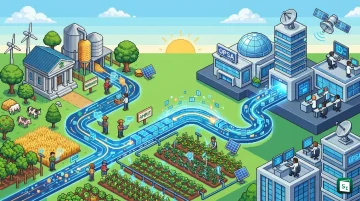
Prof. Ajay Kumar Sood, the Principal Scientific Adviser to the Government of India, has launched the 'RSVC AMRIT' (Accelerated Medium for Rural Innovations and Technologies) platform.
The platform has been developed by the National Bank for Agriculture and Rural Development (NABARD) in collaboration with the Office of the Principal Scientific Adviser (OPSA). It is designed to serve as a digital backbone to foster rural innovations and bridge the gap between advanced scientific innovations and grassroots rural needs.
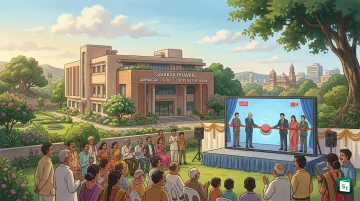
Union Minister Amit Shah virtually inaugurated 'Sahakar Bhavan', the new headquarters of the Jamnagar District Cooperative Bank in Jamnagar, Gujarat. The project was completed at a cost of Rs 25 crore.
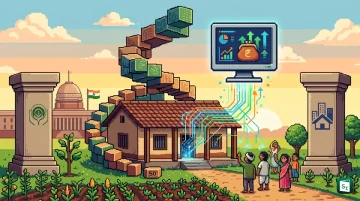
Union Minister Rajiv Ranjan Singh has launched the 'Atmanirbhar Panchayat Programme', 'SAMARTH Panchayat Portal', and the 'Model Own Source of Revenue (OSR) Rules' for Panchayati Raj Institutions (PRIs) at Krishi Bhawan in New Delhi.
The 'Atmanirbhar Panchayat Programme' aims to develop 350 projects over 4 years (50 in the first year, and 100 in each of the subsequent 3 years). NABARD and HUDCO are the institutional partners for the programme.
The 'SAMARTH Panchayat Portal' is a digital initiative by the Ministry of Panchayati Raj to strengthen the financial capacity of Gram Panchayats through technology-enabled management of OSR. The 'Model OSR Rules' serve as a framework for States and Union Territories (UTs) to enhance the financial independence of PRIs, incorporating recommendations from the Sixteenth Finance Commission.
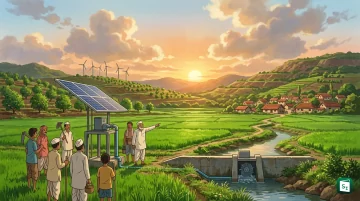
The National Bank for Agriculture and Rural Development (NABARD) has signed an MoU with Mahatma Phule Renewable Energy and Infrastructure Technology Ltd (MAHAPREIT) to jointly finance and promote green, climate-resilient, and sustainable infrastructure projects across rural India, with an initial focus on Maharashtra.

The PM Krishi Sinchayee Yojana (PMKSY), launched in 2015, has completed 10 years of advancing irrigation-led agricultural transformation in India. The scheme comprises 4 main components: Accelerated Irrigation Benefit Programme (AIBP), Har Khet Ko Pani (HKKP), Watershed Development Component (WDC), and Per Drop More Crop (PDMC).
As of August 2025, the PMKSY has benefited over 27 million farmers and created or restored irrigation potential across 24.61 million hectares (ha), supported by a budgetary allocation of ₹64,407 crore. Since the inception of the PDMC component, 110.92 lakh ha of land have been brought under micro-irrigation.
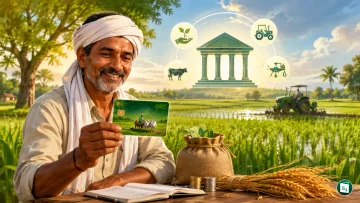
The RBI has revamped the Kisan Credit Card (KCC) scheme by standardizing the definition of crop seasons to ensure uniform loan processing and repayment. The 'KCC Directions, 2026' will be applicable to all loans sanctioned under the scheme from January 2027.
The objective of these directions is to establish a framework for providing adequate and timely credit support through the banking system to meet the working capital and investment credit requirements of borrowers engaged in agriculture and allied activities.

The RBI has directed banks to exempt agricultural and allied sector loans up to ₹2 lakh per borrower from collateral security and margin requirements under the updated guidelines of the Kisan Credit Card (KCC) scheme.
Furthermore, the voluntary pledge of gold and silver as collateral for agricultural loans up to the collateral-free limit of ₹2 lakh will not be considered a violation of the guidelines on collateral-free lending.

The Geographical Indications Registry (GIR) has granted Geographical Indication (GI) tags to 11 products from Jharkhand, including the Bhoya Saree and Fabric, Kuchai Silk Saree, Jharkhand Bamboo Craft, and Sohrai Painting.
With these additions, Jharkhand has a total of 12 GI-tagged products, of which 4 are supported by the National Bank for Agriculture and Rural Development (NABARD).
The GIR has also granted GI status to 4 traditional products from Assam, namely Karbi Anglong Handloom Products, Assam Bihu Pepa, Assam Bamboo Crafts, and Deuri Handloom Products. Assam currently holds 45 GI-tagged products in total, with 12 being supported by NABARD.
The tribal musical instrument of Tripura, Sarinda (also known as Sarinda Uakhrap), has been granted a GI tag. Tripura now possesses a total of 4 GI-tagged products, all of which are supported by NABARD. It is to be noted that a GI registration is valid for a period of 10 years from the date of registration and can be renewed for further periods of 10 years each.
Maha
185.3 P
P Pradeepa
187.3 V
V Vijay
176.8


Reviews collected across various platforms
"The memorising technique in the Scoreclever automatically stores the news in my mind and it saves time."
"It is very helpful platform to study current affairs. It has memory technique which saves lots of time during preparartion."
"Came across Editorial Vocabulary podcast video accidentally and really loved the idea. Its really useful for my preparation."
"Wonderful session. Thank you so much and really hats off to you for making current affairs and editorial an easy one."
"This is one the best app for Current Affairs. The content is cut and short whichever is required and is easy to remember with flashcards."
"Thx to daily quizzes. It played a big role in revisions. April 2024 - April 2025 I missed quizzes 3 or 4 days only. It's that interesting."
"Best app to learn current affairs in an effective way. I usually forgot current affairs easily and now I can easily remember everything."
"I studied current affairs only in Scoreclever and its really a time saver. Thanks Scoreclever team for all your efforts."
"Just wow. Haven't seen anyone explaining editorials like this. Crystal clear explanations with word by word. Thanks so much."
"This app is very useful to the persons who find difficult to go through the bunch of PDFs, and spending lots of time for revision."
"The memorising technique in the Scoreclever automatically stores the news in my mind and it saves time."
"It is very helpful platform to study current affairs. It has memory technique which saves lots of time during preparartion."
"Came across Editorial Vocabulary podcast video accidentally and really loved the idea. Its really useful for my preparation."
"Wonderful session. Thank you so much and really hats off to you for making current affairs and editorial an easy one."
"This is one the best app for Current Affairs. The content is cut and short whichever is required and is easy to remember with flashcards."
"Thx to daily quizzes. It played a big role in revisions. April 2024 - April 2025 I missed quizzes 3 or 4 days only. It's that interesting."
"Best app to learn current affairs in an effective way. I usually forgot current affairs easily and now I can easily remember everything."
"I studied current affairs only in Scoreclever and its really a time saver. Thanks Scoreclever team for all your efforts."
"Just wow. Haven't seen anyone explaining editorials like this. Crystal clear explanations with word by word. Thanks so much."
"This app is very useful to the persons who find difficult to go through the bunch of PDFs, and spending lots of time for revision."
"The memorising technique in the Scoreclever automatically stores the news in my mind and it saves time."
"It is very helpful platform to study current affairs. It has memory technique which saves lots of time during preparartion."
"Came across Editorial Vocabulary podcast video accidentally and really loved the idea. Its really useful for my preparation."
"Wonderful session. Thank you so much and really hats off to you for making current affairs and editorial an easy one."
"This is one the best app for Current Affairs. The content is cut and short whichever is required and is easy to remember with flashcards."
"Thx to daily quizzes. It played a big role in revisions. April 2024 - April 2025 I missed quizzes 3 or 4 days only. It's that interesting."
"Best app to learn current affairs in an effective way. I usually forgot current affairs easily and now I can easily remember everything."
"I studied current affairs only in Scoreclever and its really a time saver. Thanks Scoreclever team for all your efforts."
"Just wow. Haven't seen anyone explaining editorials like this. Crystal clear explanations with word by word. Thanks so much."
"This app is very useful to the persons who find difficult to go through the bunch of PDFs, and spending lots of time for revision."
Complete learning ecosystem to ace CA, English & GA
Revolutionary study technique for Current Affairs, English Vocabulary, and General Awareness. Learn once, remember forever.
Download on Play Store5x smaller, yet better than top sources. Daily Current Affairs and Editorial Vocabulary PDFs on Telegram.
Join on TelegramComprehensive, structured books with clean UI for long-term reading. Regularly updated with current events.
View DetailsIn-depth analysis of daily newspaper editorials with vocabulary breakdown, grammar insights, and key takeaways.
View DetailsCompete daily at 7 PM (Vocab) and 8 PM (Current Affairs). Win exciting rewards based on league rankings.
A dedicated website for Current Affairs preparation, featuring daily updates, and comprehensive resources.
About Us