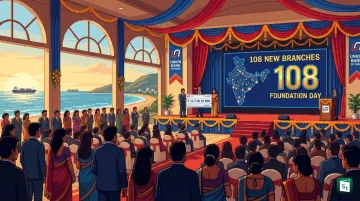
Union Bank of India (UBI) celebrated its 108th Foundation Day in Visakhapatnam, Andhra Pradesh, under the theme “108 Years Young – Shaping a Brighter Future Together.”
During the event, 108 new bank branches across the country were virtually inaugurated by M. Damodaran. Employees of the bank also contributed their Privilege Leave equivalent to ₹11.7 crore towards the National Defence Fund (NDF).

RBI has issued Master Directions (MD) on Cyber Resilience and Digital Payment Security Controls for non-bank Payment System Operators (PSOs) to tighten cybersecurity protocols.
These directions take effect on November 5, 2026, for large and medium non-bank PSOs, while small payment operators have been granted a compliance window until April 1, 2028. PSOs must notify the RBI and the Indian Computer Emergency Response Team (CERT-In) within 6 hours of detecting unusual incidents.
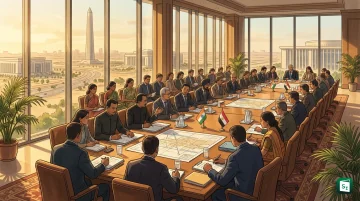
Union Minister Piyush Goyal and his counterpart Dr Mohamed Farid Saleh have co-chaired the ministerial-level 7th India–Egypt Joint Trade Committee (JTC) meeting in the New Administrative Capital of Egypt.
Both have agreed to form a Joint Working Group to evaluate a Preferential Trade Agreement (PTA) or Free Trade Agreement (FTA) to ease market access and reduce trade barriers. They have also committed to expanding bilateral trade to $12 billion.
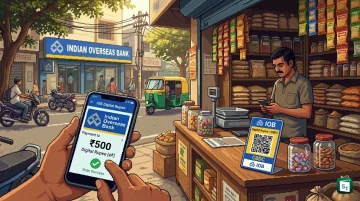
Indian Overseas Bank (IOB) has launched the ‘IOB Digital Rupee’ mobile app to enable customers to conduct transactions using the Central Bank Digital Currency (CBDC) of India.
The National Payments Corporation of India (NPCI) has launched the “UPI Vyapaar Saksham Scheme” to expand the UPI acceptance infrastructure among small merchants. The scheme will operate for 3 years from the implementation of the UPI Merchant Discount Rate (MDR).
Under the scheme, small merchants are defined as those with a maximum annual turnover of ₹40 lakh in the previous year. The initiative targets merchants in Tier-III to Tier-VI cities, North-Eastern (NE) states, Jammu & Kashmir (J&K), and Ladakh.
The financial incentives are structured into three components: Component A allocates ₹300 per QR code and ₹750 per soundbox, Component B offers a 0.03% incentive for a 5% Quarter-on-Quarter (Q-o-Q) growth, and Component C provides a 0.20% incentive on incremental transactions in targeted geographies.
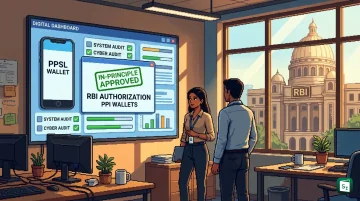
Paytm Payments Services Ltd (PPSL), a wholly-owned subsidiary of One 97 Communications Ltd, has received in-principle authorization from the RBI to set up and operate prepaid payment instruments (PPIs), including prepaid wallets, in India.
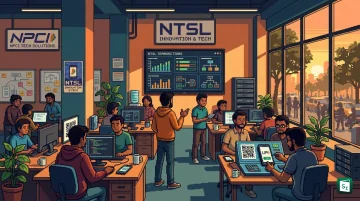
The National Payments Corporation of India (NPCI) has launched NPCI Tech Solutions Ltd (NTSL) as a new technology and innovation arm of the NPCI group. Vishal Kanvaty, Chief Technology Officer (CTO) of NPCI, has been appointed as the MD & CEO of NTSL.
It is to be noted that NTSL is the fourth wholly-owned subsidiary of NPCI, alongside NPCI International Payments Ltd (NIPL), NPCI Bharat BillPay Ltd (NBBL), and NPCI Bharat Interface for Money (BHIM) Services Ltd (NBSL).
Fibe, formerly known as EarlySalary, has launched UPI payments on its application after receiving Third-Party Application Provider (TPAP) approval from the National Payments Corporation of India (NPCI).
YES BANK has launched a new savings account named “YES vibez” specifically designed for Generation Z (Gen Z) customers aged 18-30 years.
The account offers cashback of up to ₹12,000 on debit card spends and rewards up to ₹3,000 on UPI merchant transactions, alongside various lifestyle benefits.
AU Small Finance Bank (SFB), India’s largest Small Finance Bank, has partnered with Paytm to launch the ‘Paytm AU SFB Credit Card’, India’s first Family Lounge Access RuPay Credit Card, offering rewards on digital payments and complimentary airport lounge access for families.
Karnataka Bank Ltd (KBL) has launched the “Nava Dhamaka 2026: Enhancing Banking Experience” initiative in Bengaluru.
The initiative introduces 9 banking solutions across digital banking, investments, payments, customer engagement, and lending to improve customer convenience, digital payments, service delivery, and technology-driven entrepreneurship.
Bank of India (BOI), a Public Sector Bank (PSB), has launched a User-Level Programmable Central Bank Digital Currency (CBDC) with auto-issuance capability.
The system allows users to automate recurring Digital Rupee (e₹) payments and specify the purpose for which the funds can be used. It is to be noted that the technical functionality for this programmable CBDC solution was developed by Montran India.
Union Minister Nirmala Sitharaman has launched an Alternative Investment Fund (AIF) named ‘IIT Madras Unicorn Frontier Fund-I’ during the 7th edition of ‘IITMAA Sangam’ (the annual conference of the IIT Madras Alumni Association) in Bengaluru.
The fund is a joint initiative between the IIT Madras and Unicorn India Ventures (UIV). The minister also released a book titled “Cashless Nation: How UPI Changed Everything”, authored by Santanu Paul and B Sambamurthy.
Apple Inc. has launched Apple Pay in India. The service enables transactions specifically through Visa and Mastercard credit cards issued by Axis Bank.
Samvriddhi Inclusive Growth Network Pvt Ltd (SIGN), a subsidiary of MOS Utility Ltd, has received in-principle authorisation from the RBI to operate as an Online Payment Aggregator (PA-Online).
TBX (formerly TransBnk) has launched Business-to-Business (B2B) bill payments on its TrustHub platform through Bharat Connect for Business, a service of the NPCI Bharat BillPay Ltd (NBBL).
It is to be noted that NBBL is a subsidiary of the National Payments Corporation of India (NPCI).
PhonePe has received in-principle approval from the Central Bank of the UAE for two operating licenses, marking the first international expansion of the company.
The licenses include Retail Payment Services and Card Schemes (RPSCS) and Stored Value Facilities (SVF).
The UPI and Services Committee, led by the National Payments Corporation of India (NPCI), has introduced a revised Merchant Discount Rate (MDR) framework, effective from October 15, 2026. Under the new rules, a 0.4% charge will be applied to UPI transactions above ₹2,000.
A flat MDR of ₹5 per transaction will apply to payments exceeding ₹2,000 in specific sectors like railways, telecommunications, insurance, and fuel. For capital market transactions, including mutual funds and stockbroking, the MDR is set at 0.02% of the transaction value, capped at ₹300.
The Ministry of Finance has notified that banks and payment system providers are prohibited from imposing any direct or indirect charges on UPI transactions up to ₹2,000. The MoF has also extended this prohibition to payments made through RuPay-powered debit cards.