
ECONOMY
24 September 2026 ECONOMY
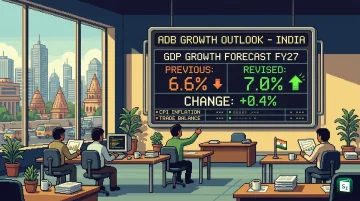
According to a report by the Asian Development Bank (ADB), the GDP growth forecast of India for FY27 is revised to 7% from the earlier estimate of 6.6% in July.
According to a report by the Asian Development Bank (ADB), the GDP growth forecast of India for FY27 is revised to 7% from the earlier estimate of 6.6% in July.

The International Big Cat Alliance (IBCA) has signed an MoU with the Asian Development Bank (ADB) to collaborate on landscape conservation, sustainable development, and financing.
The agreement was formalized during the ‘International Workshop on Tiger Landscapes’ which was inaugurated by Union Minister Bhupender Yadav. The theme of the workshop was “Tiger Landscapes: Conservation, Bioeconomy and Ecotourism as Pillars for Livelihood and Income Generation”.

Yuko Keicho, a Japanese national, has been appointed as the Vice President and Auditor General of the World Bank Group (WBG). She succeeds Amy Doherty.

The Government of India has signed a $230 million loan agreement with the Asian Development Bank (ADB) for the “Chennai Climate-Resilient Water Security and Sewerage Project”.
The initiative aims to modernize water supply and sanitation infrastructure in Chennai to strengthen the resilience of the city against climate change. The project also seeks to improve public health and quality of life by establishing a more efficient and financially sustainable urban water system.

The Department of Personnel and Training (DoPT) under the Ministry of Personnel, Public Grievances and Pensions (MoPP&P) has approved the foreign postings of senior bureaucrats. Rahul Jain has been appointed as the Senior Adviser to the Executive Director (India) at the International Monetary Fund (IMF) for 3 years.
Baldeo Purushartha has been appointed as the Senior Adviser to the Executive Director (ED) at the Asian Development Bank (ADB) in Manila, Philippines, for 3 years. Satyajit Mohanty has been appointed as the Representative of India in the Council of the International Civil Aviation Organization (ICAO) for 3 years.

The Asian Development Bank (ADB) has approved a $1 billion loan to the Government of India (GoI) to support the urban reform agenda of India. This programme is designed to support the implementation of the Urban Challenge Fund (UCF).
Additionally, the ADB has sanctioned $3 million in technical assistance to the Ministry of Housing and Urban Affairs (MoHUA) for the effective implementation of the programme.
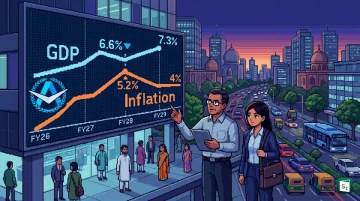
According to a report by the Asian Development Bank (ADB), India's GDP growth forecast for FY27 has been revised to 6.6% from the earlier 6.9%. The growth projection for FY28 is maintained at 7.3%.
The ADB has also raised the inflation forecast for FY27 to 5.2% from 4.5%, while the projection for FY28 is maintained at 4%.

The Asian Development Bank (ADB) has approved a loan of $182.89 million (in Japanese Yen equivalent) to Karnataka for the "Strengthening Karnataka Public Schools Program". The program aims to strengthen the public school system by establishing 500 integrated school clusters.
Additionally, the program will receive a $10 million grant and a $25 million guarantee from the International Finance Facility for Education (IFFEd).

The Asian Development Bank (ADB) has approved a Small Expenditure Financing Facility (SEFF) of $42.2 million to support the bamboo industry in the North Eastern Region (NER) of India.
The facility is designed to support community-based projects across 6 states in the NER (Assam, Manipur, Meghalaya, Mizoram, Nagaland, and Tripura).

The Asian Development Bank (ADB) has signed a $10 million financing package with Schoolnet India Ltd (SIL) to improve learning outcomes in government schools across India.
The project aims to scale up digital learning infrastructure in 30,000 government schools, directly benefiting 45 million students. Under the initiative, computer laboratories will be installed in at least 1,000 government schools.

The Asian Development Bank and Standard Chartered Bank have signed agreements to enhance supply chain finance in India. This collaboration establishes risk-sharing arrangements for transactions in both the United States Dollar (USD) and the Indian Rupee (INR).

The Asian Development Bank (ADB) has launched a $70 billion connectivity initiative to integrate power and digital networks across the Asia-Pacific region by 2035. The initiative includes a $50 billion programme named “Pan-Asia Power Grid Initiative” to transition from bilateral energy links to a regional power trade framework.
ADB will contribute $25 billion (50% of the funding). By 2035, the project aims to integrate 20 Gigawatts (GW) of renewable energy, construct 22,000 circuit-km of transmission lines, and reduce regional power sector emissions by 15%. It will improve electricity access for 200 million people by focusing on infrastructure.
The “Asia-Pacific Digital Highway” involves a $20 billion investment to bridge the digital divide and facilitate growth driven by AI. By 2035, it targets providing first-time broadband access to 200 million people and enhancing service quality for 450 million others.
The programme aims to reduce connectivity costs by 40% for remote areas. Additionally, a “Centre for AI Innovation and Development” will be established in Seoul, South Korea. The announcement was made during the 59th Annual Meeting of the bank in Samarkand, Uzbekistan.
Maha
185.3 P
P Pradeepa
187.3 V
V Vijay
176.8


Reviews collected across various platforms
"The memorising technique in the Scoreclever automatically stores the news in my mind and it saves time."
"It is very helpful platform to study current affairs. It has memory technique which saves lots of time during preparartion."
"Came across Editorial Vocabulary podcast video accidentally and really loved the idea. Its really useful for my preparation."
"Wonderful session. Thank you so much and really hats off to you for making current affairs and editorial an easy one."
"This is one the best app for Current Affairs. The content is cut and short whichever is required and is easy to remember with flashcards."
"Thx to daily quizzes. It played a big role in revisions. April 2024 - April 2025 I missed quizzes 3 or 4 days only. It's that interesting."
"Best app to learn current affairs in an effective way. I usually forgot current affairs easily and now I can easily remember everything."
"I studied current affairs only in Scoreclever and its really a time saver. Thanks Scoreclever team for all your efforts."
"Just wow. Haven't seen anyone explaining editorials like this. Crystal clear explanations with word by word. Thanks so much."
"This app is very useful to the persons who find difficult to go through the bunch of PDFs, and spending lots of time for revision."
"The memorising technique in the Scoreclever automatically stores the news in my mind and it saves time."
"It is very helpful platform to study current affairs. It has memory technique which saves lots of time during preparartion."
"Came across Editorial Vocabulary podcast video accidentally and really loved the idea. Its really useful for my preparation."
"Wonderful session. Thank you so much and really hats off to you for making current affairs and editorial an easy one."
"This is one the best app for Current Affairs. The content is cut and short whichever is required and is easy to remember with flashcards."
"Thx to daily quizzes. It played a big role in revisions. April 2024 - April 2025 I missed quizzes 3 or 4 days only. It's that interesting."
"Best app to learn current affairs in an effective way. I usually forgot current affairs easily and now I can easily remember everything."
"I studied current affairs only in Scoreclever and its really a time saver. Thanks Scoreclever team for all your efforts."
"Just wow. Haven't seen anyone explaining editorials like this. Crystal clear explanations with word by word. Thanks so much."
"This app is very useful to the persons who find difficult to go through the bunch of PDFs, and spending lots of time for revision."
"The memorising technique in the Scoreclever automatically stores the news in my mind and it saves time."
"It is very helpful platform to study current affairs. It has memory technique which saves lots of time during preparartion."
"Came across Editorial Vocabulary podcast video accidentally and really loved the idea. Its really useful for my preparation."
"Wonderful session. Thank you so much and really hats off to you for making current affairs and editorial an easy one."
"This is one the best app for Current Affairs. The content is cut and short whichever is required and is easy to remember with flashcards."
"Thx to daily quizzes. It played a big role in revisions. April 2024 - April 2025 I missed quizzes 3 or 4 days only. It's that interesting."
"Best app to learn current affairs in an effective way. I usually forgot current affairs easily and now I can easily remember everything."
"I studied current affairs only in Scoreclever and its really a time saver. Thanks Scoreclever team for all your efforts."
"Just wow. Haven't seen anyone explaining editorials like this. Crystal clear explanations with word by word. Thanks so much."
"This app is very useful to the persons who find difficult to go through the bunch of PDFs, and spending lots of time for revision."
Complete learning ecosystem to ace CA, English & GA
Revolutionary study technique for Current Affairs, English Vocabulary, and General Awareness. Learn once, remember forever.
Download on Play Store5x smaller, yet better than top sources. Daily Current Affairs and Editorial Vocabulary PDFs on Telegram.
Join on TelegramComprehensive, structured books with clean UI for long-term reading. Regularly updated with current events.
View DetailsIn-depth analysis of daily newspaper editorials with vocabulary breakdown, grammar insights, and key takeaways.
View DetailsCompete daily at 7 PM (Vocab) and 8 PM (Current Affairs). Win exciting rewards based on league rankings.
A dedicated website for Current Affairs preparation, featuring daily updates, and comprehensive resources.
About Us