

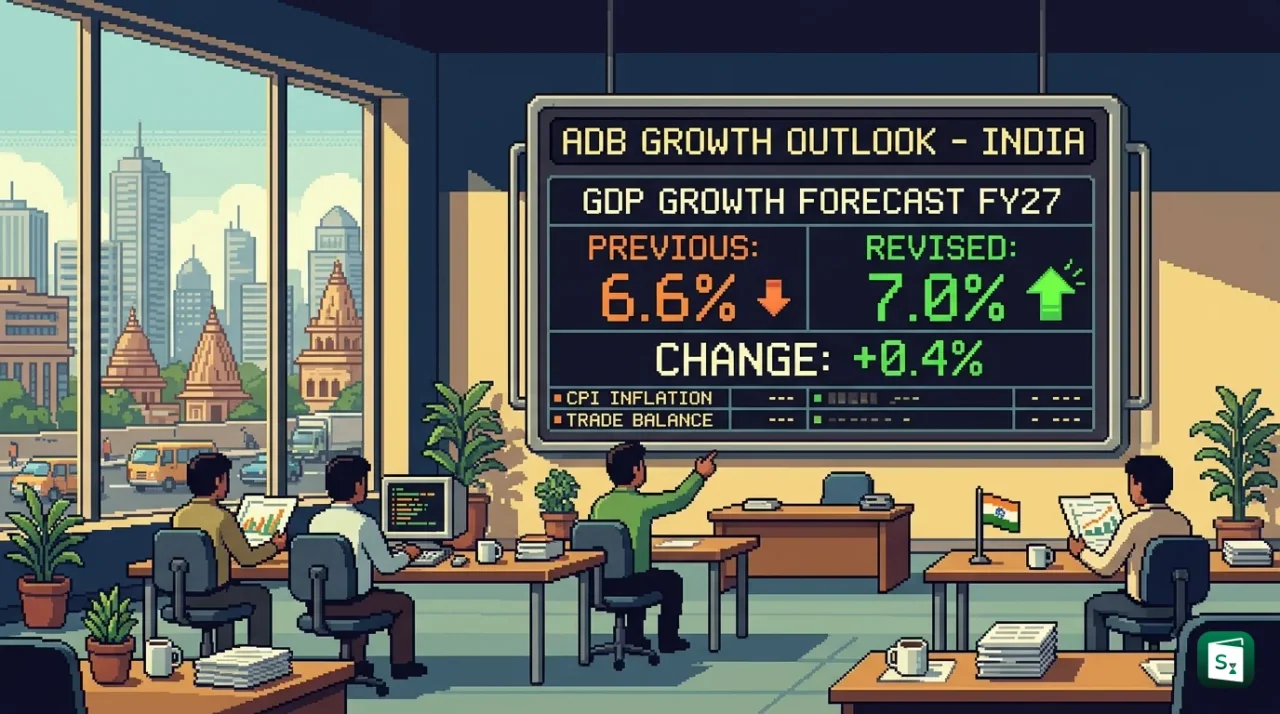
The Asian Development Bank raised India’s GDP growth forecast for FY27 to 7 percent from 6.6 percent in its Asian Development Outlook September 2026 released on 23 September 2026. The upgrade follows stronger than expected growth of 7.8 percent in the April to June quarter of FY27. It keeps India as the fastest growing major economy despite high energy prices linked to the West Asia conflict and emerging El Nino risks.
What Is GDP and How Is It Calculated in India?
Gross Domestic Product (GDP) is the total value of all final goods and services produced within a country’s borders during a specific period, usually a quarter or a year. For India, the GDP of India shows the size of the economy in rupees or in trillion dollars, while the GDP growth rate shows how fast that size is changing after removing the effect of rising prices.
In India, the Ministry of Statistics and Programme Implementation (MOSPI) compiles the estimates through the National Statistical Office (NSO). The base year for the new GDP series is 2022-23, which replaced the earlier 2011-12 series in estimates released on 27 February 2026. The base year works as the reference year for comparing prices over time, and 2022-23 was chosen because it was a normal year after the pandemic with strong survey data available.
India measures GDP using three standard methods. The production approach adds up Gross Value Added (GVA) from all sectors and then adds net taxes on products. GVA is the value of output minus the value of inputs used up in production. The income approach adds up earnings from work and capital, while the expenditure approach adds up private consumption, government spending, investment and net exports. Real GDP uses constant prices to show true volume growth, while nominal GDP uses current prices and includes inflation.
Why Did ADB Raise India’s FY27 Forecast to 7 Percent?
The Asian Development Bank (ADB) published the revision in the Asian Development Outlook (ADO) September 2026, which was released on 23 September 2026 with the theme of navigating prolonged energy shocks and El Nino. The ADB raised the forecast for FY2026 ending 31 March 2027, which is India’s FY27, to 7 percent from 6.6 percent projected in the ADO July 2026. The change is an upward revision of 0.4 percentage points and reverses the cut made in July, when the ADB had lowered the estimate from 6.9 percent projected in April due to elevated energy prices.
The ADB said domestic demand has held up better than expected despite the continuing conflict in West Asia. Private consumption has stayed firm, supported by rising real incomes and steady rural demand. Gross fixed capital formation, which reflects investment in buildings, machinery and infrastructure, has remained strong. Public capital spending by the central and state governments, along with a revival in private capital spending linked to manufacturing, power and technology including data centres and artificial intelligence related investment, has added further momentum.
Supply conditions also helped. The ADB noted lower than expected supply disruptions, sustained capital inflows and limited pass through of higher input costs to retail prices. Government steps such as fuel tax cuts, targeted credit support and efforts to attract foreign capital cushioned household budgets. Strong services exports and firm goods exports supported overall activity even as global demand stayed weak.
Q1 FY27 Performance That Drove the Upgrade
The immediate trigger was first quarter data for FY27. MOSPI estimated real GDP growth at 7.8 percent in the April to June quarter of FY27, against 6.9 percent in the same quarter last year. Real GDP stood at ₹81.36 lakh crore, while nominal GDP grew 10.3 percent to ₹88.27 lakh crore. Real GVA grew 8.2 percent to ₹73.82 lakh crore.
Manufacturing grew 9.2 percent, construction grew 7.7 percent, and the tertiary sector grew 10 percent, led by financial, real estate, information technology and professional services at 12.1 percent. On the spending side, Gross Fixed Capital Formation rose 11.9 percent and Private Final Consumption Expenditure rose 7.1 percent. The outcome beat the central bank’s projection of 7 percent for the quarter and confirmed that investment and services were carrying growth while agriculture grew 3.6 percent and mining contracted 2.4 percent.
How Does ADB’s Forecast Compare With RBI, IMF and Rating Agencies?
The ADB forecast is now the joint highest among major trackers for FY27. The Reserve Bank of India (RBI) raised its FY27 projection to 6.7 percent in August 2026 from 6.6 percent in June, with quarterly paths of 7 percent in Q1, 6.4 percent in Q2, 6.5 percent in Q3 and 6.8 percent in Q4. The RBI kept the policy repo rate unchanged at 5.25 percent and retained a neutral stance. The RBI Governor (as of September 2026) is Sanjay Malhotra, and the decision was taken by the six member Monetary Policy Committee (MPC).
The International Monetary Fund (IMF) projected 6.4 percent growth for FY27 in its World Economic Outlook Update of July 2026, slightly lower than the 6.5 percent projected in April. The World Bank has projected growth of around 6.5 percent for 2026. Among rating agencies, S and P Global Ratings raised its FY27 estimate to 7 percent from 6.6 percent, Fitch Ratings raised its estimate to 6.9 percent from 6.4 percent, and Moody’s Ratings raised its estimate to 7 percent from 6 percent. The wave of upgrades followed the same Q1 surprise that prompted the ADB move.
| Institution | FY27 Forecast for India | Previous Estimate | Direction |
|---|---|---|---|
| Asian Development Bank, September 2026 | 7 percent | 6.6 percent in July 2026 | Raised by 0.4 points |
| Reserve Bank of India, August 2026 | 6.7 percent | 6.6 percent in June 2026 | Raised by 0.1 points |
| S and P Global Ratings, September 2026 | 7 percent | 6.6 percent | Raised by 0.4 points |
| Fitch Ratings, September 2026 | 6.9 percent | 6.4 percent | Raised by 0.5 points |
| Moody’s Ratings, September 2026 | 7 percent | 6 percent | Raised by 1 point |
| International Monetary Fund, July 2026 | 6.4 percent | 6.5 percent in April 2026 | Lowered by 0.1 points |
For the next year, the ADB trimmed its FY28 forecast for India to 7.1 percent from 7.3 percent, largely due to the higher base created by stronger FY27 growth. The ADB also lifted its South Asia growth forecast for 2026 to 6.4 percent from 6 percent, with India anchoring the regional upgrade. Growth in developing Asia and the Pacific is projected at 5 percent in 2026, up 0.1 points from July but down from 5.5 percent in 2025, and 5.1 percent in 2027.
What Is the Inflation Outlook Alongside the Growth Upgrade?
The ADB revised India’s inflation forecast for FY27 down to 5 percent from 5.2 percent projected in July. The ADB said cuts in the Goods and Services Tax (GST) have limited the transfer of higher global energy prices to shop prices. The ADB kept the FY28 inflation forecast unchanged at 4 percent, on the expectation that energy prices will moderate and farm supply will return to normal.
Price pressure is still expected to rise in the second half of FY27 as the favourable effect of tax cuts fades from the yearly comparison and as higher input costs feed through. The RBI projects Consumer Price Index (CPI) inflation at 5 percent for FY27, with 4.7 percent in Q2, 5.9 percent in Q3 and 5.5 percent in Q4. S and P Global Ratings expects inflation to average 5.1 percent in FY27, up from 2.1 percent in FY26, and sees a possible rate rise of 25 basis points to 5.5 percent.
The main risk comes from weather. The ADB warned of a very strong El Nino, a climate pattern that warms Pacific waters and often weakens India’s monsoon. A poor monsoon can cut farm output, lower rural incomes and push up food prices at the same time. Combined with elevated crude prices, fertilizer costs and supply chain stress from the West Asia conflict, this keeps risks tilted to the downside for both growth and prices.
Asian Development Bank: Mandate and Institutional Profile
The Asian Development Bank (ADB) is a multilateral development bank that supports sustainable, inclusive and resilient growth across Asia and the Pacific. The ADB provides loans, grants, technical help and policy advice for infrastructure, energy, water, education and private sector development. The ADB was established on 19 December 1966 and started operations on the same date in Manila. The ADB is owned by 69 members, of which 50 are from the region.
The ADB is headquartered at 6 ADB Avenue, Mandaluyong City, Metro Manila, Philippines. The President of the ADB (as of September 2026) is Masato Kanda, who assumed office on 24 February 2025 as the eleventh President. The President also chairs the Board of Directors and is elected by the Board of Governors. The ADB publishes the Asian Development Outlook (ADO) in April, July, September and December each year. The ADO gives growth and inflation forecasts for developing Asia and the Pacific and includes special analysis, such as the September 2026 focus on public debt and the impact of a very strong El Nino.
The ADB differs from other lenders in its regional focus. The World Bank, headquartered in Washington D C and established in 1944, lends across the world. The New Development Bank (NDB), headquartered in Shanghai and established in 2014 by the BRICS countries, funds infrastructure in emerging economies. The Asian Infrastructure Investment Bank (AIIB), headquartered in Beijing and established in 2016, focuses on infrastructure in Asia. The ADB works closely with all three on co financing and policy research.
India’s Rank and Size in the Global Economy
India is the world’s fourth largest economy by nominal GDP, with a size of about $4.18 trillion. India moved ahead of Japan and now trails only the United States, China and Germany. The International Monetary Fund (IMF), headquartered in Washington D C and established in 1944, projects India’s nominal GDP at about $4.51 trillion in 2026 against about $4.46 trillion for Japan. The government has set an aim of reaching about $7.3 trillion by 2030 to become the third largest economy.
The size in dollars depends on prices and the exchange rate, so it changes every year. In rupees, nominal GDP for FY26 was estimated at ₹345.47 lakh crore under the new 2022-23 series. India’s GDP growth rate has stayed above 7 percent in recent years, with 7.8 percent in Q1 FY27 and 7.7 percent for the full FY26. This pace makes India the fastest growing major economy, well ahead of China at about 4.6 percent and the United States at under 2 percent for 2026.
The large total hides a low average income. India’s GDP per capita was about $2,694 in 2024, against about $32,487 for Japan and about $56,103 for Germany. Per capita income divides total GDP by population, and India’s population of over 1.4 billion keeps the average low despite the large total. Strong growth matters because it can raise jobs, tax collection and living standards if it creates productive work for young entrants to the labour force.
GDP vs GNP vs GVA
Readers often mix up three similar terms. GDP counts production inside the country’s borders, no matter who owns the factory or office. Gross National Product (GNP) starts from GDP and adds income earned by residents from abroad, minus income earned by foreigners inside the country and sent home. GVA counts value added at the production stage, before product taxes and subsidies are added.
| Concept | What It Measures | Simple Example |
|---|---|---|
| GDP | Value of final goods and services produced within India | Cars made in Chennai, whether by an Indian or foreign company |
| GNP | GDP plus net income of Indian residents from abroad | GDP plus profits of Indian workers abroad minus profits sent out by foreign firms in India |
| GVA | Output minus inputs, measured before taxes on products | Factory sales minus cost of steel, power and parts used |
A related idea is the GDP deflator, which is the ratio of nominal GDP to real GDP. It shows how much of the rise in money value comes from higher prices rather than higher output. Growth in real GDP is the headline number for FY27 because it shows true volume change.
The Way Forward
The ADB expects domestic demand to remain the main driver in FY27 and FY28. Continued public investment in roads, railways, ports and clean energy, along with steady services exports and improving manufacturing competitiveness, can sustain momentum. Trade agreements with partner countries and steps to join global value chains can support merchandise exports even if world demand stays soft.
Policy will need to balance growth with prices. Food management through buffer stocks and timely supply steps can reduce monsoon related spikes. Careful fuel pricing and support for farm productivity can limit second round effects from energy costs. The next test will be the Q2 FY27 GDP data due on 30 November 2026, along with monsoon outcomes and crude price trends. If investment stays above 10 percent growth and services hold firm, India can close FY27 near 7 percent and carry a stronger base into FY28.
Key Takeaways
- The Asian Development Bank raised India’s FY27 GDP growth forecast to 7 percent from 6.6 percent in the Asian Development Outlook September 2026 released on 23 September 2026.
- India’s real GDP grew 7.8 percent in Q1 FY27 to ₹81.36 lakh crore, with real GVA growth of 8.2 percent and manufacturing growth of 9.2 percent.
- The ADB lowered India’s FY27 inflation forecast to 5 percent from 5.2 percent and kept the FY28 inflation forecast at 4 percent.
- The ADB trimmed India’s FY28 growth forecast to 7.1 percent from 7.3 percent due to the higher base effect.
- The ADB was founded in 1966, is headquartered in Manila, Philippines, has 69 members and is led by President Masato Kanda.