
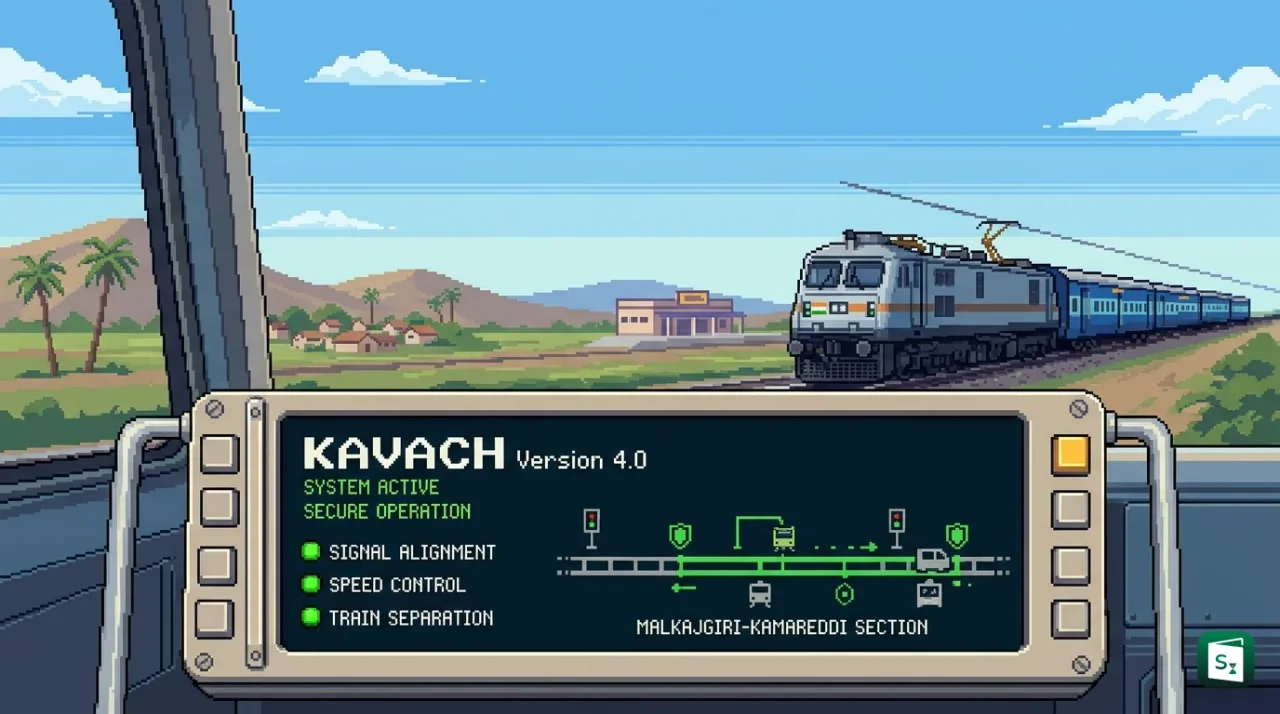
Indian Railways has commissioned the indigenous Kavach Version 4.0 for the first time on the South Central Railway, covering 108 route kilometres on the Malkajgiri-Kamareddi section of the Hyderabad Division in Telangana. The work involved an upgrade of the existing Kavach Version 3.2 to Version 4.0. The debut marks a key step in the national rollout of India’s home grown automatic train protection system for safer and faster train operations.
What Is Kavach in Indian Railways?
Kavach, which means armour in Hindi, is Indian Railways own Automatic Train Protection (ATP) system. It is an electronic safety system that stops a train automatically if the loco pilot misses a red signal, exceeds the speed limit or faces a risk of collision with another Kavach fitted train.
Kavach is fully indigenous. The Research Designs and Standards Organisation (RDSO), the research arm of Indian Railways headquartered at Lucknow and established in 1957, developed it in partnership with three Indian firms. It was first called the Train Collision Avoidance System (TCAS). Field trials on passenger trains began in February 2016, and Kavach was adopted as the National ATP system in July 2020.
Kavach carries the highest safety approval for such systems, known as Safety Integrity Level 4 (SIL-4). This certification means the chance of a dangerous failure is extremely low, stated as once in 10,000 years. The system also helps trains run safely in low visibility conditions such as dense fog, when a pilot finds it hard to see trackside signals.
First Kavach 4.0 Commissioning on South Central Railway
The South Central Railway, headquartered at Secunderabad, has commissioned Kavach Version 4.0 over 108 route kilometres between Malkajgiri and Kamareddi in the Hyderabad Division. This is the first commissioning of Version 4.0 on this zone. The General Manager of South Central Railway inspected the upgraded stretch on 22 September 2026 by travelling in a special train and checked the working of the system in different safety situations.
The importance of this stretch lies in its history. South Central Railway was the testing ground for the earlier Kavach Version 3.2, which was deployed over 1,465 route kilometres in the zone. Engineers used the lessons from those trials to improve the design. The Malkajgiri-Kamareddi work therefore involved replacing and upgrading existing Version 3.2 equipment to Version 4.0 standards, rather than building from zero.
The zone is now preparing for a much larger upgrade. Tenders have been invited to convert Version 3.2 to Version 4.0 on major routes such as the 960 km Ankai-Nanded-Dharmabad-Nizamabad-Secunderabad-Kurnool City-Dhone-Guntakal section, the 331 km Parbhani-Parli Vaijnath-Latur Road-Bidar-Vikarabad section and the 174 km Wadi-Vikarabad-Sanatnagar section. Work is also planned on 1,618 km of high density routes shared with the newly formed South Coast Railway.
How the Kavach System Works
Kavach continuously checks where a train is, how fast it is moving and what the next signal shows. If the loco pilot does not act in time, Kavach applies the brakes on its own. This action prevents three common causes of accidents, which are jumping a red signal, over speeding and collision between two trains.
The system works through five linked parts on the track and on the train. Radio Frequency Identification (RFID) tags fixed between the rails tell the train its exact location and direction. Station Kavach units at every station and block section collect signal and route information. Telecom towers and Optical Fibre Cable (OFC) carry this information quickly between stations and trains. Loco Kavach, a computer placed in the locomotive, receives the data, calculates the safe speed and connects directly to the braking system.
Indian Railways explains that Kavach prevents Signal Passing at Danger (SPAD), which means crossing a red signal, and controls speed on loop lines and at permanent speed restriction spots. It also gives protection against head on and rear end collisions through direct radio contact between two Kavach fitted locomotives. Additional features include an SOS function to stop trains in an emergency, automatic whistling at level crossing gates and cab signalling that shows signal information inside the driving cab during fog or heavy rain.
What Is New in Kavach Version 4.0?
Kavach Version 4.0 is the improved specification for large scale use across the diverse Indian network. The RDSO approved the Version 4.0 specification on 16 July 2024 under document number RDSO/SPN/196/2020. The approval followed trials and an independent safety assessment by an Independent Safety Assessor (ISA). The new version is cleared for speeds up to 160 kmph, which supports the Mission Raftaar plan to raise speeds on the Delhi-Mumbai and Delhi-Howrah trunk routes.
Four upgrades separate Version 4.0 from Version 3.2. The system gives higher location accuracy for exact train positioning. It gives better information on signal aspects in large and complex yards, where many tracks and signals meet. It provides a station to station interface over OFC for faster and more reliable communication. It also connects directly with the existing Electronic Interlocking System, which is the computer based system that sets routes and signals at a station.
| Feature | Kavach Version 3.2 | Kavach Version 4.0 |
|---|---|---|
| Deployment base | 1,465 route km on South Central Railway as pilot | Planned for national rollout on high density routes |
| Location accuracy | Basic RFID based positioning | Increased accuracy for precise positioning |
| Large yards | Limited signal information | Improved signal information in bigger yards |
| Station link | Standalone station units | Station to station interface on OFC |
| Signalling link | Indirect link | Direct interface to Electronic Interlocking |
| Speed readiness | Lower speed design | Ready for 160 kmph operations |
Kavach is often compared with the European Train Control System (ETCS), which is the standard train protection system in Europe. Indian Railways notes that Kavach offers similar core safety functions at a much lower cost and is designed for Indian conditions such as mixed traffic, large yards and high density operations.
Nationwide Rollout, Cost and Institutional Framework
Indian Railways has moved Kavach 4.0 from trials to large scale commissioning on the busiest corridors. Indian Railways had commissioned Kavach Version 4.0 on 2,633 route kilometres as on 31 July 2026, with 1,423 route km on the Delhi-Mumbai route and 1,210 route km on the Delhi-Howrah route. The programme also recorded a peak of 472.3 route km commissioned in January 2026 across the Vadodara-Virar, Tughlakabad-Palwal and Manpur-Sarmatanr sections. In addition, trackside implementation is under way on 21,794 route km covering the Golden Quadrilateral, Golden Diagonal and high density networks.
The physical progress shows the scale of work involved. The table below reflects the status reported up to mid 2026.
| Item | Progress |
|---|---|
| Optical Fibre Cable laid | 11,547 km |
| Telecom towers installed | 1,721 numbers |
| Kavach provided at stations | 1,009 stations |
| Trackside equipment installed | 7,726 route km |
| Kavach fitted in locomotives | 6,290 locomotives |
| Locomotives under fitting | 7,190 locomotives plus 1,200 EMU and MEMU coaches |
The institutional system behind Kavach is fully Indian. The RDSO sets the specification and approves vendors. Production and fitting involve Indian manufacturers and locomotive works such as Chittaranjan Locomotive Works (CLW) and Integral Coach Factory (ICF) at Chennai. At present, three original equipment makers are approved for Version 3.2 and Version 4.0, and trials for more makers are at different stages to increase capacity. Training is provided through central institutes in coordination with the Indian Railways Institute of Signal Engineering and Telecommunications (IRISET), which was set up at Secunderabad in 1957. More than 20,000 technicians, operators and engineers have been trained so far, and 69 loco sheds have been prepared for fitting work.
Cost and funding remain central to the rollout. The trackside cost including station equipment is about ₹50 lakh per km, while Kavach equipment on a locomotive costs about ₹80 lakh per loco. Indian Railways had used ₹3,875 crore on Kavach works up to June 2026. The budget allocation for 2026-27 is ₹2,066 crore, with the Railway Ministry stating that funds will be provided as per progress. Successful trials at 160 kmph with a Vande Bharat trainset on the Chipyana Buzurg-Tundla section show that Kavach 4.0 is being aligned with higher speeds and with modern trainsets fitted at the manufacturing stage.
Key Takeaways
- Kavach Version 4.0 was commissioned for the first time on South Central Railway on the 108 route km Malkajgiri-Kamareddi section of Hyderabad Division.
- Kavach is the indigenous Automatic Train Protection system developed by RDSO and adopted as the National ATP system in July 2020.
- The RDSO approved Kavach Version 4.0 on 16 July 2024 with higher location accuracy, OFC based station link and direct electronic interlocking interface.
- Kavach carries SIL-4 safety certification and prevents red signal crossing, over speeding and head on and rear end collisions.
- Indian Railways had commissioned Kavach 4.0 on 2,633 route km as on 31 July 2026, with trackside cost of about ₹50 lakh per km and loco cost of about ₹80 lakh per loco.