
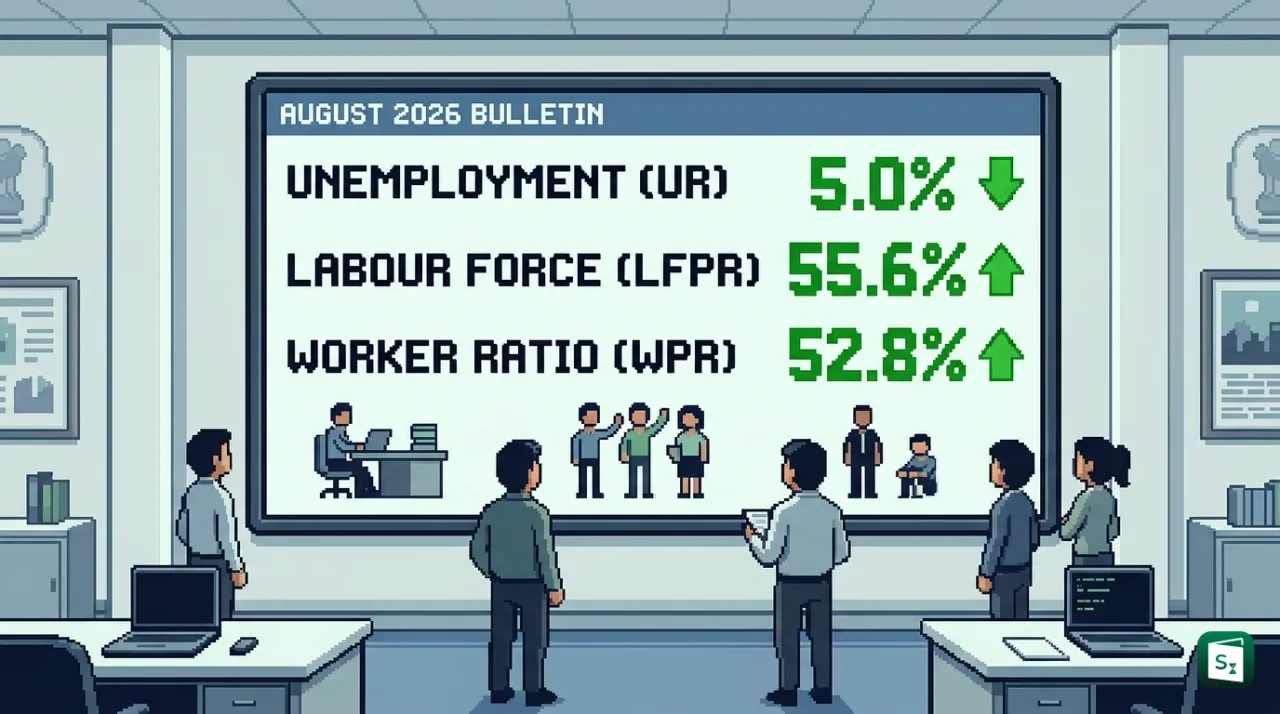
The National Statistical Office released the 17th Periodic Labour Force Survey Monthly Bulletin for August 2026 on 15 September 2026. The bulletin reports the overall unemployment rate in India for persons aged 15 years and above at 5.0 percent, while the Labour Force Participation Rate rose to 55.6 percent and the Worker Population Ratio rose to 52.8 percent. Rural areas drove the improvement, with rural unemployment falling to its lowest level since January 2026.
What Is the Unemployment Rate in India and How Is It Measured?
The unemployment rate in India is the percentage of persons in the labour force who are unemployed but seeking or available for work. It is calculated as the number of unemployed persons divided by the total labour force (employed plus unemployed), multiplied by 100. The rate therefore falls when more labour force members find work, even if the labour force itself grows.
The Periodic Labour Force Survey (PLFS) reports three linked indicators together. The Labour Force Participation Rate (LFPR) is the percentage of persons in the labour force in the total population. The Worker Population Ratio (WPR) is the percentage of employed persons in the total population. The Unemployment Rate (UR) is the percentage of unemployed persons in the labour force. In simple terms, LFPR shows how many people are offering their labour, WPR shows how many actually have work, and UR shows how many seekers could not find work.
| Indicator | What It Measures | Formula in Simple Form |
|---|---|---|
| LFPR | Share of population in labour force | (Employed plus unemployed divided by total population) multiplied by 100 |
| WPR | Share of population that is employed | (Employed divided by total population) multiplied by 100 |
| UR | Share of labour force that is unemployed | (Unemployed divided by labour force) multiplied by 100 |
What Is the Periodic Labour Force Survey?
The Periodic Labour Force Survey, universally known as PLFS, is the primary official source of employment and unemployment data in India. The National Statistical Office (NSO) conducts the survey under the Ministry of Statistics and Programme Implementation (MoSPI). The survey was launched in April 2017 by the then National Sample Survey Office to replace the earlier five yearly employment surveys and to provide faster and more frequent labour market data.
The PLFS methodology was revised from January 2025 to meet the demand for high frequency data. Under the revised system, the NSO releases monthly estimates of LFPR, WPR and UR at the all India level for rural and urban areas separately. The NSO also releases quarterly estimates with coverage for major states and union territories, along with the detailed annual report covering July to June. The August 2026 release is the 17th Monthly Bulletin in this new series.
Monthly bulletins use the Current Weekly Status (CWS) approach. CWS records the activity of each person during the seven days before the survey date. A person who worked for at least one hour on at least one day is counted as employed. A person who did no work but sought work or was available for work for at least one hour on any day is counted as unemployed. This short reference window makes the monthly series sensitive to seasonal and short term changes. The August 2026 estimates are based on responses from 3,70,160 persons, including 2,11,353 persons in rural areas and 1,58,807 persons in urban areas.
Labour Force Participation Rate Rises to 55.6 Percent
The Labour Force Participation Rate (LFPR) for persons aged 15 years and above rose to 55.6 percent in August 2026 from 55.4 percent in July 2026. The increase came entirely from rural India. Rural LFPR moved up to 58.2 percent from 58.0 percent, while urban LFPR stayed unchanged at 50.4 percent. A higher LFPR means a larger share of the population is either working or looking for work, which is generally read as a sign of confidence in job availability.
The year on year picture shows the same rural led pattern. Overall LFPR rose by 0.6 percentage point from 55.0 percent in August 2025. Rural LFPR rose by 1.2 percentage points from 57.0 percent to 58.2 percent over the same period. Urban LFPR declined by 0.5 percentage point from 50.9 percent to 50.4 percent, which shows that cities have not yet matched the rural recovery in participation.
| LFPR for Age 15 Plus (CWS) | August 2026 | July 2026 | August 2025 |
|---|---|---|---|
| All India | 55.6 percent | 55.4 percent | 55.0 percent |
| Rural | 58.2 percent | 58.0 percent | 57.0 percent |
| Urban | 50.4 percent | 50.4 percent | 50.9 percent |
Worker Population Ratio Reaches 52.8 Percent
The Worker Population Ratio (WPR) for persons aged 15 years and above increased to 52.8 percent in August 2026 from 52.5 percent in July 2026. This is the highest level recorded since March 2026. The rise was driven by rural hiring and self employment during the kharif season, when farm and allied activities create more work. Rural WPR increased to 55.8 percent from 55.4 percent, while urban WPR held steady at 47.0 percent.
Compared with August 2025, overall WPR is higher by 0.6 percentage point, up from 52.2 percent. Rural WPR is higher by 1.3 percentage points, up from 54.5 percent. Urban WPR is lower by 0.5 percentage point, down from 47.5 percent. The contrast confirms that the current employment gain is concentrated in villages, while urban employment has stabilised without clear growth.
| WPR for Age 15 Plus (CWS) | August 2026 | July 2026 | August 2025 |
|---|---|---|---|
| All India | 52.8 percent | 52.5 percent | 52.2 percent |
| Rural | 55.8 percent | 55.4 percent | 54.5 percent |
| Urban | 47.0 percent | 47.0 percent | 47.5 percent |
Unemployment Rate Eases to 5.0 Percent
The overall Unemployment Rate (UR) for persons aged 15 years and above eased to 5.0 percent in August 2026 from 5.1 percent in July 2026. Rural unemployment recorded a clear fall from 4.5 percent to 4.1 percent, the lowest rural rate since January 2026. Urban unemployment remained broadly stable at 6.8 percent compared with 6.7 percent in July. Since LFPR and WPR rose together while UR fell, the August data points to genuine job absorption rather than people leaving the labour force.
A comparison with August 2025 shows stability at the national level. The overall UR and the urban UR remained broadly unchanged over the year. Rural UR declined by 0.2 percentage point from 4.3 percent to 4.1 percent. The gender split also improved in August. The male UR fell for the third straight month to 4.9 percent from 5.4 percent in May 2026, with rural male UR down to 4.3 percent from 4.6 percent and urban male UR slightly up to 6.1 percent from 5.9 percent. The female UR fell for the second straight month to 5.1 percent from 5.9 percent in June 2026, with rural female UR down to 3.9 percent from 4.3 percent.
| UR for Age 15 Plus (CWS) | August 2026 | July 2026 | August 2025 |
|---|---|---|---|
| All India | 5.0 percent | 5.1 percent | Stable year on year |
| Rural | 4.1 percent | 4.5 percent | 4.3 percent |
| Urban | 6.8 percent | 6.7 percent | Stable year on year |
Female Labour Force Participation Shows Upward Momentum
The overall female LFPR for women aged 15 years and above rose to 34.8 percent in August 2026 from 34.4 percent in July 2026. Rural women accounted for most of the gain, with rural female LFPR rising to 39.4 percent from 38.8 percent. Urban female LFPR was broadly stable at 25.4 percent compared with 25.3 percent in July. The steady rise in rural female participation explains much of the national increase in both LFPR and WPR.
The annual change underlines the same trend. Overall female LFPR is higher by 1.1 percentage points from 33.7 percent in August 2025. Rural female LFPR is higher by 2.0 percentage points from 37.4 percent to 39.4 percent. Urban female LFPR is lower by 0.7 percentage point from 26.1 percent to 25.4 percent. Overall female WPR also improved to 33.0 percent from 32.0 percent a year ago. The wide gap between rural and urban female participation reflects greater engagement of rural women in agriculture and allied work, while urban women continue to face constraints linked to care duties, mobility and availability of regular jobs.
Key Takeaways
- The 17th PLFS Monthly Bulletin for August 2026 was released on 15 September 2026 by the National Statistical Office under MoSPI.
- The overall Unemployment Rate for age 15 plus stood at 5.0 percent in August 2026, with rural UR at 4.1 percent and urban UR at 6.8 percent.
- The overall Labour Force Participation Rate rose to 55.6 percent in August 2026, with rural LFPR at 58.2 percent and urban LFPR at 50.4 percent.
- The overall Worker Population Ratio rose to 52.8 percent, the highest level since March 2026, with rural WPR at 55.8 percent.
- Overall female LFPR increased to 34.8 percent, led by rural female LFPR at 39.4 percent, while urban female LFPR stood at 25.4 percent.
- Monthly PLFS estimates use the Current Weekly Status method with a seven day reference period and covered 3,70,160 persons in August 2026.