

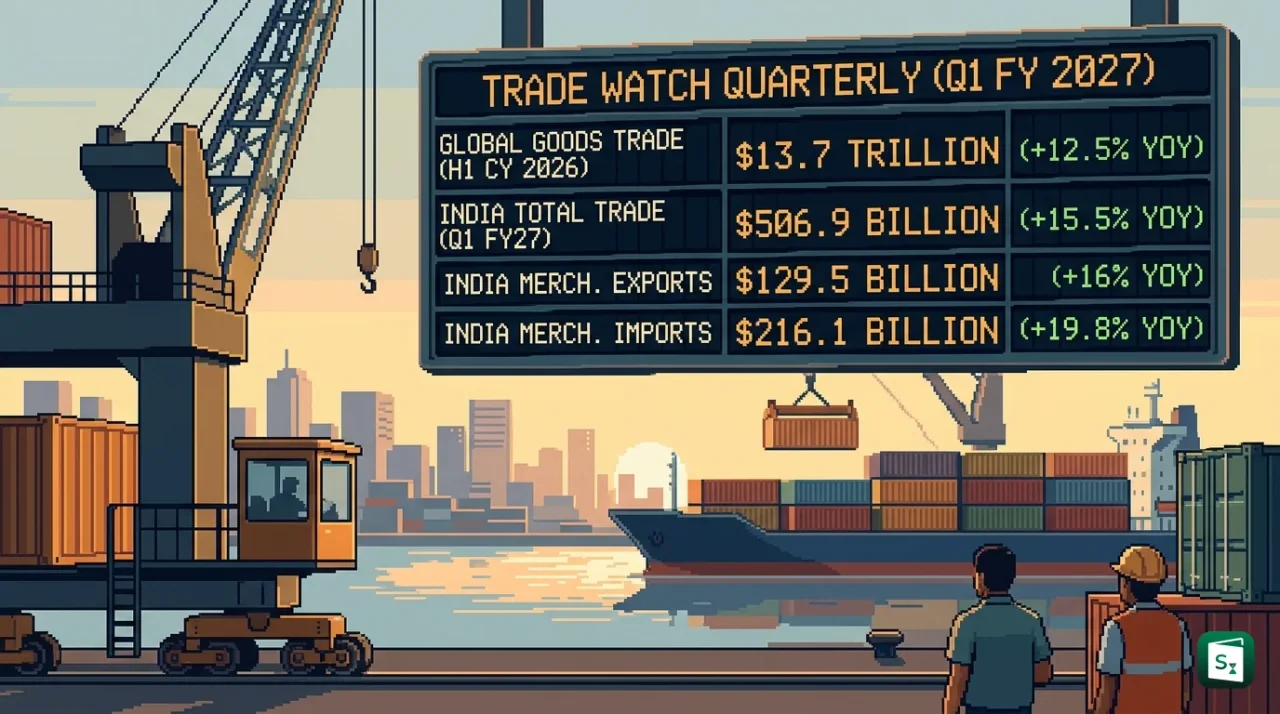
NITI Aayog released the 9th edition of Trade Watch Quarterly for Q1 FY27 (April to June 2026) on 16 September 2026 in New Delhi. The report places India total merchandise and services trade at $506.9 billion in the quarter, a 15.5% rise over the previous year, even as global goods trade touched $13.7 trillion. Its special theme is India metals and ores trade, a sector central to manufacturing, infrastructure and clean energy.
What Is Trade Watch Quarterly?
Trade Watch Quarterly is a quarterly knowledge product of NITI Aayog that tracks India merchandise and services trade against global trends and adds a deep study of one sector in every edition. The 9th edition covers Q1 FY27, which is April to June 2026, reviews global goods and services trade in the first half of calendar year 2026, and presents a thematic analysis of metals and ores trade.
NITI Aayog stands for the National Institution for Transforming India. The Union Government set it up on 1 January 2015 to replace the Planning Commission, which had been created through a Cabinet resolution on 15 March 1950. NITI Aayog works as the policy think tank of the central government, is headquartered in New Delhi, and is chaired by the Prime Minister. The 9th edition was released on 16 September 2026 by Vice Chairperson Ashok Kumar Lahiri (as of September 2026) along with senior officials.
Earlier editions have covered sectors such as automotive exports, electronics, gems and jewellery and pharmaceuticals. This continuity makes the series a regular health check of India export competitiveness, import dependence and participation in global value chains. Global value chains refer to the full chain of design, parts, assembly and marketing spread across countries to make a final product.
India Trade Overview in Q1 FY27
NITI Aayog reports that global goods trade reached $13.7 trillion in the first half of calendar year 2026, with 12.5% year on year growth, while global services trade grew by 10.5%. Global trade stayed resilient despite geopolitical tension and policy uncertainty. Against this background, the report says India merchandise and services trade grew faster than world trade.
India total trade, which means exports plus imports of both goods and services, rose to $506.9 billion in Q1 FY27 from $438.9 billion in the same quarter last year. That is a growth of 15.5%. Total exports in the quarter stood at $236.2 billion, up 13%, while total imports stood at $270.6 billion, up 17.8%.
| Indicator for Q1 FY27 (April to June 2026) | Value | Year on Year Growth |
|---|---|---|
| Total merchandise and services trade | $506.9 billion | 15.5% |
| Total exports (goods plus services) | $236.2 billion | 13% |
| Total imports (goods plus services) | $270.6 billion | 17.8% |
| Global goods trade in H1 calendar year 2026 | $13.7 trillion | 12.5% |
| Global services trade in H1 calendar year 2026 | Expansion | 10.5% |
The report also records strong services performance. Services exports rose by 9.6% to $106.75 billion, while services imports rose by 10.2% to $54.53 billion. This left a services surplus of about $52.2 billion, which partly offsets the deficit on the goods side. A trade deficit means imports are larger than exports, while a surplus means exports are larger than imports.
How Did Merchandise Exports and Imports Perform?
Merchandise trade means trade in physical goods, as distinct from services such as software and transport. NITI Aayog reports that India merchandise exports grew by 16% to $129.5 billion in Q1 FY27, while merchandise imports grew by 19.8% to $216.1 billion. The gap between the two produced a merchandise trade deficit of $86.6 billion, about 26% higher than a year ago.
In June 2026 alone, merchandise exports rose by 15.4% to $40.38 billion, while imports jumped by 30.9% to $70.8 billion. Ministry of Commerce and Industry data for the same quarter show the same broad picture, with cumulative merchandise exports at $129.32 billion. The small difference from the NITI Aayog figure reflects revisions and rounding across data sources.
The leading export groups in Q1 FY27 were mineral fuels, electrical machinery and parts, and nuclear reactors, boilers and machinery. The top five commodity groups together earned $85.7 billion, up 19.3%. On the import side, mineral fuels led with a 32.2% share, followed by electrical machinery at 15.1% and nuclear reactors and boilers at 10.6%. Nine of the ten leading import groups grew, with nuclear reactors and boilers up 35.7% and electrical machinery up 33.2%. Iron and steel was the only leading import to fall, down 7.2%.
The report also highlights two bright spots. Trade with free trade agreement partners recorded 36.3% growth in exports. India digitally delivered services exports rose from around $277 billion in 2024 to $317 billion in 2025, with 15% growth, moving India from the fifth to the fourth largest exporter of such services after the United States, the United Kingdom and Ireland.
Metals and Ores Trade: Why This Theme Matters
Metals are processed materials such as iron, steel, aluminium and copper, while ores are the natural rocks from which metals are extracted. The 9th edition of Trade Watch Quarterly focuses on India metals and ores trade because these materials form the base for manufacturing, infrastructure, energy transition and advanced industries such as electric vehicles, solar panels, batteries, semiconductors and defence equipment.
Global imports of metals and ores rose from $1.2 trillion in 2015 to nearly $2 trillion in 2025. This market now accounts for about 7.5% of world merchandise imports. India has one of the largest mineral resource bases in the world and is a leading producer of several important ores. Yet India metals and ores exports rose only from $21.8 billion to $36.8 billion in the same period, so India share of global demand moved only from 1.7% to 1.8%.
India metals exports alone stood at $34.8 billion in 2025. Three groups dominate this basket. Iron and steel, articles of iron and steel, and aluminium together account for about 78% of metal exports. Iron and steel exports reached $9.9 billion, articles of iron and steel reached $10.6 billion, and aluminium reached $6.8 billion. Aluminium is the fastest growing segment, with India share of world aluminium demand rising from 1.7% in 2015 to 2.6% in 2025.
Where Does India Stand in the Global Metals Market?
The global metals and ores market is worth $2 trillion in imports, but India supplies only $36.8 billion, or 1.8% of that demand. The split is 2.1% in metals and only 0.5% in ores. This shows that India strength lies in processing and making finished metal goods rather than in supplying raw ores.
Demand is concentrated in a few products. Iron and steel and articles of iron and steel alone make up 50.9% of global metals demand, but India captures only 2.5% of this segment. India export shares in iron and steel have stayed largely flat. By contrast, India share in global lead exports has risen to 12.1%, helped by a strong recycling system.
The bigger challenge is the shift in world demand toward high value non ferrous metals. Non ferrous metals are metals other than iron and steel, such as copper, aluminium, nickel, lead and tin. Global demand is moving toward copper, aluminium and nickel for power cables, electric vehicles and electronics. India copper exports were only $2.9 billion in 2025, about 1.1% of world copper imports. Exports of nickel, tin and copper products remain small, which limits India presence in future growth areas.
Trade partners are also concentrated. The United States takes 10% to 30% of India exports across major metal categories. China supplies 25% to 43% of India imports across leading metal categories. This concentration makes supply chains sensitive to policy changes in a few countries.
Why Is Import Dependence Deepening for Critical Minerals?
Critical minerals are minerals essential for clean energy, electronics and defence and with a high risk of supply disruption, such as lithium, cobalt, nickel, graphite and rare earth elements. NITI Aayog finds that India import dependence in this group is rising because domestic demand from factories, infrastructure and energy transition has grown faster than domestic mining and processing capacity.
India metals and ores imports nearly doubled from $32.2 billion in 2015 to $60.5 billion in 2025. Iron and steel form 32.1% of the metal import basket, copper forms 23.1%, aluminium forms 19.2% and articles of iron and steel form 11%. Copper imports more than tripled, from $3.2 billion to $11.8 billion, growing at about 13.9% per year. India meets about 96% of its copper ore and concentrate needs through imports, with only about 4% met from domestic sources.
Dependence is complete for some battery minerals. India remains 100% import dependent for nickel, cobalt and lithium. In 2025, China supplied 26.2% of India nickel imports and 34.3% of lithium carbonate imports. Equity inflows of foreign direct investment into mining stood at only $3.5 billion between 2000 and 2025, which the report cites as a sign of weak investment in exploration and processing.
To address this gap, the Union Government approved the National Critical Mineral Mission in January 2025 with an outlay of ₹16,300 crore for the period 2024-25 to 2030-31. The mission plans 1,200 exploration projects, auction of 100 critical mineral blocks, acquisition of at least 50 overseas assets, four processing parks, three centres of excellence and a national stockpile of at least five critical minerals. It also promotes recycling, research and faster clearances.
What Is the Way Forward for Metals Competitiveness?
The report links future growth to stronger domestic value addition, which means processing raw ore into refined metal and finished goods inside India instead of exporting low value material and importing high value inputs. It calls for better geological data, faster auction and start of mining in lapsed blocks, simpler mining and forest clearances, and lower logistics and export finance costs. It also asks for wider access to low cost renewable power for metal plants, since power is a large part of smelting cost.
Two global trade factors add urgency. The European Union Carbon Border Adjustment Mechanism, known as CBAM, is a charge on the carbon emitted while making imported goods. It entered its final phase on 1 January 2026 and covers cement, iron and steel, aluminium, fertilisers, electricity and hydrogen. Indian steel and aluminium exports to the European Union fell by 24.4% in 2024-25 as buyers factored in future carbon costs. India will need verified plant level emission data, use of scrap and cleaner fuels, and readiness for carbon accounting to protect market access.
The report also suggests stronger rules of origin under free trade agreements, targeted safeguards when a surge in imports hurts domestic producers, support for recycling of critical minerals, help for firms to buy overseas mineral assets, and investment in advanced materials. Together, these steps aim to lift India share beyond 1.8% of the $2 trillion market, cut dependence on a few suppliers, and link mining reform to clean manufacturing.
Key Takeaways
- The 9th Trade Watch Quarterly for Q1 FY27 (April to June 2026) was released on 16 September 2026 with the theme of metals and ores trade.
- Global goods trade reached $13.7 trillion in H1 calendar year 2026 with 12.5% growth, while India total merchandise and services trade reached $506.9 billion with 15.5% growth.
- India merchandise exports rose 16% to $129.5 billion and imports rose 19.8% to $216.1 billion in Q1 FY27, creating a merchandise deficit of $86.6 billion.
- India supplies only 1.8% of the $2 trillion global metals and ores import market, with 78% of its metal exports from iron and steel, articles of iron and steel and aluminium.
- India metals and ores imports doubled from $32.2 billion in 2015 to $60.5 billion in 2025, with 100% import dependence for nickel, cobalt and lithium.
- The National Critical Mineral Mission, approved in January 2025, targets 1,200 exploration projects and auction of 100 blocks by 2030-31.