

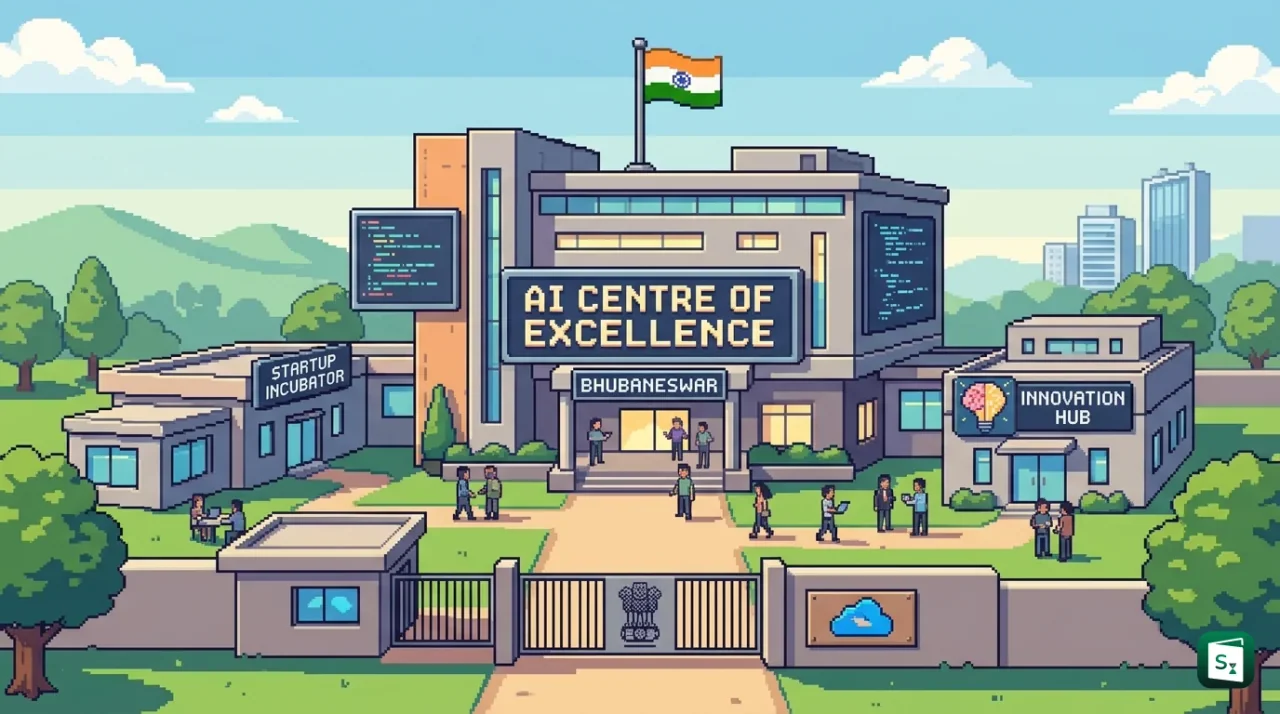
The Ministry of Electronics and Information Technology has granted in-principle approval for an IndiaAI Centre of Excellence in Bhubaneswar, Odisha. The Software Technology Parks of India will implement the centre in partnership with Blue Cloud Softech Solutions, which will contribute ₹4 crore and mentor startups. The hub will function as a national level centre for AI innovation, incubation and deployment of practical solutions under the IndiaAI Mission.
What Is an AI Centre of Excellence?
An AI Centre of Excellence (AI CoE) is a focused hub where government bodies, academic institutions, startups and industry jointly build, test and spread artificial intelligence solutions. It provides shared infrastructure, mentoring, incubation support and market links to convert research ideas into working products for health, farming, governance and other sectors.
The Bhubaneswar centre follows this national model. It will not function only as a research lab. It will act as a solution deployment hub, where startups can develop prototypes, test them with real users and government departments, and then scale them across India. Industry participation is central to this design, because companies bring ready platforms, engineering talent and customer networks that young startups often lack.
India already hosts several such centres. The Ministry of Education set up three AI CoEs in Healthcare, Agriculture and Sustainable Cities in October 2024 with an outlay of ₹990 crore for five years, led by AIIMS with IIT Delhi, IIT Ropar and IIT Kanpur. A fourth CoE for Education was announced in Budget 2025. The Software Technology Parks of India also runs more than 20 domain specific CoEs in areas such as fintech, Internet of Things and medical technology. The Bhubaneswar AI CoE adds an eastern India hub to this growing national network.
National AI Policy Context and Mission Alignment
The Bhubaneswar AI CoE is being developed under the IndiaAI Mission, the national programme for artificial intelligence administered by the Ministry of Electronics and Information Technology. The Union Cabinet approved the mission on 7 March 2024 with a budget outlay of ₹10,371.92 crore for five years. Its stated vision is Making AI in India and Making AI Work for India, which means building domestic computing strength while ensuring that AI benefits reach farmers, students, patients and small businesses.
The IndiaAI Mission is implemented by IndiaAI, an Independent Business Division under the Digital India Corporation. The mission rests on seven pillars that cover computing power, data, models, applications, skills, startup funding and safety. Together, these pillars aim to lower the cost of computing, improve access to quality datasets, create home grown models in Indian languages, and support responsible use of AI.
| Pillar | What It Does |
|---|---|
| IndiaAI Compute Capacity | Builds shared graphics processing units (GPUs) infrastructure through public private partnership and offers it at low cost, reported at about ₹65 per hour after subsidy |
| IndiaAI Innovation Centre | Supports research and development of foundational models and centres of excellence |
| IndiaAI Datasets Platform (AIKosh) | Provides unified access to non personal datasets for startups and researchers |
| IndiaAI Application Development Initiative | Funds AI solutions for health, farming, governance, education and disaster management |
| IndiaAI FutureSkills | Expands AI courses, fellowships and Data and AI Labs in Tier 2 and Tier 3 cities |
| IndiaAI Startup Financing | Gives streamlined funding and global expansion support to deep tech AI startups |
| Safe and Trusted AI | Develops tools, guidelines and the IndiaAI Safety Institute for responsible AI |
Progress under the mission has been rapid. Against an initial target of 10,000 GPUs, more than 38,000 GPUs have been empanelled through cloud providers. The mission has also selected companies to build Indian foundation models, including Sarvam AI, Soket AI, Gnani AI and Gan AI in the first phase, and launched the IndiaAI Startups Global programme in March 2025. The Bhubaneswar hub will plug directly into this pipeline by giving eastern Indian startups access to mentoring, infrastructure and deployment pathways.
Nodal Ministry Profile and Approval Authority
MeitY stands for the Ministry of Electronics and Information Technology. It is the stand alone ministry of the central government responsible for policy on electronics, information technology, digital governance, emerging technologies and cyber security. MeitY was created as an independent ministry on 19 July 2016, and it is headquartered in New Delhi.
MeitY has granted in-principle approval for the Bhubaneswar AI CoE on the recommendation of the Government of Odisha. In-principle approval means the central government has accepted the proposal in broad terms and allowed the implementing agency to move ahead with detailed planning and a formal agreement. The next step is a definitive Memorandum of Understanding between the Software Technology Parks of India and the industry partner, which will fix financial terms, space, timelines and operating roles. MeitY oversees the IndiaAI Mission through IndiaAI, while implementation on the ground is handled by its attached bodies such as the Software Technology Parks of India, the National Informatics Centre and the Centre for Development of Advanced Computing.
Implementing Agency Framework and STPI Mandate
STPI stands for the Software Technology Parks of India. It is an autonomous society set up by MeitY in 1991 to promote software exports, information technology enabled services and tech entrepreneurship. STPI began with three parks at Bhubaneswar, Bengaluru and Pune, and it now operates 73 centres with 14 jurisdictional directorates, most of them in Tier 2 and Tier 3 cities. STPI registered units contributed software exports worth about ₹10.69 lakh crore in 2024-25, which is close to half of national software exports.
STPI has built a clear record of running incubation centres and Centres of Excellence with state governments and private partners. Its tools include plug and play office space, high speed data links, labs for testing, seed support through the Next Generation Incubation Scheme (NGIS) and mentoring networks. The STPINEXT company, a Section 8 vehicle, supports research, product development and Industry 4.0 work.
STPI Bhubaneswar is one of the oldest centres in this network. It was set up in 1990 and serves Odisha, Bihar and Jharkhand, with sub centres at Berhampur, Rourkela, Balasore, Jajpur and Jeypore. Units under its jurisdiction contributed ₹3,840 crore in IT, IT enabled services and electronics exports in 2024-25. The centre also hosts an Electropreneur Park for electronics hardware and the first Fab Lab in a Tier 2 city. For the new AI CoE, STPI has set aside close to 10,000 square feet of space in Bhubaneswar and will anchor day to day operations, startup selection and links to government departments.
Industry Partner Profile and Deployment Role
Blue Cloud Softech Solutions Limited is a Hyderabad based technology company listed on the NSE (National Stock Exchange) and BSE (Bombay Stock Exchange). It describes itself as an AI first company working in artificial intelligence, cloud, cyber security, health technology and digital infrastructure. The company has reported consolidated revenue of ₹1,002 crore and profit after tax of ₹60.50 crore for the year ended March 2026, and it holds a national Internet Service Provider authorisation for cloud and connectivity work.
STPI has confirmed Blue Cloud as the industry partner for the Bhubaneswar AI CoE. Under the proposed agreement, the company will contribute ₹4 crore toward development of the centre and provide industry leadership, mentoring and strategic support to startups. The company plans to open its existing platforms to incubated teams. These include BluHealth, a camera based system for non invasive health screening, Blura SAGA and SOCEYE for public safety and governance, and Access Genie for sovereign AI and 5G infrastructure. This approach allows startups to build on tested tools and reach government and enterprise buyers faster, instead of starting from zero.
Location Profile and Regional Implementation in Odisha
Bhubaneswar, the capital of Odisha, has grown into a leading Tier 2 technology cluster in eastern India. The city already hosts STPI infrastructure, central research links and a rising base of startups, engineering colleges and IT services units. Its location makes it a natural gateway for technology spread to coastal and tribal districts as well as to neighbouring states under the STPI Bhubaneswar jurisdiction.
The AI CoE will focus on applied problems with national use and local relevance. Priority areas include healthcare, governance, disaster management, education and industrial applications. Given the Odisha context, the centre will also support work on ocean and tidal energy, coastal fisheries, and women and child development. This mix connects the national goals of the IndiaAI Mission with the needs of a coastal state that faces cyclones, marine livelihood pressures and gaps in last mile service delivery. Real time data tools, early warning models and simple citizen services built in Bhubaneswar can be tested locally and then deployed in other states.
The timing also fits Odisha’s wider push for technology investment. In July 2026 the state signed agreements with HCLTech for a Global Technology Center for 5,000 professionals and an AI Data Center in the planned Odisha Sovereign AI Park with a proposed outlay of about ₹14,257 crore. The new AI CoE adds a startup and research layer to this infrastructure push.
Startup Incubation and Innovation Ecosystem
The Bhubaneswar centre is designed as a full incubation pipeline rather than a one time grant scheme. Startups will get physical workspace, access to computing and datasets through the IndiaAI Mission, technical mentoring from STPI and Blue Cloud engineers, and help with product testing, compliance and customer discovery. The model draws on STPI’s experience with NGIS, which supports startups from 12 incubation facilities with seed funding and market links.
For AI startups in India, the main barriers are high computing costs, limited access to quality data and weak early demand from paying users. The CoE model tries to reduce all three barriers at once. Shared GPUs lower training costs, the AIKosh datasets platform improves data access, and direct links to Odisha government departments create test beds in hospitals, schools, urban bodies and disaster response units. Successful pilots can then move to wider rollout through central and state schemes. Attention to safe and trusted AI, including guidelines released in November 2025, will also guide startups on privacy, bias testing and responsible deployment.
The Way Forward
The immediate step is the signing of the definitive Memorandum of Understanding between STPI and Blue Cloud Softech Solutions. That document will lock in the ₹4 crore contribution, governance structure, intellectual property rules and the schedule for opening calls for startups. After that, the focus will shift to filling the 10,000 square feet facility, setting up labs, and announcing the first cohort in health, governance, education and disaster management.
In the medium term, success will depend on clear measures. Useful markers will include the number of startups incubated, products moved from prototype to field use, government pilots completed, jobs created in Bhubaneswar, and private funds raised by incubated teams. Close coordination with the IndiaAI Mission’s compute, datasets and financing pillars will decide whether the centre remains a local facility or grows into a true national hub for AI solution deployment.
Key Takeaways
- MeitY granted in-principle approval for the IndiaAI Centre of Excellence in Bhubaneswar, Odisha on the recommendation of the Government of Odisha.
- The centre will be implemented by STPI, set up in 1991, with Blue Cloud Softech Solutions as industry partner contributing ₹4 crore.
- The IndiaAI Mission was approved on 7 March 2024 with an outlay of ₹10,371.92 crore and rests on seven pillars including compute, datasets and safe AI.
- STPI Bhubaneswar, set up in 1990, will host the hub in about 10,000 square feet and support focus areas such as health, governance, disaster management and education.
- The earlier national AI CoEs for Healthcare, Agriculture and Sustainable Cities were approved with ₹990 crore and are led by AIIMS with IIT Delhi, IIT Ropar and IIT Kanpur.