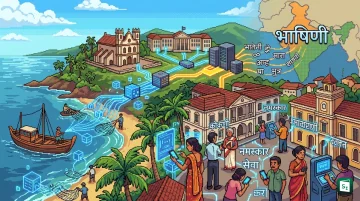
The Digital India BHASHINI (BHASHa INterface for India) Division (DIBD), in collaboration with the Goa government, has organised the 'BHASHINI Rajyam: State Engagement Workshop' in Panaji, Goa.
The workshop aimed to promote multilingual AI, strengthen the Konkani language ecosystem, and expand AI-powered multilingual access to citizen-centric government services.
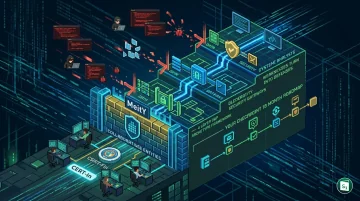
The Ministry of Electronics and Information Technology (MeitY) has released the second edition of the "Digital Threat Report 2025–26". The report was developed in collaboration with the Indian Computer Emergency Response Team (CERT-In), the Computer Security Incident Response Team in Finance (CSIRT-Fin), and SISA Information Security.
It outlines an 18-month roadmap for financial institutions to strengthen their cybersecurity. The report also introduces the "Anatomy of Cyber Failure – 4 layer Gap Archetype Framework", which explains how a cyberattack progresses from initial system weaknesses to a full-scale security breach.
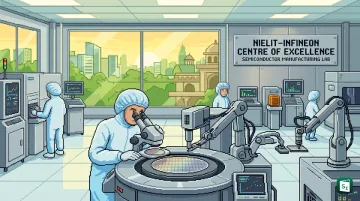
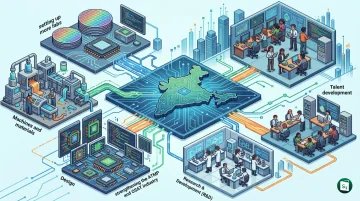
The Union Cabinet has approved 'Semicon 2.0' with a total outlay of ₹1.27 lakh crore to holistically develop the semiconductor design and manufacturing ecosystem in India.
The scheme is structured around 6 key pillars: Design, Machines and materials, setting up more fabs, strengthening the Assembly, Testing, Marking, and Packaging (ATMP) and Outsourced Semiconductor Assembly and Test (OSAT) industry, Research & Development (R&D), and Talent development.
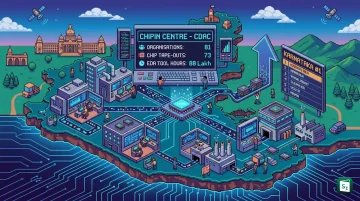
To date, the government has approved 12 semiconductor manufacturing units with a cumulative investment of over ₹1.64 lakh crore. Additionally, 24 semiconductor design projects from start-ups and Micro, Small and Medium Enterprises (MSMEs) have been approved for financial support, and 105 entities have been granted access to industry-standard Electronic Design Automation (EDA) tools.
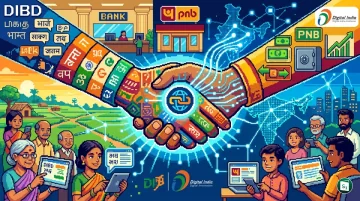
The Digital India BHASHINI Division (DIBD) has signed an MoU with the Punjab National Bank (PNB) to collaborate on advancing multilingual AI solutions.
The partnership aims to enhance inclusive banking and citizen-centric financial services through the 'BHASHINI for Seva/Sanchalan' initiative.
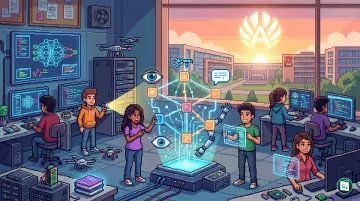
The Ministry of Electronics and Information Technology (MeitY), in collaboration with the Drone Federation India (DFI), has launched the second edition of the 'National Innovation Challenge for Drone Application and Research' (NIDAR 2.0, 2026-27) at Electronics Niketan, New Delhi, in a hybrid mode.
The challenge is conducted under the 'SwaYaan' initiative, which was approved by MeitY in 2022 with a total financial outlay of ₹89.87 crore over a five-year period.
The National Internet Exchange of India (NIXI) has celebrated its 23rd Foundation Day and launched 4 digital platforms.
The platforms include: 'IX Portal' to optimize the operations and management of domestic internet exchanges. 'myIRINN Portal' as a secure platform for members and affiliates of the Indian Registry for Internet Names and Numbers (IRINN). '.IN Auction Portal' to streamline the bidding and acquisition process for premium '.in' domain names. 'AI-Powered WHOIS Screening Platform' to secure the '.in' domain space of India.
The Ministry of Electronics and Information Technology (MeitY) has awarded the IndiaAI Fellowship to 7 Computer Science Engineering (CSE) students at Chandigarh University.
Each recipient will receive financial assistance of ₹1 lakh for innovative projects using AI and Machine Learning applications.
The Ministry of Electronics and Information Technology (MeitY) has issued an emergency nationwide order to block the messaging platform 'Telegram'. The directive was executed under the provisions of Section 69A of the Information Technology (IT) Act, 2000.
This measure was implemented after the National Testing Agency (NTA) and intelligence agencies identified a significant rise in organized cheating rackets on the platform, specifically in the period leading up to the National Eligibility cum Entrance Test-Undergraduate (NEET-UG) 2026 re-test.
The Digital India BHASHINI Division (DIBD) has signed an MoU with the Assam Innovation & Startup Foundation (AISF) to collaborate on promoting language technology and Generative AI solutions across the state.
The Digital India BHASHINI Division (DIBD) has signed an MoU with the Government e Marketplace (GeM) to launch the “BHASHINI for Seva/Sanchalan - A BHASHINI Sahayogi Program”.
The initiative aims to strengthen multilingual digital capabilities across the public procurement ecosystem of India by leveraging the BHASHINI Platform.
Bengaluru-based Avataar has launched 'Varya', India’s first indigenous, distilled video AI model, designed to make generative video storytelling accessible and affordable at a population scale. It was launched in partnership with the IndiaAI Mission.
The AI model operates as a text-to-video and image-to-video foundation model, offering enhanced speed and cost efficiencies to the digital ecosystem.
The National e-Governance Division (NeGD), an independent business division under the Digital India Corporation (DIC) of the Ministry of Electronics and Information Technology (MeitY), has empanelled 6 firms to provide AI and Machine Learning (ML) solutions for central ministries and agencies.
The selected firms are TCS, NEC India, Kyndryl Solutions, Innefu Labs, CoRover.ai, and Cactus Technology Solutions. The empanelment is valid for 2 years, with a provision for an extension of up to 1 year.
The Digital India BHASHINI Division (DIBD) has launched the ‘VYOMA Innovation Challenge’ to promote the development of open-source, multilingual, and voice-first AI solutions. The initiative is launched in partnership with Current AI and Kalpa Impact.
The challenge focuses on creating AI solutions that can operate in offline and low-connectivity environments. It is structured around ‘Sunno Sutra’, a multilingual, voice-first, open-source handheld AI reference device.
The Digital India BHASHINI Division (DIBD) has signed an MoU with the Centre for Digital Public Infrastructure & Artificial Intelligence (DPI-AI) at Kathmandu University, Nepal.
The partnership aims to advance Language AI, multilingual digital public infrastructure, and inclusive digital ecosystems in both India and Nepal.
The India Semiconductor Mission (ISM), under the Ministry of Electronics and Information Technology (MeitY), has launched the official online “Investors Support” portal.
The portal serves as a single-window digital platform designed to streamline communication and enhance confidence for global and domestic companies entering the semiconductor ecosystem of India. The platform also enables project tracking by providing comprehensive overviews of approved ventures under the national “Semicon India Programme”.
Union Minister Ashwini Vaishnaw has virtually inaugurated the first Small and Medium Enterprise (SME)-led semiconductor Assembly, Testing, Marking, and Packaging (ATMP) / Outsourced Semiconductor Assembly and Test (OSAT) facility in India at Bhiwadi, Rajasthan.
The facility has been established by Sahasra Semiconductors Pvt Ltd under the Scheme for Promotion of Manufacturing of Electronic Components and Semiconductors (SPECS). Constructed with an investment of over ₹150 crore, the unit spans an area of 57,000 sq ft.
India has assumed the chairmanship of the Common Criteria Development Board (CCDB) for a 2-year period, from April 2026 to April 2028. The leadership was confirmed during the 1st Quarter Meeting of the Common Criteria Recognition Arrangement (CCRA) held in Tokyo, Japan.
Under the CCRA, member countries accept each other’s IT security certificates without re-certification, facilitating seamless global trade in secure IT products. It is to be noted that India has been a member of the CCRA since 2013.
The Ministry of Electronics and Information Technology (MeitY) has launched the ‘Intellectual Property (IP) Catalyst’ initiative and its dedicated digital platform (https://cipie.in). The launch took place during the national conference ‘From Patent to Product: Accelerating IP Commercialization in Electronics & Information Technology (IT)’ held at the India Habitat Centre in New Delhi.
The initiative is implemented by the Centre for Development of Advanced Computing (C-DAC) with the support of MeitY. It is to be noted that the CIPIE platform serves as a unified online gateway for Intellectual Property and technology commercialization support services.