

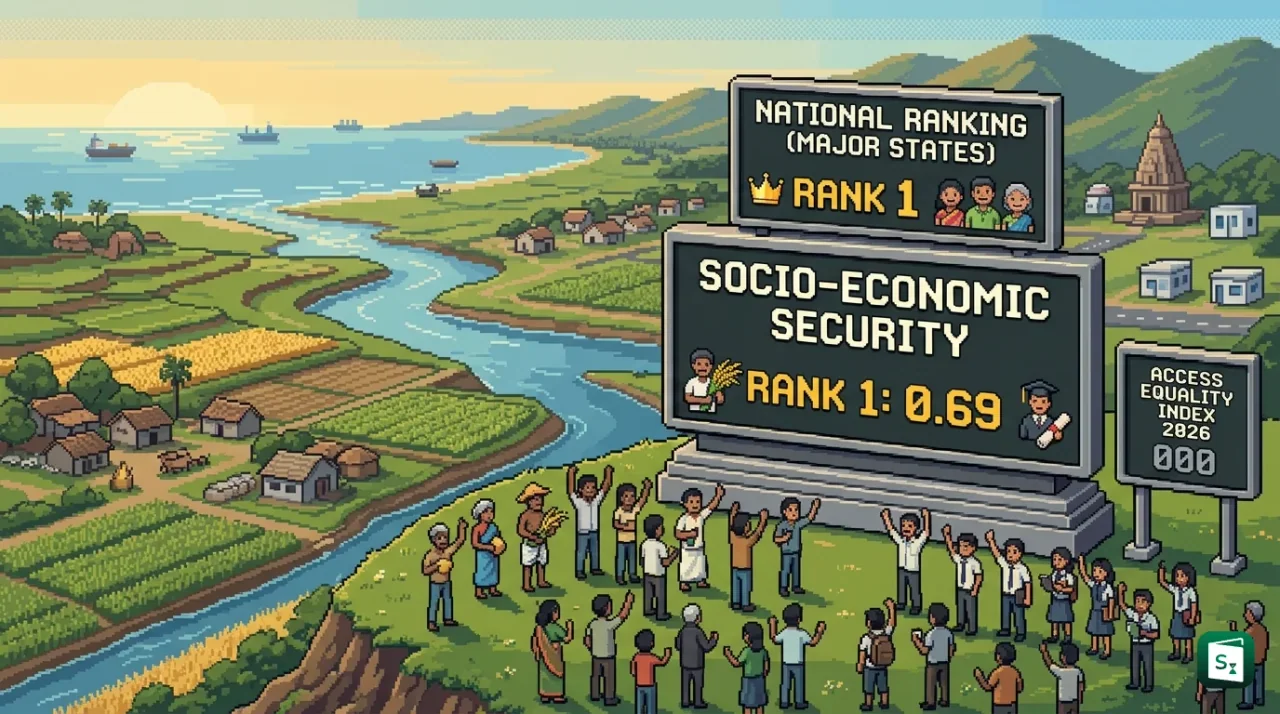
Goa has secured the first rank among 28 states in the Access Equality Index 2026 with an overall score of 0.68. Andhra Pradesh stood second with 0.66, followed by Sikkim with 0.63, in the index released by the Centre for New Economics Studies at O.P. Jindal Global University. The result is notable because Andhra Pradesh, ranked only 13th in per capita income, emerged as the highest ranked major state.
What Is the Access Equality Index 2026?
The Access Equality Index (AEI) 2026 is a national index that ranks 28 Indian states on how equally people can reach basic services and opportunities. The Centre for New Economics Studies (CNES) at O.P. Jindal Global University in Sonipat, Haryana, has prepared the index. O.P. Jindal Global University is a private non profit university established in 2009.
The 2026 edition is the latest in a series that began with the first AEI in 2021 and was updated in 2024. It covers 28 states. Union Territories are scored separately to keep comparisons fair between very different sizes of administration.
AEI 2026 does not measure income or wealth. It measures equality of opportunity, which means whether a person can actually use essential services irrespective of income, gender, caste or place of residence. A high score means access is more equal across households. A low score means large gaps remain.
The index uses 60 indicators grouped under 23 categories. Each of the five pillars carries equal weight. Scores range from 0 to 1.
The final score is calculated using the geometric mean of the five pillar scores, so poor performance in one pillar cannot be fully hidden by good performance in another. This method is also used in well known measures such as the Human Development Index.
Goa, Andhra Pradesh and Sikkim Lead the 2026 Rankings
The AEI 2026 places Goa at the top with a composite score of 0.68. Goa performed strongly in basic amenities and healthcare and stood second in education. Chief Minister Pramod Sawant publicly shared the result and linked it to piped water, housing, health facilities and internet access in schools.
Andhra Pradesh followed closely with 0.66. Sikkim stood third with 0.63. Kerala, Tamil Nadu and Telangana followed in the list of front runners.
| Rank | State | AEI 2026 Score |
|---|---|---|
| 1 | Goa | 0.68 |
| 2 | Andhra Pradesh | 0.66 |
| 3 | Sikkim | 0.63 |
| 4 | Kerala | 0.60 |
| 5 | Tamil Nadu | 0.57 |
| 5 | Telangana | 0.57 |
Scores group states into three bands used in earlier editions. States above 0.51 are called front runners. States in the middle range are called achievers. States at the lower end are called aspirants.
In AEI 2026, Andhra Pradesh has been identified as a front runner and as the highest ranked major state.
Goa has held the top position in earlier rounds as well. It scored 0.69 in the 2024 edition and 0.67 in the first 2021 round. Direct comparison across years needs care because methods and data years have been revised.
Five Pillars That Decide the Score
The AEI 2026 gives equal importance to five pillars. Each pillar captures a different part of daily life. The table below gives a simple view.
| Pillar | What It Covers |
|---|---|
| Basic Amenities | Drinking water, sanitation, housing, clean cooking fuel and electricity |
| Healthcare | Reproductive health, immunisation, insurance, government hospitals and beds, sub centre coverage and public spending |
| Education | Enrolment and attendance at secondary level, dropout rate, pupil teacher ratio, school distance, toilets for girls, vocational courses, digital facilities and public spending per student |
| Socio-Economic Security | Jobs, banking access, insurance, pensions and social protection |
| Legal Services | Police, courts, prisons, legal aid and ease of reaching justice institutions |
Andhra Pradesh ranked first in the country in socio economic security with 0.69, ahead of Goa at 0.50. That gap is wide. It shows a clear lead for Andhra Pradesh in employment support, financial inclusion and pension type protection.
Goa led in basic amenities and healthcare. It also stood second in education. Punjab has been strong in education in past editions.
Nagaland has shown a mixed pattern in past analysis, with relative strength in justice alongside weakness in other pillars. Such uneven profiles help states see which single pillar needs urgent work.
Why Andhra Pradesh Stands Out Despite Lower Income
Money matters for access. The AEI 2026 analysis finds that per capita income explains about three fourths of the differences between states. A state with double the income of another scores about 0.11 points higher on average on a scale where the gap between the top and bottom states is about a third of a point. More revenue helps build clinics, staff schools and lay pipes.
Andhra Pradesh breaks this pattern. The state ranks 13th in per capita income. Its expected access score based on income alone was 0.51. Its actual score is 0.66. The difference of plus 0.15 points is the highest positive gap among all states. Kerala follows with plus 0.07 and Himachal Pradesh with plus 0.06.
This makes Andhra Pradesh the clearest case of a state delivering more access than its income predicts. Kerala and Himachal Pradesh also sit above the expected line, in line with their long record of spending on schools, health and social services. Gujarat and Karnataka sit below what their income levels would predict, which researchers say needs closer study.
The pull of income is not equal across pillars. Income explains most of the gap in basic amenities and health. It explains only about a third of the gap in education and socio economic security.
School access and economic security depend more on how programmes are designed and run. State choices count more in these two areas than cash alone.
How the Index Measures Access Through the 4As
The word access in AEI 2026 covers four ideas called the 4As. Availability means the service exists in adequate number. Approachability means people can reach it within reasonable distance.
Affordability means households can pay for it without severe strain. Appropriateness means the quality meets basic needs.
Data on drinking water, sanitation, housing, clean energy, health centres, schools, banks, insurance, pensions and courts are tested against these four ideas. The index also looks at gaps between rural and urban areas and across caste and gender groups.
This focus on equal reach links to the Right to Equality in the Constitution of India under Articles 14 to 18. Article 14 guarantees equality before law and equal protection of laws. Article 15 bars discrimination on grounds of religion, race, caste, sex or place of birth in access to public places and services.
Article 16 guarantees equality of opportunity in public employment. The AEI applies the same spirit to schools, clinics, banks and courts by asking who can actually use them.
The design also punishes uneven progress. Because the final score uses the geometric mean, a very high score in one pillar cannot hide very low scores in others.
Disadvantage compounds in states that sit in the bottom third on several pillars at once. In those states, weak health access tends to come with weak schooling, thin economic security and harder to reach justice. Coordinated action across sectors matters more there than a single scheme.
Key Takeaways
- Goa ranked first among 28 states in the Access Equality Index 2026 with a score of 0.68.
- Andhra Pradesh ranked second with 0.66 and is the highest ranked major state, followed by Sikkim at 0.63.
- Andhra Pradesh ranked first in socio economic security with 0.69, ahead of Goa at 0.50.
- The index is prepared by the Centre for New Economics Studies at O.P. Jindal Global University, established in 2009 at Sonipat, Haryana, using 60 indicators across 23 categories under five equally weighted pillars.
- Despite ranking 13th in per capita income, Andhra Pradesh recorded the highest positive gap of plus 0.15 points above its expected score of 0.51.