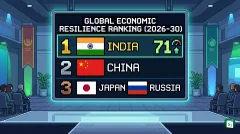

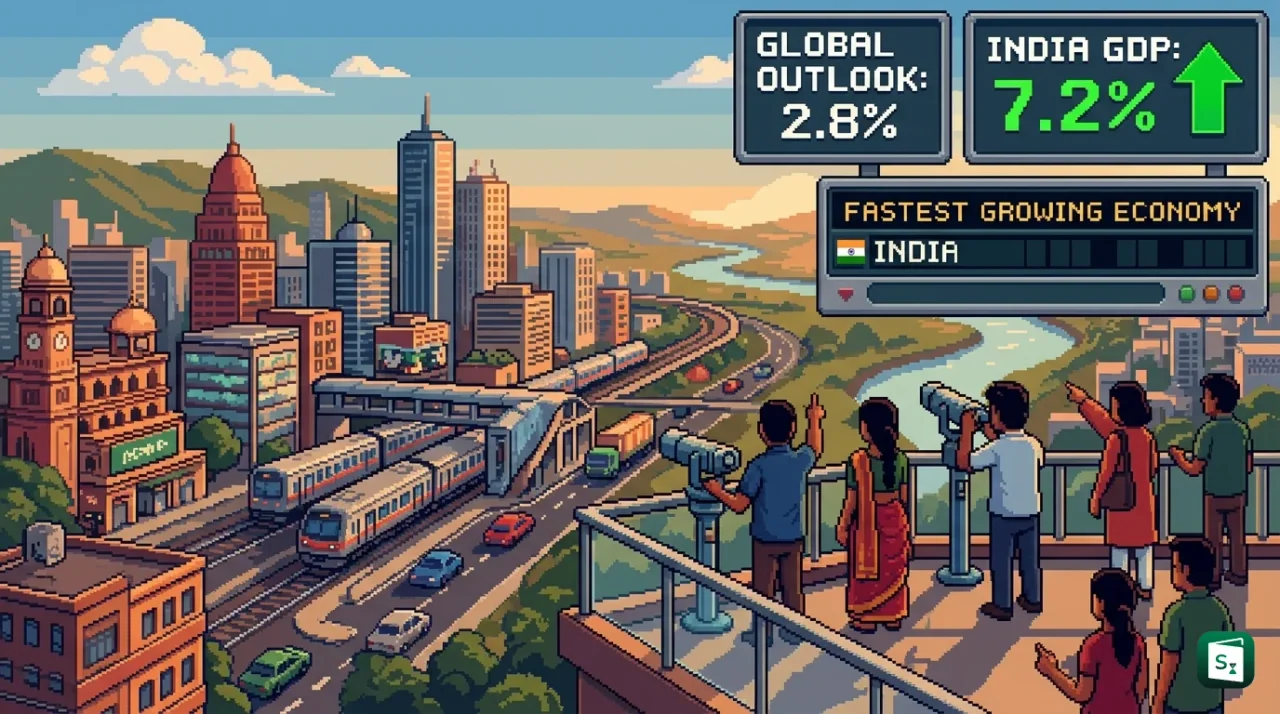
Goldman Sachs Research projects global GDP growth at 2.8 percent in calendar year 2027, up from 2.7 percent in 2026, in its Global Economic Outlook 2027 report released in November 2026. The report projects India GDP growth at 7.2 percent in CY27, retaining the position of fastest growing major economy despite easing from an estimated 7.9 percent in 2026. The outlook links the global recovery to lower energy prices and a rise in nominal AI investment to $1.8 trillion.
What Is GDP in Economics?
Gross Domestic Product in economics is the total market value of all final goods and services produced within a country during a specific year. It excludes intermediate inputs to avoid double counting and serves as the headline measure of economic size and growth. GDP growth rate shows the annual percentage change in this output after adjusting for price changes.
India measures GDP at market prices by adding Gross Value Added (GVA) at basic prices and net taxes on products. GVA is the value of output minus intermediate consumption. In simple terms, GVA shows what farms, factories and service firms actually add, while GDP adds the taxes collected by the government and subtracts subsidies.
| Term | What It Measures | How It Differs From GDP |
|---|---|---|
| GDP | Value of final goods and services produced inside the country | Headline measure at market prices |
| GVA | Value added by producers before product taxes and subsidies | GDP equals GVA plus net product taxes |
| GNP | Output by residents of a country, including net income from abroad | GDP counts production inside borders, GNP counts production by nationals |
| GDP per capita | GDP divided by mid year population | Shows average output per person, not individual income |
| GDP deflator | Ratio of nominal GDP to real GDP | Tracks overall price change in the economy |
The GDP of India in dollar terms reflects conversion because India reports GDP in rupees for fiscal years and global bodies convert it into dollars. The National Statistics Office (NSO) under the Ministry of Statistics and Programme Implementation releases official estimates. Global houses such as Goldman Sachs, the International Monetary Fund (IMF) and the World Bank usually present calendar year growth for cross country comparison.
What Did Goldman Sachs Project for 2027?
Goldman Sachs Research released the Global Economic Outlook 2027 report in November 2026 under Chief Economist Jan Hatzius. The report forecasts steady but modest global expansion and places India clearly ahead of other large economies. Goldman Sachs was founded in 1869 by Marcus Goldman and Samuel Sachs and is headquartered in New York. Its research division provides the annual outlook used by investors and policymakers.
| Economy | 2026 Estimate | 2027 Forecast (Goldman Sachs) | Consensus View |
|---|---|---|---|
| World | 2.7 percent | 2.8 percent | Mixed, near 3 percent |
| India | 7.9 percent | 7.2 percent | 6.8 percent |
| China | 4.6 percent | 4.5 percent | 4.4 percent |
| United States | 2.3 percent | 2.4 percent | Below 2.4 percent |
For India, the 7.2 percent call is a moderation from 2026 but stays above the market consensus of 6.8 percent. The report also projects Consumer Price Inflation at 5.7 percent in 2027, up from an estimated 4.6 percent in 2026. It expects the repo rate to rise to 6.25 percent by end 2027 from 5.75 percent at end 2026, and the rupee to stabilise near 96 per dollar over the next 12 months.
Why Does Goldman Sachs Expect Global Growth at 2.8 Percent?
Goldman Sachs Research expects two positive forces to outweigh tighter financial conditions and lower government spending in 2027. The first is energy. High oil and gas prices hurt growth in 2026. The bank expects supply adjustment in West Asia to bring Brent crude down to $78 per barrel by end 2027, with a similar cooling in liquefied natural gas prices. Lower fuel costs would turn energy from a drag into a small support for growth.
The second force is artificial intelligence. Goldman Sachs estimates nominal global AI investment will rise to $1.8 trillion in 2027 from $1.1 trillion in 2026. Spending on hardware in the United States alone may reach $500 billion. The report estimates this investment could add about 0.4 percentage point to global growth in 2027. Even as the pace of AI spending slows, the level remains large enough to matter.
The United States, Japan and the United Kingdom are expected to grow slightly faster than consensus. South Korea and Taiwan should continue to benefit from strong AI related exports. Europe faces a different path. Past energy price rises are still passing through to households, so financial conditions remain tight there.
Why Is India the Fastest Growing Major Economy at 7.2 Percent?
Goldman Sachs expects India GDP growth to ease to 7.2 percent in CY27 from 7.9 percent in CY26 but to stay the highest among large economies. The main reason is a recovery in private investment alongside strong domestic demand. Capital expenditure growth among NSE 500 companies rose to 17 percent year on year in 2026, the second highest in a decade. Utilities, energy, automobiles, capital goods and materials led the rise.
Corporate results support the view. Companies in the MSCI India index, excluding commodities, posted 16 percent profit growth and 21 percent revenue growth in the third quarter. Goldman Sachs expects earnings growth of 15 percent in both 2027 and 2028, helped by home demand and fresh investment. Lower crude prices would help India more than most peers because India imports a large share of its oil. A rotation of global funds from North Asian AI stocks toward less AI exposed markets has also supported inflows into India.
China provides the contrast. Goldman Sachs projects Chinese growth at 4.5 percent in 2027. Exports offer some support. Weak household spending and stress in the property sector continue to limit momentum. The United States is projected at 2.4 percent, helped by resilient business investment but held back by tighter credit and reduced fiscal support.
How Is GDP Calculated in India?
India calculates GDP using production, income and expenditure methods under the System of National Accounts 2008. The production method adds value added across farms, factories and services to get GVA and then adds product taxes minus subsidies to get GDP. The expenditure method adds private consumption, government consumption, investment and net exports.
The National Statistics Office compiles the estimates. In February 2026, India shifted the GDP base year to 2022-23 from 2011-12. The base year is the reference year used to remove price effects and to update methods. The year 2022-23 was chosen as a normal post Covid year with full survey data. The revision corrected earlier overestimation of about 3 to 4 percent and gave a clearer picture of the economy.
Key upgrades in the new series include annual data from the Annual Survey of Unincorporated Sector Enterprises and the Periodic Labour Force Survey to capture informal firms better, use of double deflation in agriculture and manufacturing, splitting of multi activity companies using MCA filings, and adoption of the Supply and Use Table framework to reduce the gap between production and spending estimates. Private consumption estimates now use the COICOP 2018 classification and more granular price indices.
Where Does India Stand on GDP Size, Rank and Per Capita Income?
India GDP in trillion dollars stood at $4.06 trillion in nominal terms in 2026, which placed India sixth in the world. The United States led with $32.64 trillion, followed by China at $21.54 trillion, Germany, Japan and the United Kingdom. India slipped from fifth to sixth because of two technical factors. The rupee weakened by nearly 10 percent against the dollar over the past year, which lowered dollar GDP even as rupee GDP grew fast. The base year revision to 2022-23 also reduced nominal levels compared with the old series.
| Measure for India (IMF, October 2026) | 2026 | 2027 Projection |
|---|---|---|
| Nominal GDP | $4.06 trillion, rank 6 | $4.52 trillion |
| GDP in purchasing power parity | $19.19 trillion, rank 3 | Higher, behind China and the US |
| GDP per capita nominal | $2,750, rank near 172 | $3,036 |
| GDP per capita in PPP terms | $12,998 | Rising with real growth |
PPP adjusts for local prices and shows larger size for emerging economies. On this basis India is already third, ahead of Germany, Japan and the United Kingdom.
Per capita income remains low because of a large population of about 147.6 crore. Bangladesh at $2,886 is slightly ahead of India at $2,749 in 2026 in nominal per capita terms. India is expected to move ahead again by 2029. The IMF expects India to cross the United Kingdom and Japan by 2028 to become the fourth largest economy and to cross Germany by 2032 to become the third largest, provided nominal growth in dollar terms stays above 10 percent and the rupee stabilises. The $5 trillion economy milestone, once targeted for earlier years, is now close. Current projections place nominal GDP near $5.54 trillion by 2029 and above $6.12 trillion by 2030.
What Do IMF, World Bank and RBI Forecasts Say About India?
Goldman Sachs is more positive on India for 2027 than most forecasters. Its 7.2 percent calendar year call sits above the Reserve Bank of India (RBI) survey median and above the IMF calendar year figure of 7.0 percent. The RBI, established in 1935 under the RBI Act, 1934 and headquartered in Mumbai, is India central bank and sets the repo rate. The repo rate is the rate at which RBI lends to banks. When it rises, loans become costlier and demand cools.
| Organisation | Forecast for India | Reference Period |
|---|---|---|
| Goldman Sachs | 7.2 percent | CY27, above 6.8 percent consensus |
| IMF World Economic Outlook, October 2026 | 7.0 percent | Both FY27 and FY28, calendar 2026 at 7.4 percent and 2027 at 7.0 percent |
| World Bank India Development Update, October 2026 | 7.1 percent | FY27, up from 6.6 percent, FY28 at 7.2 percent |
| RBI Monetary Policy, October 2026 | 7.1 percent | FY27, up from 6.7 percent |
| RBI Survey of Professional Forecasters, September 2026 | 7.1 percent in FY27, 7.0 percent in FY28 | Median of 47 forecasters |
The upgrades followed stronger than expected growth of 7.8 percent in the first quarter of FY27. Private consumption remains the main driver. The World Bank assumes crude around $90 to $100 per barrel in FY27 and $80 to $85 in the medium term. It expects tax cuts and lower excise duty on fuel to cushion demand. The IMF expects consumer inflation near 5.0 percent in FY27 and 4.4 percent in FY28, slightly below RBI assessment of 5.2 percent for the current year.
What Are the Risks to the 2027 Outlook?
Goldman Sachs notes that risks to global growth are tilted to the downside. A renewed escalation in the Iran conflict could push energy prices up again and erase the expected relief. Large fiscal deficits, especially in advanced economies such as France, could push long term bond yields higher and tighten credit. AI spending could fall short if chip capacity, regulation, funding stress or weak demand limit projects. Early signs of AI linked pressure on jobs add to caution.
For India, the report flags higher input costs and weather risk. A possible El Nino event could hurt farm output, raise food prices and weaken rural demand. This explains the higher inflation forecast of 5.7 percent for 2027. Higher costs could also squeeze company margins even as sales improve. The World Bank adds two external risks. A longer West Asia conflict could keep oil high and pressure inflation, the current account and public finances. A sharp stock market correction could trigger volatile capital outflows. Domestic fuel subsidies that shielded consumers in 2026 may be reduced as crude cools, which would limit the net boost to growth.
Key Takeaways
- The Global Economic Outlook 2027 by Goldman Sachs Research projects global GDP growth at 2.8 percent in CY27, up from 2.7 percent in 2026.
- India GDP growth at 7.2 percent in CY27 is projected as the fastest among major economies, above the 6.8 percent consensus and ahead of China at 4.5 percent.
- Global AI investment is projected to rise to $1.8 trillion in 2027 and contribute about 0.4 percentage point to global growth.
- Goldman Sachs expects Brent crude near $78 per barrel by end 2027, turning energy from a drag into support for growth.
- For India, inflation at 5.7 percent in 2027 could lift the repo rate to 6.25 percent, with the rupee seen near 96 per dollar.