

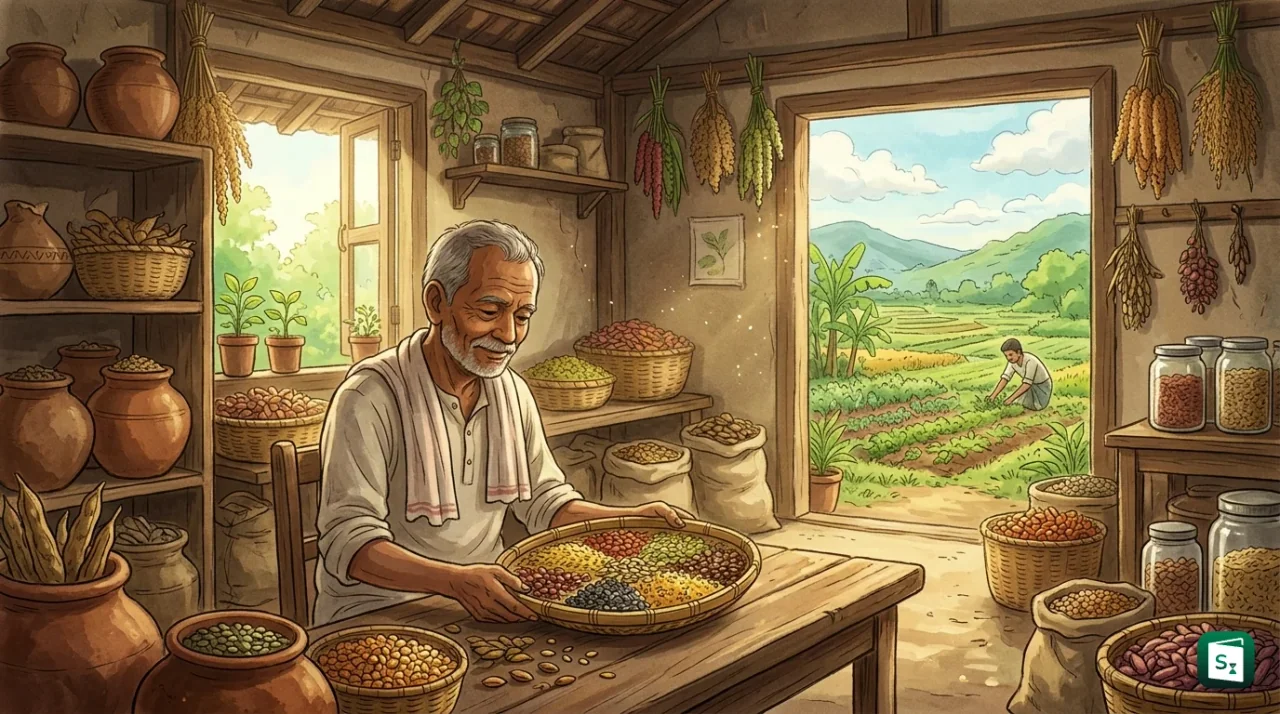
The Protection of Plant Varieties and Farmers Rights Authority presented Plant Genome Saviour awards to two farmers from Wayanad in Kerala on 12 November 2026 in New Delhi. Babu N.K. received the Plant Genome Saviour Farmer Reward for 2023-24 with ₹1.5 lakh, while Sooraj C.S. received the Plant Genome Saviour Farmer Recognition for 2024-25 with ₹1 lakh. The ceremony, held on the 22nd Foundation Day of the Authority, highlighted how farmer led conservation of traditional seeds supports food security and climate resilience.
What Are the Plant Genome Saviour Awards Presented on PPVFRA Foundation Day?
The Plant Genome Saviour awards are national awards for farmers and farming communities who conserve plant genetic resources. Plant genetic resources mean the seeds and planting material of landraces and wild relatives of crops. Landraces are traditional varieties developed by farmers over many generations. Wild relatives are wild plants closely related to crops.
The Protection of Plant Varieties and Farmers Rights Authority gives these awards every year from the National Gene Fund. The Fund was created under Section 45 of the Protection of Plant Varieties and Farmers Rights Act, 2001. The awards honour conservation where the saved material has been used as a donor of genes in varieties that can be registered under the Act.
There are three categories. The table below shows the number and prize for each.
| Award Category | Who Can Receive It | Number Per Year | Prize |
|---|---|---|---|
| Plant Genome Saviour Community Award | Community of farmers, especially tribal and rural communities | Up to 5 | ₹10 lakh, citation and memento |
| Plant Genome Saviour Farmer Reward | Individual farmer conserving landraces and wild relatives | Up to 10 | ₹1.5 lakh, citation and memento |
| Plant Genome Saviour Farmer Recognition | Individual farmer conserving landraces and wild relatives | Up to 20 | ₹1 lakh, citation and memento |
Farmers must apply through the Chairperson or Secretary of the local Panchayat Biodiversity Management Committee, the District Agricultural Officer, the Director of Research of the State Agricultural University or the District Tribal Development Office. Shortlisted farmers must deposit a fixed quantity of seeds or planting material for conservation and verification.
The 2026 ceremony was held on 12 November 2026 at the National Agricultural Science Complex at Pusa in New Delhi. The Protection of Plant Varieties and Farmers Rights Authority observed its 22nd Foundation Day on that day. The event also marked 25 years of the 2001 Act. P.K. Mishra, Principal Secretary to the Prime Minister, addressed the gathering and presented the awards.
How PPVFRA Protects Plant Varieties and Farmers Rights Under the 2001 Act
The Protection of Plant Varieties and Farmers Rights Authority is a statutory body set up under the Protection of Plant Varieties and Farmers Rights Act, 2001. Parliament passed the Act to create an effective system to protect plant varieties and the rights of farmers and breeders. The Act also aims to encourage the development of new varieties of plants.
India adopted a sui generis system under this law. Sui generis means a system of its own kind. It meets the requirement of the Agreement on Trade Related Aspects of Intellectual Property Rights to protect plant varieties through patents, a special system or a mix of both. The Indian law is broadly in line with the International Union for the Protection of New Varieties of Plants Convention of 1978, but it gives strong and separate rights to farmers.
The Central Government established the Authority on 11 November 2005. The Authority works under the Ministry of Agriculture and Farmers Welfare and is based in New Delhi at Plant Authority Bhawan on Dev Prakash Shastri Marg near the National Agricultural Science Complex. The Chairperson is the chief executive. The post carries the rank of Secretary to the Government of India. Trilochan Mohapatra is the present Chairperson. The Authority has 15 members besides the Chairperson, including central government officers, state governments and agricultural universities, and nominees for farmers, tribal groups, the seed industry and women engaged in agriculture. The Registrar General acts as Member Secretary.
A central task of the Authority is registration of plant varieties. It has framed Distinctiveness, Uniformity and Stability test guidelines, called DUS guidelines, for about 197 crop species. Distinctiveness means the variety is clearly different from others. Uniformity means its plants look similar. Stability means its traits remain the same after repeated propagation. DUS testing uses field trials and now also imaging tools.
The Act gives farmers clear rights. Farmers can save, use, sow, resow, exchange, share or sell farm produce including seed of a protected variety in the same way as before the Act. They cannot sell branded seed of a protected variety in a commercial packing labelled as such. Farmers who breed a new variety can register it and get the same protection as a commercial breeder. The law also provides for benefit sharing and payment from the National Gene Fund to farming communities that supply genetic material used in new varieties.
Who Are the 2023-24 and 2024-25 Awardees From Wayanad?
Both winners in the news are farmers from Wayanad district in Kerala. Their work was identified and documented by the Kerala Agricultural University and its Krishi Vigyan Kendra at Wayanad. Krishi Vigyan Kendra means farm science centre. It links research institutes with farmers for training and field trials.
Babu N.K. won the Plant Genome Saviour Farmer Reward for 2023-24. He conserves a wide range of traditional and underused crops on his four acre farm. His collection includes 39 varieties of banana, 11 varieties of root tubers, nine varieties of colocasia, six varieties of ginger, four varieties of turmeric and three varieties of Amorphophallus, besides yams, arrowroot, coleus, cassava, mango, jackfruit, passion fruit, arecanut, coconut, cardamom, pepper and coffee.
Babu has shared greater yam germplasm with the ICAR Central Tuber Crops Research Institute for research. Germplasm means living material that carries the hereditary traits of a plant. He has also given seed corms and tubers to the Seed Gene Bank of Kerala Agricultural University. His work keeps alive varieties that suit local soils and rainfall and can supply useful genes for future breeding.
Sooraj C.S., also reported as Suraj Purushothaman of Mathamangalam, won the Plant Genome Saviour Farmer Recognition for 2024-25. He maintains about 670 diverse genetic resources on about five acres near his home. His collection includes 104 tomato varieties, 23 brinjal varieties, 36 chilli accessions, 32 banana varieties, 15 rice varieties, 17 tuber varieties, 55 medicinal plant accessions and 58 wild edible leafy plant accessions, along with other vegetables, fruits, spices and ornamental plants.
Sooraj collects indigenous seeds from different parts of India. He also develops new types through hand pollination. He has shared leafy vegetable and spice germplasm with Kerala Agricultural University for characterisation and nutritional profiling. He has also provided chilli, tomato and brinjal accessions to the Department of Genetics and Plant Breeding at the College of Agriculture, Vellanikkara, for research. His farm shows how on farm conservation keeps both cultivated diversity and associated knowledge alive.
What Is the National Genebank Maintained by NBPGR?
NBPGR stands for the National Bureau of Plant Genetic Resources. It is the nodal institute in India for the management of plant genetic resources. It works under the Indian Council of Agricultural Research (ICAR). ICAR is the apex body for agricultural research in India and works under the Ministry of Agriculture and Farmers Welfare.
The Bureau traces its roots to a plant introduction scheme started in 1946 in the Botany Division of the Indian Agricultural Research Institute. It became the Division of Plant Introduction in 1961, the National Bureau of Plant Introduction in August 1976 and the National Bureau of Plant Genetic Resources in January 1977. Its headquarters is at the Pusa Campus in New Delhi. It has five divisions, three units, an experimental farm and 10 regional stations in different plant geographical zones.
The Bureau manages the National Genebank of India. The present genebank building was inaugurated in November 1996 and was notified as the National Genebank. A refurbished state of the art facility was inaugurated in August 2021. The seed bank has 12 long term storage modules and one medium term module with a total capacity of one million accessions. An accession means a distinct sample of seeds or planting material stored for conservation.
The National Genebank is the second largest genebank in the world. It holds more than 4.7 lakh accessions belonging to more than 2,150 species, including cereals, millets, legumes, oilseeds and vegetables. It also maintains an in vitro bank for tissue cultures and a cryobank for storage at very low temperatures. The collections are available to public and private agencies for crop improvement.
The Union Budget for 2025-26 announced a Second National Genebank with capacity for 10 lakh germplasm lines. The new facility aims to strengthen conservation for future food and nutritional security and support both public and private seed work.
What Is the Genome India Project?
The Genome India Project is a national initiative funded by the Department of Biotechnology to catalogue genetic variations of the Indian population. It has completed whole genome sequencing of 10,000 healthy individuals from 99 communities and stores the data at the Indian Biological Data Centre in Faridabad.
Genome means the complete set of genetic instructions in an organism. Genome sequencing means reading the exact order of these instructions. The Genome India Project was sanctioned in late 2019 and launched in January 2020 by the Department of Biotechnology under the Ministry of Science and Technology. A consortium of 20 national institutes carries it out.
The goal is to build a reference catalogue that reflects Indian diversity. India has more than 4,600 population groups, many of them endogamous. Endogamous means marriage within the group. Global databases contain mostly European data, so they do not predict disease risk well for Indians. A reference genome for India helps design low cost diagnostic chips and supports precision medicine. Precision medicine means treatment shaped to a person’s genetic makeup.
The project collected more than 19,200 blood samples for a biobank and completed sequencing of 10,074 individuals. Analysis has found about 130 million genetic variants, including more than 44 million variants not seen in global databases. The data is archived at the Indian Biological Data Centre at Faridabad and shared for research through open access protocols. The findings help link geography, language and ancestry to disease risk and drug response.
How Many Agro Biodiversity Hotspots Are There in India?
India has 22 agro biodiversity hotspots identified by the Protection of Plant Varieties and Farmers Rights Authority. A task force led by M.P. Nayar identified them in 2009 based on crop diversity, wild relatives, social relevance and uniqueness of farming systems.
Agro biodiversity means the variety of crops, their wild relatives and the farming practices linked to them. The Authority set up a task force in October 2007 to locate areas where this diversity is richest. The task force used clear tests such as number of crop species, number of varieties, presence of wild relatives, age of agriculture in the area, livelihood dependence and unique practices tied to culture and festivals.
The National Gene Fund gives priority to farmers and communities in these hotspots. Support is meant for in situ and on farm conservation. In situ means protection in the natural habitat. On farm means protection through continued cultivation by farmers.
The 22 regions cover deserts, hills, plains, plateaus, coasts and islands:
| Zone | Hotspot Regions |
|---|---|
| Himalayan and North East | Cold Desert, Western Himalayan, Eastern Himalayan, Brahmaputra Valley, Khasia Jaintia Garo Hills, North Eastern Hills |
| Arid and Central | Arid Western, Malwa Plateau and Central Highlands, Kathiawar, Bundelkhand |
| Gangetic | Upper Gangetic Plains, Lower Gangetic Plains, Gangetic Delta |
| Tribal Belt | Chotanagpur, Bastar, Koraput |
| Peninsular and Coastal | Southern Eastern Ghats, Kaveri, Deccan, Konkan, Malabar |
| Islands | Islands Region covering Andaman and Nicobar Islands and Lakshadweep |
Wayanad falls in the Malabar region, which is rich in spices, tubers, rice and plantation crops. This context explains why conservators from Wayanad often figure among national awardees.
Why 3,000 Climate Resilient Varieties Matter for Food Security
India has released 2,996 climate resilient crop varieties between 2014 and 2025 through the National Agricultural Research System led by ICAR. Climate resilient means the variety can give a stable yield despite drought, flood, heat, salinity or pests. The total includes 587 extreme climate tolerant varieties, with 341 tolerant to drought, 89 to flood, 80 to salinity, 59 to heat stress and 18 to cold.
The work is led by ICAR institutes, State Agricultural Universities and central universities. The crop wise break up for 2014 to 2025 shows the scale:
| Crop Group | Total Varieties Released | Climate Resilient Varieties |
|---|---|---|
| Cereals | 1,574 | 1,453 |
| Oilseeds | 444 | 397 |
| Pulses | 473 | 446 |
| Fibre crops | 408 | 392 |
| Forage crops | 207 | 185 |
| Sugarcane | 96 | 96 |
ICAR launched the National Innovations on Climate Resilient Agriculture in 2011. The programme assessed risk in 651 agricultural districts and found 310 districts highly or very highly vulnerable to climate change. It set up 448 Climate Resilient Villages in 151 vulnerable districts across 28 states and Union Territories. These villages test drought and flood tolerant rice, wheat, soybean and mustard, along with direct seeded rice, zero till wheat and residue management.
P.K. Mishra noted that about 3,000 such varieties are now in the field. He called for stronger community seed banks and field genebanks to keep traditional material available. He also stressed benefit sharing so that conservators get a fair return when their material is used in breeding. Farmer collections such as those of Babu and Sooraj feed directly into this chain. Their seeds can supply genes for tolerance to water stress, pests and disease.
Key Takeaways
- Babu N.K. from Wayanad received the Plant Genome Saviour Farmer Reward for 2023-24 carrying ₹1.5 lakh for conserving 39 banana varieties and many tubers and spices.
- Sooraj C.S. from Wayanad received the Plant Genome Saviour Farmer Recognition for 2024-25 carrying ₹1 lakh for maintaining about 670 genetic resources including 104 tomato varieties.
- The awards were presented on 12 November 2026 during the 22nd Foundation Day of PPVFRA in New Delhi, marking 25 years of the PPVFR Act, 2001.
- The PPVFRA was established on 11 November 2005 under the Ministry of Agriculture and Farmers Welfare and gives up to 5 community awards of ₹10 lakh, 10 rewards of ₹1.5 lakh and 20 recognitions of ₹1 lakh each year.
- The National Genebank at ICAR-NBPGR in New Delhi, set up in 1996, is the second largest in the world with more than 4.7 lakh accessions of over 2,150 species.
- India has 22 agro biodiversity hotspots identified by PPVFRA and has released 2,996 climate resilient crop varieties between 2014 and 2025.