Union Minister Amit Shah has flagged off India’s first Liquefied Natural Gas (LNG)-powered train from the Sabarmati Railway Station in Ahmedabad, Gujarat.
During the event, he also inaugurated various railway development projects worth ₹1,472 crore and the Wide Gauge, Alternating Current, Goods (WAG-12) Maintenance Shed for railway locomotive engines, built at a cost of ₹700 crore.
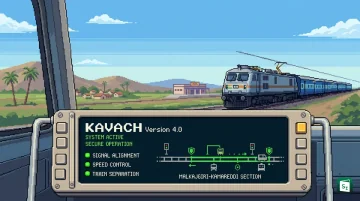
Indian Railways has commissioned KAVACH Version 4.0 for the first time on the South Central Railway (SCR). The project involved the upgradation from KAVACH Version 3.2 to Version 4.0.
The implementation was completed on the Malkajgiri-Kamareddi section of the Hyderabad Division, covering a total distance of 108 Route Kilometres (RKm).
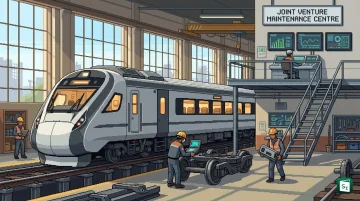
Bharat Heavy Electricals Ltd (BHEL) has partnered with Titagarh Rail Systems Ltd (TRSL), a railway rolling stock manufacturer, to establish a 50:50 Joint Venture Company (JVC). The JVC will be responsible for the maintenance of Vande Bharat Sleeper trainsets for a period of 35 years.
The Lucknow-Delhi-Lucknow Tejas Express, operated by the Indian Railway Catering and Tourism Corporation (IRCTC), is set to become India’s first privately branded passenger train.
The semi-high-speed train will be temporarily renamed as the ‘Sprite’ Tejas Express for a duration of 6 months.
Union Minister Ashwini Vaishnaw has implemented 8 additional structural reforms under the 'Reform Express' initiative at Rail Bhawan, New Delhi. This brings the total number of reforms implemented to 17, advancing the ministry's strategic objective to execute 52 reforms within 52 weeks.
The newly introduced reforms (10 to 17) encompass Fly Ash Transportation, reforms in the Container Sector, Fertilizer Transportation, a policy for skilling artisans in railway projects and works, Construction reforms, a policy for wagon design approval, Petroleum Products Transportation, and the transportation of Foodgrains, Flour, and Pulses.
Indian Railways has approved the installation of the ‘Kavach’ automatic train protection system on the balance Broad Gauge sections of the Ambala Division (Northern Railway), spanning 811 route km at a cost of ₹201 crore.
Additionally, it has approved the installation of ‘Kavach’ Version 4.0 on 598 route km across 48 block sections of the Ahmedabad Division (Western Railway) in Gujarat, at a cost of ₹140 crore.
The Cabinet Committee on Economic Affairs (CCEA) has approved the development of a brownfield ship repair facility at Vadinar in Gujarat with an estimated investment of ₹1,570 crore. The project will be jointly executed by the Deendayal Port Authority (DPA) and Cochin Shipyard Ltd (CSL).
The proposed infrastructure of the facility includes a 650-meter jetty. Additionally, the CCEA has sanctioned several railway multi-tracking projects with a total financial outlay of ₹23,437 crore.
The Cabinet Committee on Economic Affairs (CCEA) has approved two multi-tracking projects of the Ministry of Railways (MoR) with a total estimated cost of ₹24,815 crore. The projects aim to expand the network of Indian Railways by 601 km, covering a total track length of 1,317 km.
The expansion will span across 15 districts in the states of Uttar Pradesh and Andhra Pradesh. The infrastructure development is scheduled for completion by the FY31.