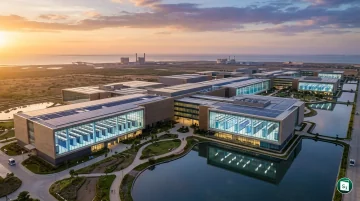
The International Finance Corporation (IFC), the private-sector arm of the World Bank Group (WBG), has pledged $371 million to Sify Infinit Spaces Ltd (SISL), a subsidiary of Sify Technologies Ltd.
The financing will support the development of AI-ready, energy-efficient Data Centre (DC) infrastructure in Navi Mumbai and Chennai.
According to the "Global Startup Ecosystem Report 2026" (GSER 2026) released by Startup Genome, Bengaluru is ranked 15th globally among the top startup ecosystems. It has also emerged as the second-best AI-native cluster in Asia, positioned behind Beijing (China).
Silicon Valley (USA) topped the global rankings, followed by New York City (USA) and London (UK).
The Digital India BHASHINI Division (DIBD) has signed an MoU with the Assam Innovation & Startup Foundation (AISF) to collaborate on promoting language technology and Generative AI solutions across the state.
The Maharashtra government has signed a Letter of Intent (LoI) with Google for Education to train teachers in AI and digital technology.
The 18-month initiative aims to strengthen teachers' digital competencies, improve AI literacy, and promote technology-enabled learning in schools, in line with the National Education Policy (NEP) 2020.
PM Narendra Modi has visited France to strengthen the India-France Special Global Strategic Partnership, focusing on trade, technology, and security. He held bilateral talks with President Emmanuel Macron in Nice and participated in the 52nd G7 Outreach Summit as a guest partner.
PM Modi and President Macron co-launched the 'Bharat Innovates' initiative in Nice, featuring participation from over 120 Indian startups. At the VivaTech 2026 expo in Paris, the largest technology exhibition in Europe, India was designated as the 'AI Country of Focus'.
The visit resulted in 13 key outcomes, including the adoption of the 'India-France Innovation Roadmap 2030', the establishment of a Joint Working Group (JWG) on AI Governance, and the expansion of the UPI in France. PM Modi also addressed the Indian diaspora during the 'Bonjour Modi' event held in Paris.
The Indian National Space Promotion and Authorisation Centre (IN-SPACe) has selected 3 Indian space startups as the first set of Non-Governmental Entities (NGEs) to receive funding under its Technology Adoption Fund (TAF) scheme.
The selected startups are Astrobase Space Technologies Pvt Ltd (Bengaluru), SatSure Analytics India Pvt Ltd (Bengaluru), and TM2SPACE Technologies Pvt Ltd (Hyderabad). Under this initiative, SatSure Analytics India Pvt Ltd will develop a Large Earth Observation Model (LOM) named "Dhaarini".
Union Minister Pralhad Joshi has launched the tech-driven Smart Warehousing System at Bharat Mandapam in New Delhi. This system represents the world's largest deployment of AI and Internet of Things (IoT)-based technologies in public-sector storage.
The system is currently operational across 216 grain warehouses managed by the Central Warehousing Corporation (CWC). The Food Corporation of India is scheduled to transition 150 of its warehouses to the smart system by October 2026.
The World Economic Forum (WEF) has released its “2026 Technology Pioneers” cohort, which features 100 early-stage companies from 23 countries. The USA leads the list with 43 startups, followed by China and the UK.
India is represented by 9 startups in the 2026 cohort (compared to 10 in the 2025 list), bringing the total number of Indian firms in the WEF cohort to 28. The selected companies will contribute to WEF initiatives through a two-year engagement program.
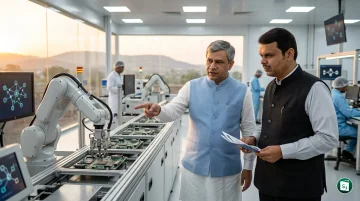
Union Minister Ashwini Vaishnaw, in the presence of Maharashtra CM Devendra Fadnavis, has inaugurated the advanced manufacturing facility of Jabil Inc. at the Maharashtra Industrial Development Corporation (MIDC) in Ranjangaon, Pune.
The facility aims to create an export-centric ecosystem for manufacturing next-generation hardware for AI data centres.
Sarvam AI, an Indian full-stack sovereign AI startup, has become the 130th unicorn of India. The company raised $234 million as part of its $300 million Series B funding round.
With this, the valuation of the company has reached $1.5 billion, making it the only AI startup in India to achieve this valuation.
Bengaluru-based Avataar has launched 'Varya', India’s first indigenous, distilled video AI model, designed to make generative video storytelling accessible and affordable at a population scale. It was launched in partnership with the IndiaAI Mission.
The AI model operates as a text-to-video and image-to-video foundation model, offering enhanced speed and cost efficiencies to the digital ecosystem.
The National e-Governance Division (NeGD), an independent business division under the Digital India Corporation (DIC) of the Ministry of Electronics and Information Technology (MeitY), has empanelled 6 firms to provide AI and Machine Learning (ML) solutions for central ministries and agencies.
The selected firms are TCS, NEC India, Kyndryl Solutions, Innefu Labs, CoRover.ai, and Cactus Technology Solutions. The empanelment is valid for 2 years, with a provision for an extension of up to 1 year.
Union Minister Ashwini Vaishnaw has inaugurated a 20 kW Akashvani FM transmitter in Jaisalmer, Rajasthan, to upgrade communication capabilities along the India-Pakistan border.
He also announced the establishment of an Advanced Quantum Computing and Quantum Communications Lab and a dedicated AI Lab at the Malaviya National Institute of Technology (MNIT) in Jaipur.
The ICAR-Indian Institute of Oilseeds Research (ICAR-IIOR), Hyderabad, has launched “Oilseeds Kisaan Mitra,” a WhatsApp-based AI advisory service.
The initiative aims to harness digital technology to benefit the farming community. It enables oilseed farmers across India to access free, trusted, and instant crop advisory through WhatsApp.
India has joined ‘Project Glasswing’, a global cybersecurity initiative led by Anthropic PBC, gaining access to ‘Claude Mythos AI’, an advanced AI model.
This model is designed to identify software vulnerabilities and strengthen cyber defences for critical infrastructure, helping participating nations enhance their cybersecurity resilience and safeguard their critical digital infrastructure.
According to the “State of India’s Digital Economy (SIDE) 2026” report released by the Indian Council for Research on International Economic Relations (ICRIER)-Prosus Centre for Internet and Digital Economy (IPCIDE), India ranks as the world’s 5th most digitalised economy.
In the Connect, Harness, Innovate, Protect and Sustain (CHIPS) index for AI, India is positioned 4th globally, behind USA, China, and Singapore. India also recorded an 8.8% growth in internet users. It is to be noted that India accounts for 19.9% of global AI users and possesses the 2nd largest concentration of AI talent worldwide.
The Digital India BHASHINI Division (DIBD) has launched the ‘VYOMA Innovation Challenge’ to promote the development of open-source, multilingual, and voice-first AI solutions. The initiative is launched in partnership with Current AI and Kalpa Impact.
The challenge focuses on creating AI solutions that can operate in offline and low-connectivity environments. It is structured around ‘Sunno Sutra’, a multilingual, voice-first, open-source handheld AI reference device.
The Indian Army has successfully completed operational trials of the Divyastra Mk-1 in Jodhpur, Rajasthan.
The Divyastra Mk-1 is an advanced indigenous AI powered tactical loitering munition system developed by Hoverit. It is designed to strengthen Intelligence, Surveillance, and Reconnaissance (ISR) capabilities along the border regions of India.