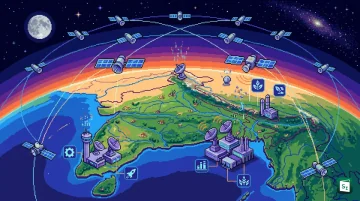
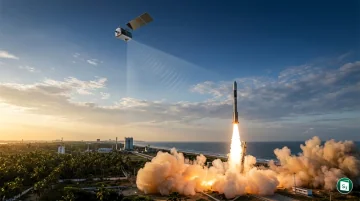
The Indian Space Promotion and Authorization Centre (IN-SPACe) has approved an agreement for the development of the first indigenous and fully commercial Earth Observation (EO) constellation of India under the Public Private Partnership (PPP) model.
The agreement is signed with a private consortium, Allied Orbits Pvt Ltd, which is led by PixxelSpace India Pvt Ltd and includes Dhruva Space Pvt Ltd, PierSight Space Pvt Ltd, and Satsure Analytics India Pvt Ltd.
The consortium will be responsible for the design, construction, ownership, and operation of the 12-satellite constellation. It is to be noted that the consortium will invest over ₹1,200 crore for the project, which is expected to be developed and operationalized by 2029.
Skyroot Aerospace Pvt Ltd has signed a Multi-Launch Agreement (MLA) with HEX20 for 3 dedicated Vikram-series missions.
The launches will support the Earth Observation constellation, in-orbit payload demonstration missions, and rideshare capacity for third-party spacecraft of the latter.
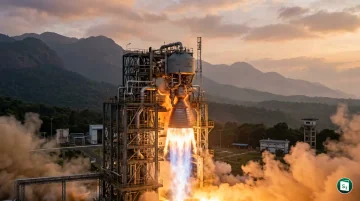
Astrobase Space Technologies Pvt Ltd has unveiled “EVEREST”, the first privately developed 800 kilonewton (kN) Full-Flow Staged Combustion (FFSC) rocket engine of India, in Bengaluru. The engine is specifically designed for reusable medium-lift launch vehicles and advanced orbital missions.
It is to be noted that Astrobase completed sub-scale and turbopump tests during 2025 and 2026, with plans to produce around 20 engines and conduct full-scale hot-fire testing in 2026.
The Indian National Space Promotion and Authorisation Centre (IN-SPACe) has released guidelines titled "Norms, Guidelines and Procedures for Implementation of Indian Space Policy-2023 in respect of Authorisation for Undertaking Planned Re-entry of Space Objects".
Under these guidelines, entities of India must obtain approval from IN-SPACe for the planned re-entry of space objects. Foreign entities intending to perform re-entry must apply through an entity incorporated in India. Entities are required to maintain a casualty risk of less than 1 in 10,000 and must submit trajectory and risk assessments for approval.
The Vikram Sarabhai Space Centre (VSSC), a unit of the ISRO, has signed an MoU with the Council of Scientific and Industrial Research-Indian Institute of Chemical Technology (CSIR-IICT) to jointly develop indigenous technology for next-generation, environmentally sustainable blowing agents.
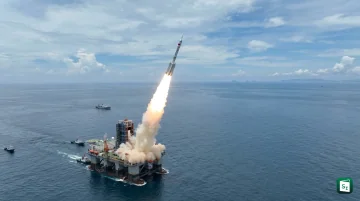
The Chinese aerospace company, Orienspace, has successfully launched its 'Gravity-1 Y4' carrier rocket from a sea-based platform in the East China Sea. The mission successfully deployed 9 satellites into their intended orbits.
It is to be noted that this was the 3rd flight of the rocket and its 1st long-range sea launch.
The Human Space Flight Centre (HSFC) of the ISRO has signed an Implementing Agreement (IA) with the Thiruvananthapuram-based Sree Chitra Tirunal Institute for Medical Sciences and Technology (SCTIMST) for collaboration in space medicine and Bioastronautics research and training.
Under this partnership, both institutions have launched India's first indigenous 2-year Postdoctoral Fellowship programme in Bioastronautics.
Indian Analog Astronaut Captain Aman Johri has successfully completed a microgravity research flight under 'Project Astra Farm'.
The mission focused on studying the behavior of onions and potatoes grown in Maharashtra under microgravity conditions. The research was conducted using a passive microgravity payload in collaboration with the National Research Council Canada (NRC-CNRC).
Reliance Jio Infocomm Ltd (Jio) has received technical approval from the Indian National Space Promotion and Authorisation Centre (IN-SPACe) to deploy a Low Earth Orbit (LEO) satellite constellation consisting of 1,600 satellites.
The company intends to file for global orbital slots under the International Telecommunication Union (ITU) to launch India's first home-grown satellite broadband constellation. The project aims to provide a capacity of 4.5–5 Tbps, supported by 20–22 ground stations in India.
The Japan Aerospace Exploration Agency (JAXA) has successfully conducted the inaugural lift-off and landing test of its reusable rocket prototype, 'RV-X', at the Noshiro Testing Center in Japan.
The prototype is developed in partnership with Mitsubishi Heavy Industries (MHI). It measures 7.3 m in length and 1.8 m in diameter, featuring an enhanced-durability engine and 4 shock-absorbing landing legs.
China has successfully executed the first controlled recovery of an orbital-class reusable rocket booster following the maiden launch of the Long March-10B carrier rocket from Hainan Province.
It is to be noted that this comes over a decade after SpaceX became the first entity to recover an orbital-class rocket booster in 2015.
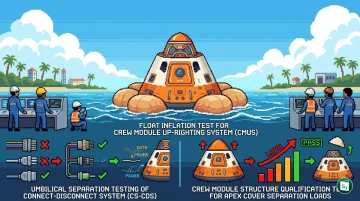
ISRO has successfully conducted 3 critical tests of the Gaganyaan Crew Module (CM) systems as part of the human spaceflight programme of India.
These tests included the float inflation test for the Crew Module Up-Righting system (CMUS), the Umbilical Separation Testing of the Connect-Disconnect System (CS-CDS), and the crew module structure qualification test for Apex Cover separation loads.
The ISRO has successfully conducted the Integrated Main Parachute Airdrop Test-05 (IMAT-05) for the Gaganyaan G1 mission at the Aerial Delivery Research and Development Establishment (ADRDE) drop zone in Sheopur, Madhya Pradesh.
The test aimed to validate the Main Parachute System under maximum expected load conditions for the first uncrewed Gaganyaan G1 mission. It is to be noted that the Gaganyaan Crew Module uses a system of 10 parachutes of 4 distinct types.
China has launched its latest oceanographic satellite, 'Haiyang (HY)-2E', aboard a Long March 4B rocket from the Jiuquan Satellite Launch Center (JSLC) in Northwest China.
This marks the 47th space mission of China in 2026 and the 654th flight of the Long March rocket series.
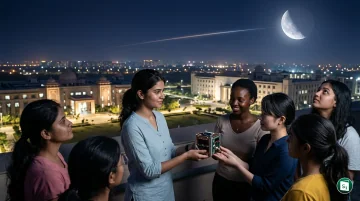
Gautam Buddha University (GBU) has partnered with Space Kidz India and the Indian National Space Promotion and Authorisation Centre (IN-SPACe) to support "Mission ShakthiSAT".
The mission is the world's first all-girls international lunar mission. The initiative aims to empower 12,000 young girls from 108 countries. Mahima Rajput, a student from Raipur, Chhattisgarh, has been selected to participate in this international space mission.
Finland-based ICEYE has signed a partnership agreement with Chennai-based AgniKul Cosmos to build, launch, and operate Synthetic Aperture Radar (SAR) Earth observation systems from India. Both companies will collaborate to develop an end-to-end sovereign SAR Earth observation capability.
France-based Safran Electronics & Defence and the Indian Earth intelligence firm SatSure Analytics India Pvt Ltd have signed an MoU to collaborate on Geospatial Intelligence (GEOINT) solutions for the Indian market.
This partnership is established under the 'France-India Year of Innovation' initiative, which aims to promote cooperation in aerospace and defence technology.
ISRO has successfully conducted a hot test of its semi-cryogenic engine power head at the ISRO Propulsion Complex (IPRC) in Tamil Nadu. The test demonstrated stable operation at a thrust level of 175 tons, achieving 88% of the target thrust.
This semi-cryogenic propulsion stage is being developed to replace the L110 core stage on the LVM3 (Launch Vehicle Mark 3) launch vehicle. The system is powered by the 2,000-kilonewton (kN) SE2000 engine.