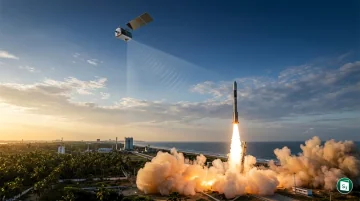
Finland-based ICEYE has signed a partnership agreement with Chennai-based AgniKul Cosmos to build, launch, and operate Synthetic Aperture Radar (SAR) Earth observation systems from India. Both companies will collaborate to develop an end-to-end sovereign SAR Earth observation capability.

France-based Safran Electronics & Defence and the Indian Earth intelligence firm SatSure Analytics India Pvt Ltd have signed an MoU to collaborate on Geospatial Intelligence (GEOINT) solutions for the Indian market.
This partnership is established under the 'France-India Year of Innovation' initiative, which aims to promote cooperation in aerospace and defence technology.
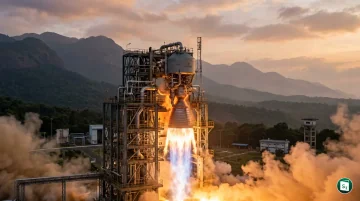
ISRO has successfully conducted a hot test of its semi-cryogenic engine power head at the ISRO Propulsion Complex (IPRC) in Tamil Nadu. The test demonstrated stable operation at a thrust level of 175 tons, achieving 88% of the target thrust.
This semi-cryogenic propulsion stage is being developed to replace the L110 core stage on the LVM3 (Launch Vehicle Mark 3) launch vehicle. The system is powered by the 2,000-kilonewton (kN) SE2000 engine.
The ISRO, in collaboration with the Department of Atomic Energy (DAE), is developing an advanced artificial heating system for future lunar landers. This technology is designed to enable landers to survive lunar nights, where temperatures drop below –129°C.
It is to be noted that this system aims to extend the operational life of lunar landers from the current duration of one lunar day (14 Earth days) to up to 200 days.
The Indian National Space Promotion and Authorisation Centre (IN-SPACe) has selected 3 Indian space startups as the first set of Non-Governmental Entities (NGEs) to receive funding under its Technology Adoption Fund (TAF) scheme.
The selected startups are Astrobase Space Technologies Pvt Ltd (Bengaluru), SatSure Analytics India Pvt Ltd (Bengaluru), and TM2SPACE Technologies Pvt Ltd (Hyderabad). Under this initiative, SatSure Analytics India Pvt Ltd will develop a Large Earth Observation Model (LOM) named "Dhaarini".
The World Economic Forum (WEF) has released its “2026 Technology Pioneers” cohort, which features 100 early-stage companies from 23 countries. The USA leads the list with 43 startups, followed by China and the UK.
India is represented by 9 startups in the 2026 cohort (compared to 10 in the 2025 list), bringing the total number of Indian firms in the WEF cohort to 28. The selected companies will contribute to WEF initiatives through a two-year engagement program.
The Indian National Space Promotion and Authorization Centre (IN-SPACe) has signed an agreement with the Gujarat government to develop a Common Technical Facility (CTF) for the space-tech sector at the Gujarat Industrial Development Corporation (GIDC) in Khoraj, Gujarat.
IN-SPACe will provide technical expertise and financial assistance of up to ₹100 crore for the procurement of equipment required for the development of the CTF.
Technology Hub (T-Hub) has inaugurated the third cohort of the ORBIT programme, an Atal Innovation Mission (AIM)-supported Atal Innovation Incubation Centre (AIC)-T-Hub Space-Tech Accelerator Programme. The third cohort includes 13 startups, including Sanyak Space Technologies, Humanity Space, Red Balloon Aerospace, and Nibiaa Devices.
With this, the ORBIT programme has supported 36 space-tech startups in total, while the broader space-tech initiatives of T-Hub have engaged over 100 startups. It is to be noted that previous cohorts have collectively raised nearly ₹30 crore in funding and developed 18 Intellectual Properties (IPs).
The Chandrayaan-2 spacecraft, orbiting the Moon since 2019, has provided evidence of subsurface water ice deposits within the permanently shadowed regions (PSRs) of lunar south polar craters. This study, conducted by the Physical Research Laboratory (PRL) in Ahmedabad, was published in the Nature Portfolio Journal (NPJ) Space Exploration.
Researchers utilized the Dual-Frequency Synthetic Aperture Radar (DFSAR) to analyze ‘doubly shadowed craters’ within the PSRs. The findings from a 1.1 km crater in the Faustini Basin indicate an impact into an ice-rich subsurface that briefly flowed before refreezing.
An international team of researchers led by Dr. Ronaldo Laishram from the National Astronomical Observatory of Japan (NAOJ) has discovered an ancient cosmic structure named the “Loktak Protocluster”.
Located 12.6 billion light-years away in the constellation Sextans, the structure allows astronomers to observe the universe as it existed when it was only 1.2 billion years old (9% of its current age).
It is named after Loktak Lake in Manipur, the largest freshwater lake in Northeast India, famous for its “phumdis” (floating masses of vegetation). The discovery was made by integrating data from the Japan-based Subaru Telescope and the James Webb Space Telescope (JWST) of NASA.
The Ministry of Jal Shakti has signed an MoU with the ISRO to enhance water resource management using satellite technology. The collaboration involves joint research across 24 key areas. It is to be noted that the Ministry has already supported 113 research projects in the water sector over the past decade.
Additionally, the third phase of the Jal Sanchay Jan Bhagidari (JSJB) campaign has been launched, aiming to create 2 crore water conservation structures between June 2026 and May 2027. The previous phase of the campaign successfully created over 1.5 crore water conservation structures.
The National Aeronautics and Space Administration (NASA) has unveiled a $20 billion, 3-phased plan to establish a permanent lunar base equipped with rovers and drones.
The plan aims to set up the base by March 2027, with the objective of landing astronauts on the moon in 2028. The mission is structured into 3 phases: Moon Base-I (2026-2028), Moon Base-II (2029-2032), and Moon Base-III (2032 onwards).
The Birla Institute of Technology Mesra (BIT Mesra) has signed an MoU with the North Eastern Space Applications Centre (NESAC), which functions under the Department of Space (DoS) and the North Eastern Council (NEC).
The MoU is valid for 5 years and aims to strengthen cooperation in the fields of geospatial technologies, Geospatial Artificial Intelligence (GeoAI), remote sensing, and higher education.
China has launched the Shenzhou-23 spacecraft carrying 3 astronauts to the Tiangong Space Station for scientific research and orbital operations.
The spacecraft was launched onboard a Long March-2F Y23 (LM-2F Y23) carrier rocket from the Jiuquan Satellite Launch Center. The mission marks the first spaceflight of the country expected to support a year-long human residency in orbit. It is scheduled to conduct over 100 scientific experiments during its orbital tenure.
Red Balloon Aerospace has launched “Mission SANA”, the first indigenous super-pressure platform of India carrying commercial payloads from 7 national and international partners.
The launch places India among only 5 nations globally, alongside the United States, France, Japan, and China, to possess indigenous stratospheric (hydrogen) balloon capability.
The VISTA super-pressure platform of the company ascended to an altitude of 25 km above Earth from the Indira Gandhi Stadium in Vijayawada, Andhra Pradesh. It is to be noted that Red Balloon Aerospace, established in 2025, achieved operational commercial flight within an 8-month timeframe.
The Department of Space (DoS) has approved the establishment of Common Technical Facilities (CTFs) in Gujarat and Tamil Nadu. The initiative aims to strengthen the space ecosystem of India by promoting domestic manufacturing capabilities and supporting the growth of the space sector industry base.
Under this, a Space Manufacturing Park will be established at Khoraj, Gujarat, while a Space Vehicles Cluster will be set up at Thoothukudi, TN.
The Chandrayaan-3 mission of the ISRO has received the 2026 Goddard Astronautics Award from the American Institute of Aeronautics and Astronautics (AIAA).
The award was presented at the Accelerating Space Commerce, Exploration, and New Discovery (ASCEND) 2026 Conference held in Washington DC, USA. Vinay Kwatra, the Ambassador of India to the USA, accepted the award on behalf of ISRO.
The European Space Agency (ESA) and the Chinese Academy of Sciences (CAS) have successfully launched a joint spacecraft named “Solar wind Magnetosphere Ionosphere Link Explorer (SMILE)” onboard the Vega-C rocket from the Kourou Spaceport in French Guiana.
It is to be noted that the scientific observations are scheduled to begin 3 months post-launch, and the SMILE mission is projected to operate for a duration of 3 years to improve protection against solar and geomagnetic storms.
Professor Kuljeet Kaur Marhas has been elected as a Fellow of The Meteoritical Society, becoming the first Indian woman to receive this distinction. She is the third Indian scientist to be awarded this international honour, following space scientists Devendra Lal and JN Goswami.
The Bureau of Indian Standards (BIS), under the Department of Consumer Affairs, has organized the 35th Plenary and Working Groups meetings of the International Organization for Standardization (ISO) Technical Committee (TC) 20 / Subcommittee (SC) 14. The meetings for the ‘Space Systems and Operations’ subcommittee were hosted for the first time in India at Bharat Mandapam, New Delhi.
The event saw the participation of 131 international delegates from 13 countries. It is to be noted that the ISO/TC 20/SC 14 is responsible for developing international standards for space systems to ensure safety and sustainability in global space activities.