
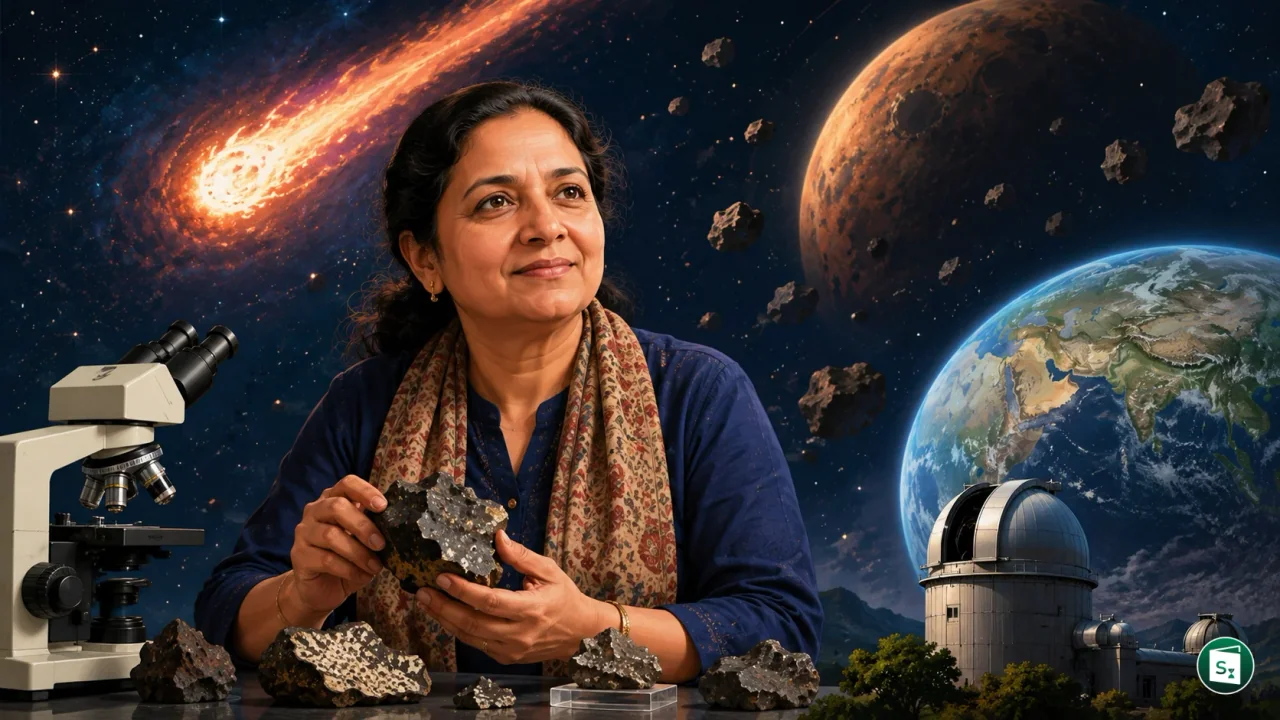
Professor Kuljeet Kaur Marhas from the Physical Research Laboratory in Ahmedabad has been elected as a Fellow of The Meteoritical Society, becoming the first Indian woman to achieve this milestone. She is only the third Indian scientist to receive this international recognition, following space pioneers Devendra Lal and J. N. Goswami. This fellowship honors her pioneering research in cosmochemistry, particularly her investigations into the origin and evolutionary processes of the early Solar System.
Who is Professor Kuljeet Kaur Marhas?
Professor Kuljeet Kaur Marhas is a senior planetary scientist serving in the Planetary Science Division of the Physical Research Laboratory in Ahmedabad. She completed her doctoral research at the Physical Research Laboratory and went on to conduct advanced postdoctoral research at several prominent international institutions, including Washington University in St. Louis in the United States. Throughout her career, she has specialized in the chemical and isotopic analyses of cosmic materials, mapping the origins of the Solar System.
Her research employs laboratory-based analytical techniques rather than observational telescopes, a branch of planetary science often referred to as experimental cosmochemistry. Over the years, her scientific insights have earned her prestigious recognitions, including election as a Fellow of the American Geophysical Union and the receipt of the Devendra Lal Memorial Medal for outstanding contributions to Earth and space sciences. Her election to the class of 2026 Fellows of The Meteoritical Society cements her status as a global leader in planetary science.
Significance of the Meteoritical Society Fellowship
The Meteoritical Society, established in 1933 as the Society for Research on Meteorites, is a leading international organization dedicated to planetary science. It focuses on the study of meteorites, cosmic dust, asteroids, and other extraterrestrial materials to decode the history of our Solar System. The society is a global non-profit body governed by an elected council, and it publishes prominent scientific journals such as Meteoritics & Planetary Science.
Election to the status of Fellow is a lifetime honor reserved for members who have demonstrated exceptional and sustained contributions to the field of meteoritics or planetary science. Historically, this global group of Fellows has been highly selective. The election of a scientist from India is a rare distinction, and the selection of the first Indian female Fellow highlights the growing role of Indian women in cutting-edge planetary research.
Core Scientific Contributions and Research Focus
Professor Marhas has pioneered methods for analyzing ancient extraterrestrial matter. Her work focuses on reconstructing the conditions of the early Solar System before or during the formation of the Sun and planets.
Explaining Short-Lived Radionuclides and Presolar Grains
One of her key research areas is the study of short-lived radionuclides, which are radioactive isotopes that existed in the early Solar System but have since decayed completely into stable daughter isotopes. By analyzing primitive solids in meteorites, she has traced isotopes such as beryllium-10, aluminum-26, and calcium-41. This research helps resolve a major debate in planetary science: whether these radioactive isotopes were injected into the solar nebula by a nearby supernova or were generated locally by energetic flares from the young Sun.
Additionally, she studies presolar grains, which are microscopic stardust grains found in primitive meteorites. These grains formed in the outflows of dying stars before the birth of the Sun. Because they survived the formation of the Solar System, their isotopic compositions provide a record of stellar nucleosynthesis, the process by which stars create new chemical elements, and the evolution of the galaxy.
Role in India’s Space Research Infrastructure
Professor Marhas has also been instrumental in building India’s capability for advanced material analysis. After completing her research tenures abroad, she returned to the Physical Research Laboratory and led the establishment of a state-of-the-art Secondary Ion Mass Spectrometry (SIMS) and NanoSIMS facility. This facility allows scientists to perform high-resolution isotopic measurements of cosmic and terrestrial samples down to the sub-micron scale.
Her laboratory has analyzed samples returned by international space missions, including the National Aeronautics and Space Administration (NASA)‘s Stardust mission, which collected comet dust, the Japanese Hayabusa mission, which retrieved asteroid samples, and the lunar samples brought back by the Apollo program. This infrastructure makes the Physical Research Laboratory a vital node in global planetary material research.
Historical Context: Indian Fellows of the Meteoritical Society
In the 93-year history of the Meteoritical Society, only three Indian scientists have ever been elected as Fellows. All three of these scientists share a deep association with the Physical Research Laboratory in Ahmedabad, highlighting the institution’s role as the premier center for planetary science in India.
The first Indian to receive this honor was Devendra Lal, a prominent geophysicist who served as the Director of the Physical Research Laboratory from 1972 to 1983. He was elected a Fellow of the Meteoritical Society in 1970 for his pioneering research on cosmic ray interactions in planetary materials and terrestrial environments.
The second Indian Fellow was J. N. Goswami, a distinguished planetary scientist who also served as the Director of the Physical Research Laboratory. He is widely recognized for his leadership as the principal scientist for India’s first lunar mission, Chandrayaan-1, and for his extensive research on early solar flare activity recorded in primitive space materials.
The election of Kuljeet Kaur Marhas in 2026 as the third Indian Fellow, and the first Indian woman, continues this legacy. To summarize their contributions and milestones, the table below provides a comparative overview:
| Scientist | Year of Election | Primary Institution | Key Scientific Focus |
|---|---|---|---|
| Devendra Lal | 1970 | Physical Research Laboratory | Cosmic ray interactions and geophysics |
| J. N. Goswami | (Elected Fellow) | Physical Research Laboratory | Lunar exploration and early Solar System chronology |
| Kuljeet Kaur Marhas | 2026 | Physical Research Laboratory | Cosmochemistry, short-lived radionuclides, and NanoSIMS facility |
Key Takeaways
- Professor Kuljeet Kaur Marhas was elected as a Fellow of The Meteoritical Society in May 2026, becoming the first Indian woman to achieve this milestone.
- She is only the third Indian scientist to receive this fellowship, following space scientists Devendra Lal and J. N. Goswami.
- The Physical Research Laboratory in Ahmedabad, established in 1947 by Dr. Vikram Sarabhai, serves as the primary institution for all three Indian Fellows.
- The Meteoritical Society, founded in 1933 in Chicago, is a global scholarly organization focused on the study of extraterrestrial materials such as meteorites and cosmic dust.
- Professor Marhas’s research focuses on short-lived radionuclides and presolar grains using high-precision techniques like Secondary Ion Mass Spectrometry (SIMS).