

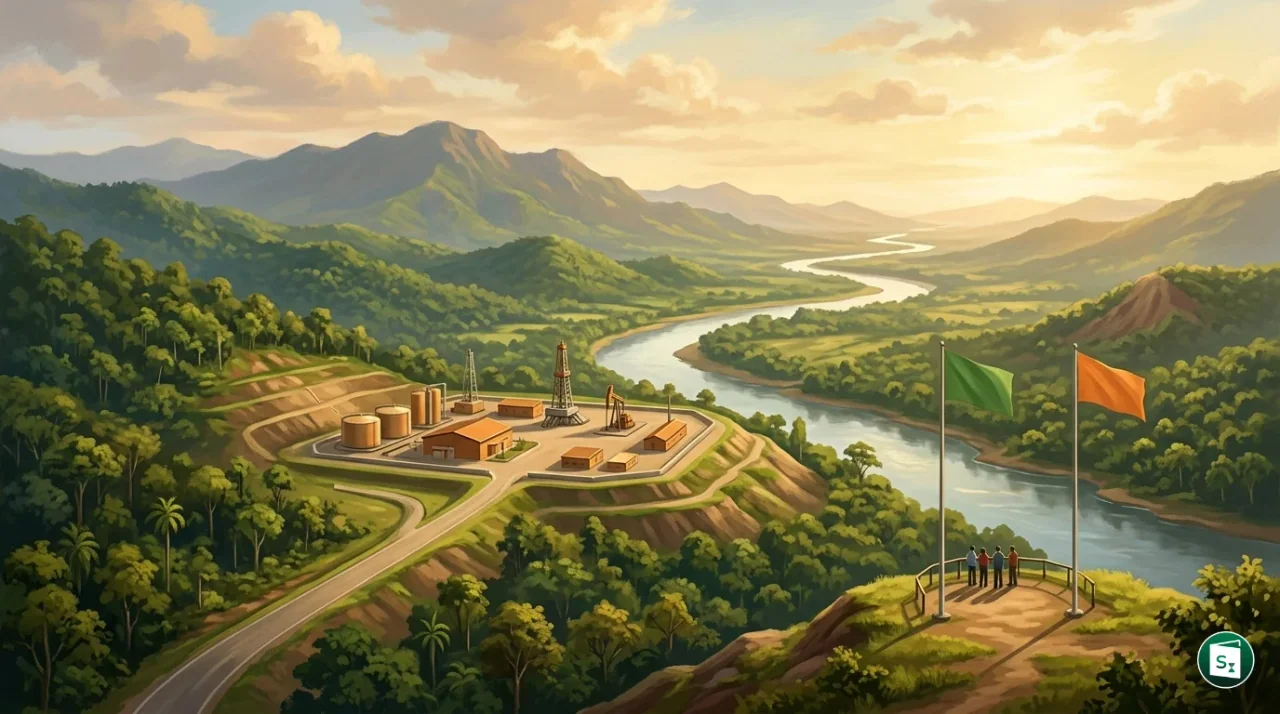
The Government of India signed a historic tripartite Memorandum of Understanding with Assam and Nagaland on June 11, 2026, to resume oil and gas exploration in their disputed border regions. This landmark agreement aims to resolve a 31 year deadlock by establishing a 50:50 revenue sharing model for resources extracted from the contested areas. By decoupling economic development from territorial claims, the pact seeks to unlock the massive hydrocarbon potential of the Northeast while strengthening regional cooperation.
A Historic Breakthrough in Border Resource Management
The tripartite agreement was formalized in New Delhi in the presence of Union Home Minister Amit Shah and Union Minister for Petroleum and Natural Gas Hardeep Singh Puri. The Chief Ministers of both states, Himanta Biswa Sarma of Assam and Neiphiu Rio of Nagaland, participated in the signing ceremony. Under the terms of the Memorandum of Understanding (MoU), both states have agreed to a 50:50 revenue sharing formula for all hydrocarbon resources extracted from the contested boundary zones.
This arrangement covers an expansive area of over 1,000 square kilometres along the 434 kilometre long border between the two states. The pact specifically targets six identified disputed oilfields, which have been categorized into Sectors A, B, C, D, E, and F. By establishing a clear financial framework, the agreement allows exploration and production activities to proceed without waiting for a final legal resolution of the boundary dispute. The Ministry of Petroleum and Natural Gas, which oversees the hydrocarbon sector in India, will facilitate the technical operations through state-run entities.
The 31-Year Impasse and the Disputed Area Belt
The conflict over the Assam-Nagaland boundary dates back to the creation of Nagaland as a separate state in 1963. Nagaland has long claimed several forest tracts currently within Assam, leading to a contested 434 kilometre boundary. The resource rich land along this border is known as the Disputed Area Belt (DAB). Due to administrative deadlocks and security concerns, oil exploration in this region was largely suspended in May 1994.
Before the standoff, the Oil and Natural Gas Corporation (ONGC) was the primary agency operating in these fields. ONGC was established in 1956 and is headquartered in New Delhi. It is a Maharatna public sector undertaking and remains the largest crude oil and natural gas company in India. For more than three decades, the potential of the Naga-Schuppen Belt remained untapped as both states asserted competing claims over jurisdictional and mineral rights.
Constitutional Tug-of-War: Article 371A vs Union List
At the heart of the legal dispute is the interpretation of Article 371A of the Constitution of India. This article, which stems from the 16-Point Agreement of 1960, provides special status to Nagaland. It specifies that no Act of Parliament regarding “ownership and transfer of land and its resources” shall apply to the state unless the Nagaland Legislative Assembly passes a resolution. Nagaland has historically argued that this gives the state exclusive rights over mineral oil and other natural resources found within its territory.
However, the Union Government has consistently pointed to Entry 53 of the Union List in the Seventh Schedule. This entry grants Parliament the exclusive power to regulate and develop oilfields and mineral oil resources. The impasse peaked in 2012 when Nagaland framed its own Petroleum and Natural Gas (NPNG) Regulations, which the Centre declared unconstitutional. The current 2026 agreement represents a political middle path that bypasses these legal contradictions to focus on shared economic benefits.
Economic and Strategic Significance for the Northeast
The resumption of oil operations is expected to transform the Northeast into a major energy hub for India. Officials estimate that the daily oil extraction capacity in this belt could increase tenfold, rising from the current 1,500 barrels per day to more than 15,000 barrels per day. A single field within the disputed area is projected to hold recovery potential valued at over ₹15,000 crore. The entire Naga-Schuppen Belt, which stretches through the Assam-Arakan Basin, is estimated to contain nearly 600 million metric tons of oil and gas reserves.
This surge in domestic production is a critical component of India’s strategy to reduce its heavy dependence on energy imports. Beyond energy security, the agreement is set to stimulate regional economic growth through infrastructure development and job creation. The Union Government has also indicated that the successful implementation of this MoU could lead to further mineral mining initiatives across other states in the Northeast. This project aligns with the broader vision of a prosperous and self reliant Northeast under the Act East Policy.
Strengthening Energy Infrastructure in the Northeast
The implementation of the tripartite agreement will involve major state run energy firms, including Oil India Limited (OIL) and the Oil and Natural Gas Corporation (ONGC). Oil India Limited, which is headquartered in Duliajan, Assam, has a long history of operations in the region. Assam is home to the Digboi refinery, which is the oldest operating refinery in Asia, having been established in 1901. The technical expertise of these organizations will be crucial in navigating the challenging terrain and geological complexities of the border belt.
Beyond hydrocarbon extraction, the MoU is seen as a major step toward resolving the broader Assam-Nagaland border dispute. By prioritizing shared economic interests, the agreement fosters an environment of trust between the two state governments. Union Minister Amit Shah highlighted that this “win-win” model serves as a template for other states to resolve territorial conflicts through cooperative federalism. This approach ensures that natural resources are utilized for national progress while safeguarding the financial interests of the local populations.
Key Takeaways
- The tripartite Memorandum of Understanding (MoU) was signed on June 11, 2026, between the Center, Assam, and Nagaland to resume oil exploration in disputed border areas.
- The agreement establishes a 50:50 revenue sharing formula for hydrocarbon resources extracted from the Disputed Area Belt (DAB).
- The pact covers over 1,000 square kilometres along the 434 kilometre long border and initially focuses on six identified oilfields.
- Article 371A of the Constitution provides special provisions for Nagaland regarding the ownership of land and resources, which was a core point of the long standing legal impasse.
- Exploration in this region was largely suspended in May 1994 and its resumption could increase regional oil production by more than tenfold.
- ONGC and Oil India Limited (OIL) are the primary state run entities that will facilitate the exploration and production activities in the Naga-Schuppen Belt.