

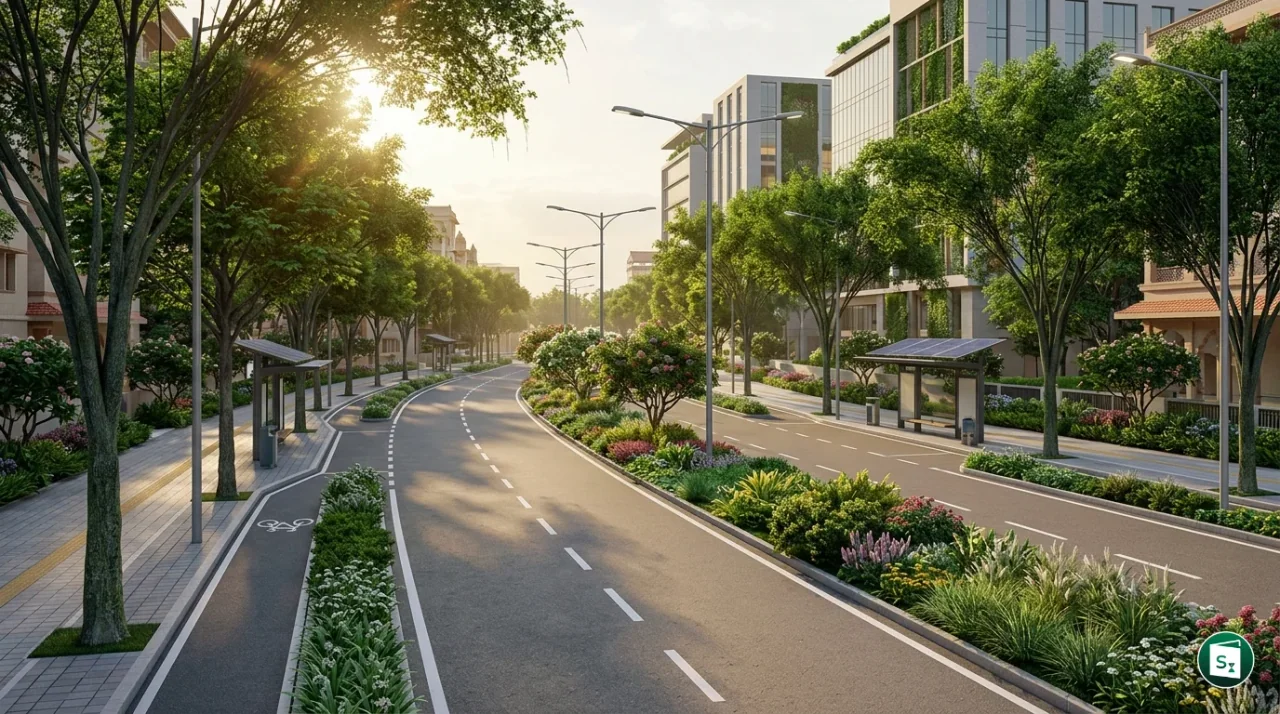
The Public Works Department of Uttar Pradesh, the Central Road Research Institute, and the School of Planning and Architecture, New Delhi, signed a tripartite Memorandum of Agreement on June 12, 2026. This collaboration focuses on implementing a scientific framework for paving and greening urban roads, primarily targeting districts within the National Capital Region. The initiative aims to modernize infrastructure while significantly reducing road dust, a major contributor to air pollution in urban clusters.
The Four Technical Pillars of Implementation
The scientific framework is structured into four specialized work packages that address different aspects of the urban road ecosystem. These pillars are designed to transform roads from mere transport corridors into integrated green assets.
| Work Package | Primary Focus | Key Deliverables |
|---|---|---|
| Space Standards | Road Cross-Sections | Redesigning layouts to maximize paving and greening within the right-of-way. |
| Greening Measures | Scientific Green Belts | Implementing multi-layered plantations using local dust-trapping species. |
| Asset Management | RAMS | Introducing data-driven tracking for proactive road health monitoring. |
| Innovative Materials | Sustainability | Promoting the use of recycled plastic waste and permeable paving solutions. |
Institutional Synergy and Nodal Roles
The collaboration leverages the unique strengths of two premier national institutions. The Central Road Research Institute (CSIR-CRRI), established in 1952 and headquartered in New Delhi, is a constituent laboratory of the Council of Scientific and Industrial Research (CSIR) under the Ministry of Science and Technology. It is the nodal agency for road engineering research in India, focusing on highway design, bridge engineering, and traffic management.
The School of Planning and Architecture (SPA), New Delhi, serves as the primary technical partner for urban design and streetscape planning. Originally founded in 1955 as the School of Town and Country Planning, it was integrated with the Department of Architecture in 1959. SPA New Delhi functions under the Ministry of Education and was declared an Institution of National Importance in 2014. Its role in this MoA involves creating aesthetic and functional road designs that incorporate Scientific Green Belts—multi-layered plantations of trees, shrubs, and grass that act as natural air filters.
Addressing the Air Quality Crisis in NCR
The primary driver behind this MoA is the urgent need to mitigate air pollution in the National Capital Region (NCR). Road dust is a major source of Particulate Matter (PM10 and PM2.5), which often exceeds safe limits in cities like Ghaziabad, Noida, and Meerut. By scientifically paving the edges of roads and creating dense green buffers, the framework aims to trap dust particles at the source.
The initiative aligns with the Commission for Air Quality Management (CAQM) directives to achieve “dust-free” urban centers. Beyond dust mitigation, the increased green cover will help mitigate the Urban Heat Island effect, where concrete surfaces trap heat and raise local temperatures. The use of local plant species ensures high survival rates and minimal water requirements, making the project ecologically sustainable in the long term.
Key Takeaways
- A tripartite MoA was signed on June 12, 2026, between CSIR-CRRI, UP PWD, and SPA New Delhi.
- The agreement aims to implement a scientific framework for paving and greening urban roads to reduce road dust and improve air quality.
- CSIR-CRRI, established in 1952, is the nodal laboratory for road research under the Ministry of Science and Technology.
- SPA New Delhi was declared an Institution of National Importance in 2014 and operates under the Ministry of Education.
- The project integrates the Road Asset Management System (RAMS) for data-driven maintenance and emphasizes the use of recycled materials.
- The initiative specifically targets districts in the National Capital Region (NCR) to address rising levels of PM10 and PM2.5 pollution.