

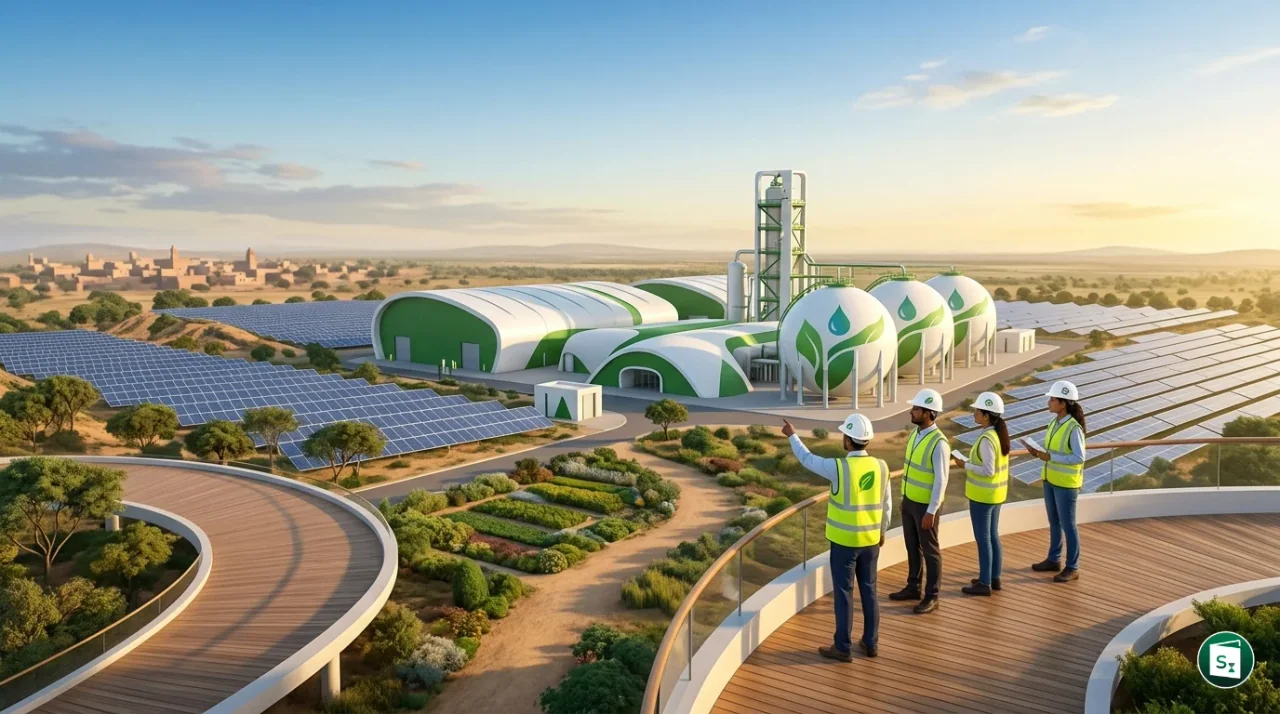
The International Finance Corporation (IFC) led a consortium of global investors to commit $105 million in equity to Hygenco Green Energies on June 12, 2026. This landmark transaction represents the first direct investment into India’s burgeoning green hydrogen sector by the IFC, Siemens Financial Services, and Fullerton Carbon Action Fund. The capital injection is set to accelerate the development of commercial scale green hydrogen and ammonia projects across the country, supporting India’s transition to a low carbon economy.
Financing Structure and Global Participation
The $105 million investment package is a combination of direct equity and blended finance. The International Finance Corporation (IFC) has committed a total of $50 million, which includes $25 million from its own account and another $25 million in blended finance. This blended portion consists of $20 million from the Clean Technology Fund (CTF) and $5 million from the Frontier Opportunities Fund, an initiative supported by the German government.
Other major participants in this funding round include Siemens Financial Services, which contributed $25 million, and the Fullerton Carbon Action Fund, which provided up to $30 million. The latter is managed by Fullerton Fund Management, a Singapore-based investment firm. This diverse group of investors brings together development finance, industrial expertise, and private institutional capital to scale up hydrogen infrastructure in India.
Hygenco: Pioneering “Hydrogen-as-a-Service”
Founded in 2020 by Amit Bansal, Anshul Gupta, and Aashish Gupta, Hygenco Green Energies is headquartered in Gurugram, Haryana. The company has positioned itself as a specialist in the “Hydrogen-as-a-Service” model. Under this model, Hygenco designs, builds, owns, and operates green hydrogen plants, allowing industrial customers to transition to clean energy without the burden of heavy capital expenditure or technical complexities.
The company has already achieved several milestones in India’s green hydrogen landscape. In March 2022, it commissioned Project Heartland in Ujjain, Madhya Pradesh, which serves as the country’s first 100% green hydrogen demonstration and research plant. Furthermore, its Project Steel One in Hisar, Haryana, became India’s first commercial megawatt scale green hydrogen plant, supplying clean fuel to Jindal Stainless Steel. Hygenco aims to develop 10 GW of green hydrogen and distribution assets by 2030.
Supporting the National Green Hydrogen Mission
This investment significantly bolsters India’s National Green Hydrogen Mission, which was launched in January 2023 with an initial outlay of ₹19,744 crore. The mission aims to make India a global hub for the production, usage, and export of green hydrogen. By scaling up domestic production, the government intends to reduce dependence on fossil fuel imports and achieve its goal of becoming Net Zero by 2070.
The mission has set several ambitious targets to be achieved by 2030:
- Development of a green hydrogen production capacity of at least 5 Million Metric Tonnes (MMT) per annum.
- Addition of approximately 125 GW of renewable energy capacity dedicated to hydrogen production.
- Abatement of nearly 50 MMT of annual greenhouse gas emissions.
- Mobilization of over ₹8 lakh crore in total investments.
- Creation of over 6 lakh jobs in the clean energy sector.
Understanding the Colors of Hydrogen
The classification of hydrogen is based on the source of energy and the production method used. While hydrogen is a colorless gas, these labels help in identifying its environmental impact.
| Color Type | Production Method | Energy Source | Carbon Impact |
|---|---|---|---|
| Green | Electrolysis | Renewable Energy | Zero |
| Blue | Steam Methane Reforming (SMR) | Natural Gas + Carbon Capture | Low |
| Grey | Steam Methane Reforming (SMR) | Natural Gas | High |
| Brown | Gasification | Coal | Very High |
Green Hydrogen is produced by splitting water into hydrogen and oxygen using an electrolyzer powered by renewable energy like solar or wind. This process produces no carbon dioxide as a byproduct, making it the most sustainable choice for industrial decarbonization. In contrast, Grey Hydrogen, which currently dominates the market, relies on natural gas and releases significant amounts of CO2 into the atmosphere. Blue Hydrogen acts as a bridge technology by capturing and storing the carbon emissions generated during production from fossil fuels.
The Global Role of the IFC
The International Finance Corporation (IFC) is the largest global development institution focused exclusively on the private sector in developing countries. Established on July 20, 1956, and headquartered in Washington, D.C., the IFC is a member of the World Bank Group. Unlike other World Bank arms that provide loans to governments, the IFC provides loans, equity, and advisory services to private companies in emerging markets.
India is a founding member and the largest client country for the IFC globally. As of early 2026, the IFC’s investment portfolio in India is managed under the leadership of Ajay Banga, who serves as the President of the World Bank Group and the IFC. In January 2024, Imad N. Fakhoury was appointed as the Regional Director for South Asia, based in New Delhi. The IFC aims to reach an annual investment of $10 billion in India by 2030, focusing on climate finance, infrastructure, and the growth of small and medium enterprises.
Key Takeaways
- Hygenco Green Energies secured a $105 million investment from an IFC led consortium to develop commercial scale green hydrogen projects in India.
- The International Finance Corporation (IFC) committed $50 million, marking its first direct investment in India’s green hydrogen sector.
- The investment includes $25 million from Siemens Financial Services and up to $30 million from Fullerton Carbon Action Fund.
- Hygenco, headquartered in Gurugram, operates on a “Hydrogen-as-a-Service” model to provide clean fuel to industries like steel and refining.
- The National Green Hydrogen Mission, launched in 2023, targets a production capacity of 5 MMT per annum by 2030.
- The IFC, established in 1956, is the private sector arm of the World Bank Group and is headquartered in Washington, D.C.