RBI has issued the "Master Directions – RBI (Credit Derivatives) Directions, 2026", which will come into effect on June 25, 2026. These directions aim to deepen the corporate bond market in India and expand the range of risk-management tools for market participants.
The framework introduces new products, including Total Return Swaps (TRS) linked to corporate bonds and derivatives on credit indices. Additionally, the RBI has mandated the creation of a Credit Derivatives Determinations Committee under the Fixed Income Money Market and Derivatives Association of India (FIMMDA) to support market development.
The RBI has revamped the Kisan Credit Card (KCC) scheme by standardizing the definition of crop seasons to ensure uniform loan processing and repayment. The 'KCC Directions, 2026' will be applicable to all loans sanctioned under the scheme from January 2027.
The objective of these directions is to establish a framework for providing adequate and timely credit support through the banking system to meet the working capital and investment credit requirements of borrowers engaged in agriculture and allied activities.
The RBI has directed banks to exempt agricultural and allied sector loans up to ₹2 lakh per borrower from collateral security and margin requirements under the updated guidelines of the Kisan Credit Card (KCC) scheme.
Furthermore, the voluntary pledge of gold and silver as collateral for agricultural loans up to the collateral-free limit of ₹2 lakh will not be considered a violation of the guidelines on collateral-free lending.
The RBI has cancelled the licence of Karnataka-based Shree Mahalaxmi Urban Co-operative Credit Bank. The cancellation was due to inadequate capital and lack of earning prospects of the bank.
Bank of Baroda has launched the 'bob Golden Goal Deposit Scheme', a 555-day retail term deposit plan for deposits below ₹3 crore, offering interest rates up to 7.4% per annum.
The bank has also introduced the 'bob Legend Foreign Currency Non-Resident (Bank) [FCNR(B)]' deposit scheme, which offers interest rates of 6% for tenures of 3 to less than 4 years, 6.1% for 4 to less than 5 years, and 6.5% for 5-year deposits.
The RBI has approved the extension of the tenure of Keki Mistry as the Interim Part-Time Chairman of HDFC Bank Limited for a period of 3 months. He will continue in the position until 18 September 2026.
The RBI has relaxed capital requirements for bank loans backed by the Emergency Credit Line Guarantee Scheme (ECLGS 5.0), effective immediately.
Under the revised norms, 75% of the guaranteed portion of the loan attracts a zero-risk weight, while the remaining 25% of the exposure attracts a 20% risk weight. To qualify for the 0% risk weight, banks must settle claims within 30 days from the date of invocation.
The RBI has launched "RBI Reelathon 2026", a statewide cyber fraud awareness campaign in Kerala.
The initiative is being conducted across 150 colleges in the state to promote financial literacy, cyber hygiene, safe digital banking, smart borrowing, and vigilance against online financial threats through student engagement and a reel-making competition.
The Government of India has nominated Sanjay Lohiya as a Non-Executive Director on the Central Board of the RBI and the State Bank of India (SBI). He succeeds M Nagaraju.
The RBI has issued the “Third Amendment Directions, 2026” to govern bank lending to Real Estate Investment Trusts (REITs) and Infrastructure Investment Trusts (InvITs), while strengthening risk and exposure norms.
Banks are permitted to extend credit only to those REITs and InvITs that are registered with the SEBI and listed on recognized Stock Exchanges. Lending to REITs is restricted to listed trusts where at least 80% of assets consist of cash-generating properties that have been operational for more than 1 year.
Banks may lend to listed InvITs only if at least 80% of their assets are invested in completed and revenue-generating infrastructure projects that have demonstrated positive cash flows for a period exceeding 1 year.
The Government of India has re-appointed Swaminathan Janakiraman as the Deputy Governor of the RBI for a tenure of 2 years. This re-appointment will be effective from June 26, 2026.
The RBI has imposed a monetary penalty of ₹41.8 lakh on Canara Bank for failing to comply with regulatory norms. The fine was imposed after a supervisory review revealed lapses in ‘Know Your Customer’ (KYC) norms and account classification.
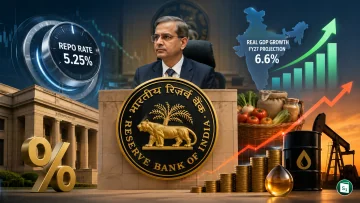
The Monetary Policy Committee (MPC) of the RBI, chaired by Governor Sanjay Malhotra, held its second bi-monthly meeting for FY27. The committee unanimously voted to maintain the policy repo rate at 5.25% and retained a ‘neutral’ stance.
The RBI has maintained other key policy rates: Standing Deposit Facility (SDF) rate at 5%, Marginal Standing Facility (MSF) rate at 5.5%, Bank Rate at 5.5%, Cash Reserve Ratio (CRR) at 3%, and Statutory Liquidity Ratio (SLR) at 18%. The real GDP growth projection for India for FY27 is revised to 6.6% from 6.9%.
The quarterly real GDP growth is projected at 6.6% for Q1, 6.3% for Q2, 6.5% for Q3, and 6.8% for Q4. The Consumer Price Index (CPI) inflation projection is increased to 5.1% from 4.6%, and core inflation to 4.7% from 4.4%. Additionally, the baseline crude oil price projection is revised to $95 per barrel, up from $85 per barrel.
The Ministry of Finance has introduced reforms to increase the participation of Foreign Portfolio Investors (FPIs) in Government Securities (G-Secs).
The measures include tax exemptions on interest income, Long Term Capital Gains (LTCG), and Short Term Capital Gains (STCG). Additionally, the reforms involve the expansion of specified securities under the Fully Accessible Route (FAR).
The Government of India (GoI) has extended the Credit Guarantee Scheme for Microfinance Institutions-2.0 (CGSMFI-2.0) until August 2026 or until guarantees amounting to ₹20,000 crore are issued, whichever is earlier.
The government has also increased the maximum loan amount cap for Large Sized Non-Banking Financial Company-Micro Finance Institutions (NBFC-MFIs)/Micro Finance Institutions (MFIs) from ₹300 crore to ₹1,000 crore, subject to an overall ceiling of 20% of Assets under Management (AUM).
The RBI has introduced two special USD-Rupee forex swap facilities to attract foreign currency inflows and support external financing.
The first facility is for fresh Foreign Currency Non-Resident Bank (FCNR (B)) deposits, allowing Authorised Dealer (AD) Category-I banks to access the RBI’s forex swap facility (available in USD only) for deposits raised in any freely convertible currency.
The second facility is for eligible External Commercial Borrowings (ECBs) with an average maturity of 3 years and above, and overseas Foreign Currency Borrowings (OFCBs) raised by AD Category-I banks with a minimum maturity of 3 years.