
Welcome to Scoreclever ⏳ Current Affairs 🌏

  • 👉 Detailed daily current affairs on website
  • 👉 Crisp current affairs on daily PDFs
  • 👉 Easy memorization and revision with app

Recent Current Affairs related to RBI

171 News
8 October 2026 BANKING

Bank of India (BOI), a Public Sector Bank (PSB), has launched a User-Level Programmable Central Bank Digital Currency (CBDC) with auto-issuance capability.

The system allows users to automate recurring Digital Rupee (e₹) payments and specify the purpose for which the funds can be used. It is to be noted that the technical functionality for this programmable CBDC solution was developed by Montran India.
7 October 2026 DEFENCE

Union Minister Rajnath Singh has launched several digital and financial management initiatives during the 279th Annual Day of the Defence Accounts Department (DAD) held at DRDO Bhawan in New Delhi.

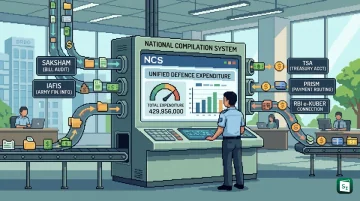
As part of the event, the System for Accounting and Knowledge Sharing Management (SAKSHAM), which serves as the bill audit and payment system of the DAD, was integrated with the Indian Army Financial Information System (IAFIS).

The Treasury Single Account (TSA) system was operationalised through the Payment Routing and Integrated System Management (PRISM) platform and integrated with the Reserve Bank of India (RBI) e-KUBER system. A revamped National Compilation System (NCS) was also introduced to function as a unified platform for the accounting and compilation of overall defence expenditure.

6 October 2026 ECONOMY

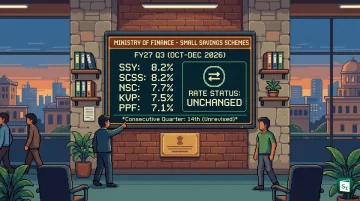
The Department of Economic Affairs under the Ministry of Finance (MoF) has maintained the interest rates for all Small Savings Schemes (SSS) for the third quarter (Q2) of the FY27. This marks the 14th consecutive quarter without a revision since the last adjustment in December 2024.

The interest rates for Sukanya Samriddhi Yojana (SSY) and Senior Citizen Savings Scheme (SCSS) are fixed at 8.2%. The rates for National Savings Certificate (NSC), Kisan Vikas Patra (KVP), and Public Provident Fund (PPF) are 7.7%, 7.5%, and 7.1% respectively.

It is to be noted that the MoF has performed quarterly reviews of SSS interest rates since 2016 based on the methodology of the Shyamala Gopinath Committee (2023). Under this framework, SSS rates are kept 25 to 100 basis points (bps) higher than the government bond yields.

6 October 2026 BANKING

Anup Bagchi has been appointed as the MD and CEO of HDFC Bank for a 3-year term starting October 27, 2026. He succeeds Sashidhar Jagdishan.

Anup Kumar Saha is appointed as the MD & CEO of Kotak Mahindra Bank Ltd for 3 years, starting January 2027. He succeeds Ashok Vaswani. Mahesh Muralidhar Pai has been appointed as the MD & CEO of the South Indian Bank for a 3-year term starting October 2026. He succeeds PR Seshadri.

5 October 2026 ECONOMY

According to the monthly bulletin of the RBI, the net Foreign Direct Investment (FDI) into India reached a five-year high of $7.35 billion in July 2026. This is the highest recorded inflow since May 2021 when it stood at $8.80 billion.

The net FDI in July 2026 represents a 64% increase compared to the same period in the previous year. The cumulative net FDI for the period from April to July 2026 reached $13.4 billion.

3 October 2026 ECONOMY

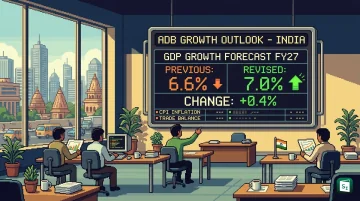
According to the “Asian Development Outlook (ADO) September 2026: Navigating Prolonged Energy Shocks and El Nino” report released by the Asian Development Bank (ADB), the Gross Domestic Product (GDP) growth of India for FY27 is raised to 7% (an increase of 40 basis points from the earlier estimate of 6.6%).

The report also projected the inflation rate of India for FY27 at 5%.

3 October 2026 BANKING

Sagarmala Finance Corporation Ltd has launched the inaugural blue bond in India. The bond aims to raise ₹600 crore, with a ₹500 crore green shoe option, and has a tenor of 10 years.

The debt offering received an AA+ rating, signifying its status in the upper tier of domestic debt instruments, and SBI Capital Markets served as the arranger for the issuance. It is to be noted that SMFCL is the first NBFC in India dedicated to the maritime sector.

30 September 2026 ECONOMY

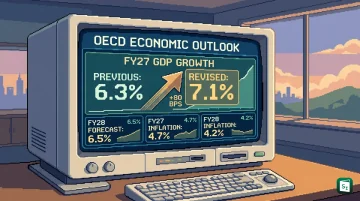
According to the “OECD Economic Outlook, Interim Report September 2026: Weathering Successive Shocks” released by the Organisation for Economic Cooperation and Development (OECD), the Gross Domestic Product (GDP) growth of India for FY27 is revised upwards by 80 basis points (bps) to 7.1% from the earlier 6.3%.

The growth for FY28 is projected at 6.5%. The report also estimated the inflation of India for FY27 and FY28 at 4.7% and 4.2% respectively.

30 September 2026 BANKING

RBI has issued final directions titled ‘RBI (Commercial Banks - Minimum Capital Requirements for Market Risk) Directions, 2026’ outlining the minimum capital requirement for market risk under the Basel III framework for commercial banks. The new framework will come into effect on April 1, 2027.

Additionally, the RBI has eased KYC requirements for Foreign Portfolio Investors (FPIs), allowing them to submit original certified copies of specified documents certified by authorised authorities outside India. These directions came into force with immediate effect from September 18, 2026.

29 September 2026 BANKING

RBI has issued directions to alter the valuation norms for units of Infrastructure Investment Trusts (InvITs) and Real Estate Investment Trusts (REITs) held by All-India Financial Institutions (AIFIs).

The revised valuation directions came into effect immediately. It is to be noted that the India REIT market hits $17.7 billion, overtakes Hong Kong to become Asia’s 4th largest.

28 September 2026 ECONOMY

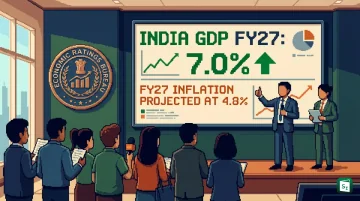
According to the report “Economic Outlook Asia-Pacific Q4 2026: Exports, Domestic Demand Will Shore Up Growth” released by S&P Global Ratings, the GDP growth of India for FY27 is revised upwards to 7% from 6.6%.

The growth for FY28, FY29, and FY30 is projected at 7.2%, 7%, and 6.8% respectively.

26 September 2026 BANKING

The RBI has cancelled the Certificates of Registration (CoR) of 5 Non-Banking Financial Companies (NBFCs) and accepted the surrender of licenses from 8 other NBFCs.

These regulatory actions were taken due to entities exiting the Non-Banking Financial Institution (NBFI) business, corporate mergers, and adjustments in regulatory compliance requirements.

Explore by Topic

Topics