

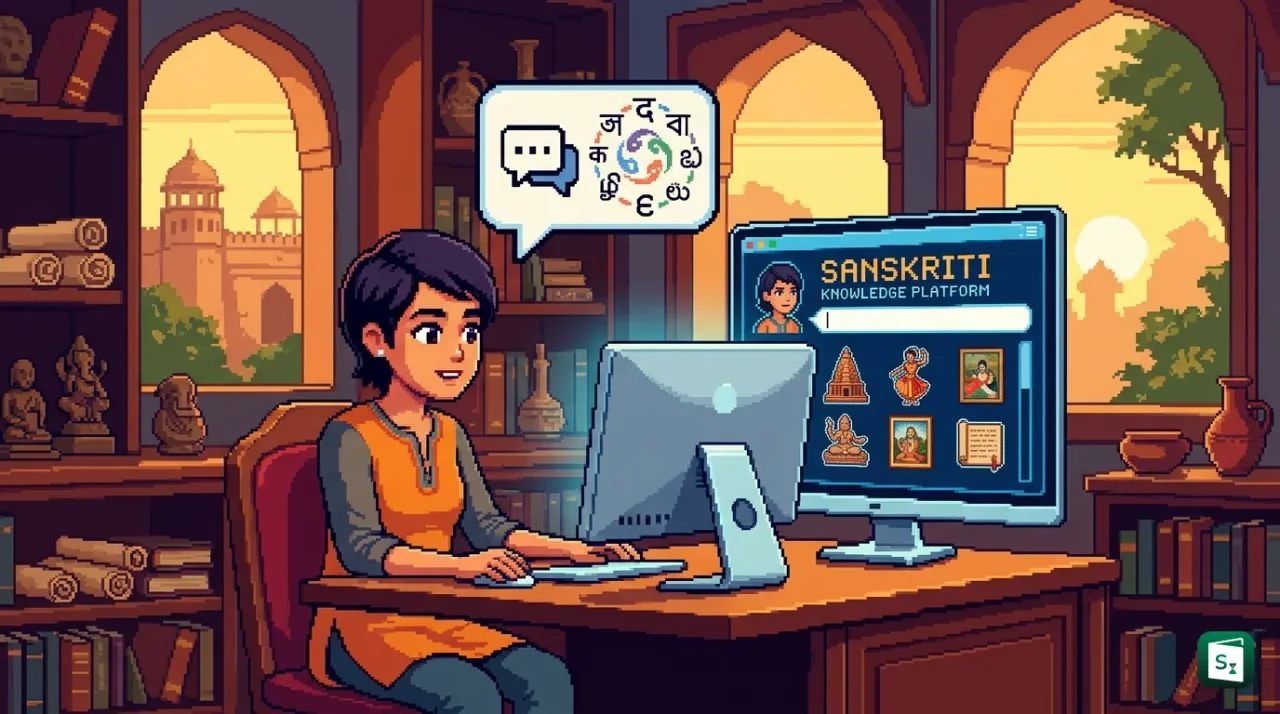
The Ministry of Culture launched Sanskriti AI, a conversational chatbot and semantic search platform, on 16 November 2026 on its main website culture.gov.in. The system searches 65 digital portals of the ministry and its institutions at once and gives cited answers from official records only. It works in 22 scheduled languages through the national translation platform BHASHINI and needs no login.
What Is Sanskriti AI and How Does It Work?
Sanskriti AI is a conversational AI chatbot and semantic search engine placed on the homepage of culture.gov.in. A conversational AI chatbot is software that understands questions written in everyday language and replies in a natural, step by step conversation. A semantic search system understands the intent and context behind words instead of matching exact keywords.
The Ministry of Culture unveiled the platform in New Delhi on 16 November 2026. Culture Secretary Vivek Aggarwal launched it at Kartavya Bhawan. Work on the system had started about a year earlier. A vendor selected through tender built it.
Sanskriti appears as a search bar on culture.gov.in and as a chat toggle at the bottom right of the page. A user can type a plain question such as which manuscripts on Ayurveda are held in national collections. The system reads the question, searches all linked portals, and returns one clear answer.
Every answer has two layers. A short quick answer comes first. A longer detailed answer follows for readers who want more depth. Each statement carries a numbered citation. Clicking the number opens the exact ministry page the fact came from.
The platform uses Natural Language Processing (NLP), embeddings, a knowledge graph and Retrieval-Augmented Generation (RAG). NLP helps the computer read human language. Embeddings turn words into numerical patterns that capture meaning. A knowledge graph links people, places, objects and events. RAG pulls the right official records first and then frames them into an answer. This design keeps the tool grounded in official sources and reduces false or invented information.
It is built on open source foundation models and follows an LLM agnostic design. LLM agnostic means the system can shift to another large language model later, including Indian sovereign AI models. Data is stored and processed on premises within ministry systems. Users can flag wrong information, which helps institutions spot gaps.
| Keyword Search | Sanskriti Semantic Search |
|---|---|
| Matches exact words typed by the user | Understands intent behind the question |
| Shows a list of links from one portal | Combines relevant results from 65 portals into one answer |
| Gives same results for all users | Understands follow up questions in context and continues the conversation |
| Shows text only | Adds photos, artefacts, documents and multimedia from official collections |
Why 65 Scattered Portals Needed One Search Window
The Ministry of Culture manages around 65 digital portals. These sites hold archives, museums, monuments, manuscripts, tangible heritage such as buildings and objects, and intangible heritage such as music, dance, festivals and oral traditions. They also cover preservation work, commemorative programmes and flagship campaigns.
The ministry has 43 organisations under it. Each body built its own website over many years with no common link. A researcher looking for a manuscript, a festival date and an art form had to visit several portals separately. Students and curious citizens had no single entry point.
Sanskriti works as a hub and spoke model. The main website culture.gov.in acts as the hub. The 65 portals act as spokes. A single question triggers a search across all spokes at once. This saves time and brings scattered records into one readable reply.
The tool answers only from official ministry portals. It never pulls from the open internet. If material is thin, it says so instead of guessing. The ministry has presented this closed search as a guard against distorted or unauthorised cultural information online.
A common search also makes data gaps visible. Each institution remains responsible for updating its own portal. Weekly review meetings in the ministry now track these updates. Institutions are also being shifted to a common e filing system linked to the ministry to keep records current.
Sanskriti AI in 22 Languages: Role of the BHASHINI Platform
BHASHINI stands for BHASHa INterface for India. It is the national AI led language translation platform for governance and public services. BHASHINI works under the Ministry of Electronics and Information Technology. It is run by the Digital India BHASHINI Division under the Digital India Corporation. The platform was launched by the Prime Minister in July 2022 at the Digital India Week in Gandhinagar under the National Language Translation Mission.
Sanskriti is built with BHASHINI. A user can ask by voice and hear the answer read aloud in a natural Indian voice. The system offers text to text translation, voice to text input and text to voice output. This helps first time internet users, people with low literacy and people with visual impairment.
The service covers all 22 scheduled languages listed in the Eighth Schedule of the Constitution. These include Hindi, Bengali, Marathi, Telugu, Tamil, Gujarati, Kannada, Malayalam, Odia, Punjabi, Sanskrit, Assamese, Urdu and others. No login is needed. No personal profile is created. Anyone can open culture.gov.in and start asking at once.
| BHASHINI Fact | Detail |
|---|---|
| Full form | BHASHa INterface for India |
| Nodal ministry | Ministry of Electronics and Information Technology |
| Launched | July 2022 |
| Core technologies | Automatic speech recognition, machine translation, text to speech, optical character recognition |
| Language coverage in Sanskriti | All 22 scheduled languages, with voice input and spoken answers |
| Scale | Powers more than 500 government websites and handles over 15 million language requests daily |
Links to Indian Culture Portal, Gyan Bharatam and National Archives
Sanskriti does not create new content. It reads live from the ministry’s largest national databases. For the biggest collections, it queries the source portal at the exact moment a question is asked. This keeps even deep archival records searchable.
Four major databases sit at the centre of this live search.
Indian Culture Portal at indianculture.gov.in is the unified gateway for museums, libraries, archives and cultural institutions. It was first launched in December 2019. Version 2.0 was launched in March 2026 with a modern React and Drupal 10 design, Progressive Web App access, 3D exploration, virtual tours and an AI chatbot named Bharti. The portal offers content in 22 languages through BHASHINI and hosts curated sections such as Iconic Battles of India, Folktales of India and Classical Dances of India.
Gyan Bharatam Mission is the flagship manuscript programme announced in the Union Budget on 1 February 2025. It aims to survey, conserve, digitise and share more than one crore manuscripts, the largest such holding in the world. The Standing Finance Committee has approved ₹491.66 crore for 2025 to 2031. The Gyan Bharatam Portal was launched by the Prime Minister on 12 September 2025 at the International Conference on Gyan Bharatam in Vigyan Bhawan, New Delhi. More than ten lakh manuscripts have been digitised so far with support from institutions such as the Asiatic Society in Kolkata, Bhandarkar Oriental Research Institute in Pune and Saraswati Mahal Library in Thanjavur.
Abhilekh Patal is the digital portal of the National Archives of India, established in 1891 and headquartered in New Delhi. It gives online access to public records, files, maps and rare documents.
Mera Gaon Meri Dharohar maps the cultural life of villages. It records local art forms, food, dress, festivals and oral histories from across India.
Together, these sources cover tangible sites such as monuments and museum objects and intangible practices such as rituals and folk music. Sanskriti pulls text, photographs, artefact records and documents from them into a single answer with sources.
What Comes Next: AI for Stolen Antiquities and Museum Records
The ministry plans to extend AI beyond search. Culture Secretary Vivek Aggarwal said the next use will be a visual library of stolen antiquities. India loses sculptures, idols and paintings to illegal export. When a suspect object appears in a foreign gallery or auction, India must prove quickly that it matches a stolen piece.
AI can compare dimensions, shapes, surface marks and exact indentations from photographs. This scientific comparison can support a fast request to stop an auction. Physical verification will still be needed for the legal process. The digital match gives investigators speed at the first stage.
Cataloguing of museum objects is the second priority. Many museums hold large stores that are not fully photographed or described. AI tools can help tag, sort and link these records. Deeper work on Gyan Bharatam is the third priority, including reading old scripts and linking related manuscripts.
These plans fit a wider push. Ministries were asked to prepare AI roadmaps after the India AI Impact Summit held in February 2026 at Bharat Mandapam in New Delhi. The ministry also took part in the BRICS Culture Ministers Meeting in August 2026. The Bhopal Declaration from that meeting called for transparency and fair pay for the use of copyrighted works in AI systems.
Key Takeaways
- The Sanskriti AI chatbot was launched on 16 November 2026 on culture.gov.in by Culture Secretary Vivek Aggarwal.
- The platform searches 65 digital portals of the Ministry of Culture and gives answers only from official sources with numbered citations.
- It uses NLP, embeddings, knowledge graph and RAG on an LLM agnostic, open source and on premises design.
- It works in all 22 scheduled languages through BHASHINI, the national translation platform under the Ministry of Electronics and Information Technology launched in July 2022.
- Live search covers Gyan Bharatam, Abhilekh Patal, Indian Culture Portal and Mera Gaon Meri Dharohar, with future AI work planned for stolen antiquities and museum cataloguing.